Posts

Showing posts with the label Ophelia's songs

Ophelia's Valentine and Claudius (Part 5, Claudius series)

Image
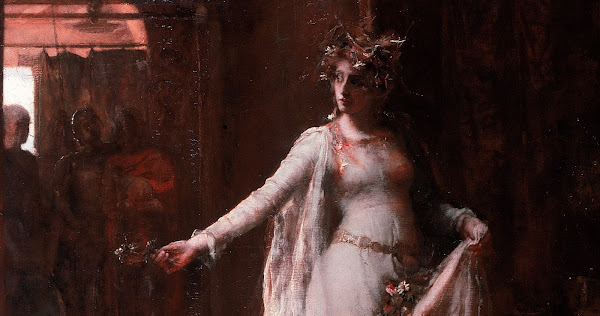
OPHELIA'S VALENTINE & CLAUDIUS.... In Shakespeare’s time, it was widely assumed that the martyr St. Valentine (d. 269 AD) was executed under orders from the Roman Emperor Claudius II, an idea not lost on many in his early audiences when Ophelia sings her Valentine song. They would make the connection: Claudius II ordered the execution of St. Valentine; Claudius of Denmark secretly ordered the execution of Ophelia’s Valentine, Hamlet. CONSIDER: Some form of “Valentine” occurs 70 times across seven Shakespeare plays [1]. “Saint Valentine” is mentioned only twice: once in A Midsummer Night’s Dream , and once in Hamlet . The only St. Valentine’s Day song is sung by Ophelia (taken from a familiar folk-song of the time) with interjections from Claudius. The pagan precursor of Valentine’s Day, Lupercal, is mentioned twice in Julius Caesar. It is often claimed that Pope Gelasius I disliked the pagan feast, and in 496 AD, set the feast of the martyr St. Valentine to be on February 14 to...

Part 37: Sts. Gertrude, pilgrim's lovers, & mousetraps (Interlude D.4)

Image
Gertrude is more associated with “mousetrap” than many scholars have allowed. Previously [1], I argued that Gertrude suspects a poison cup but doesn’t know for certain, so she signals publicly that she will drink in order to mousetrap Claudius. He tells her not to drink; she replies, “I will, my lord; I pray you pardon me.” [2] Hamlet said he would catch the conscience of the king, but first, his playlet sought to catch Gertrude’s conscience. I am grateful to Federico La Sala for mentioning saints by the name of Gertrude whose legends were familiar in the middle ages and Shakespeare’s time. These included  Gertrude the Great from the monastery of Helfta, a mystic who, with other sisters, explored a spirituality in which they believed they were “brides of Christ.” In The Herald of Divine Love, she speaks of paying a debt, [3] which sounds like the widow helped by the prophet Elijah (2 Kings 4:1-7), which Hamlet associated with his mother. [4] Gertrude as a “bride of Christ” also rel...

Part 25: Ophelia's Self-Catching Conscience in the Mirror of her Arts

Image
Unlike Claudius, who ignored qualms of conscience to murder his brother and usurp the throne, Ophelia’s relationship to her conscience is more healthy, rich, and self-directed.   Claudius just doesn’t get it, so he needs Hamlet to catch his conscience in The Mousetrap, [1] which reenacts Claudius poisoning his brother and wooing his victim’s wife. Hamlet says playing holds a mirror up to the age [2], and he uses the playlet to hold a mirror up to Gertrude and Claudius, showing what they’ve done. But Ophelia gets it, and doesn’t need someone to hold up a mirror for her conscience. She chooses her own songs, stories, and allusions to reflect upon her sadness and conscience. [3] She knows her father died, but doesn’t know that Hamlet killed him thinking it was Claudius. She sings songs of mourning for perhaps her father and/or the dead king [4], songs of her own choosing. Ophelia knows Hamlet made to her “almost all the holy vows of heaven” [5] perhaps the equivalent of a handfast w...