Posts

Showing posts with the label Horatio

Faith vs. Works in Hamlet: Horatio and Marcellus in 1.4

Image
My last post was on "Works vs. Faith" [1], relating to Hamlet changing the death letter on his ship to England. Salvation by faith and/or works was a hot topic in Shakespeare’s England, much less so today. But an analogy can be found in economics: - Some advocate Laissez-faire (or “free-market”) economics with minimal guidelines or interventions, a materialistic parallel of salvation by faith. - Others advocate managed economics (like democratic socialism). This is like faith plus works: basic faith in the system, but more “works” regulating it, and more social safety net to level the playing field. Some critics and scholars note a reference to a faith vs. works in Act 1, scene 4, when Hamlet wants to follow the ghost and commands his friends not to stop him: MARCELLUS: Let’s follow. ’Tis not fit thus to obey him. HORATIO: Have after. To what issue will this come? MARCELLUS: Something is rotten in the state of Denmark. HORATIO: Heaven will direct it. MARCELLUS: Nay, let’s f...

Holy Saturday and Harrowing of Hell in Shakespeare and Christianity

Image
Today is Holy Saturday, traditionally a day Jesus spends in the underworld, the “Harrowing of Hell,” referenced in the Apostles Creed: “He descended into hell,” or “to the dead.” Ancient sources claimed that after his death, Jesus went to the underworld to free the souls of the just, all who died in faith before the life and death of Jesus. The use of the word “harrowing” has old English roots [1]. Shakespeare parodies a medieval Mystery play based on the harrowing of hell in the porter scene of Macbeth [2] [3]. He uses the word “harrow” three times, once in Coriolanus, and twice in Hamlet, first by Horatio (1.1.51), and second, by the ghost (1.5.21). Some might claim that this was quite nice of Christians. Although to them, salvation and eternal life are only through Christ, how generous to say that Jesus descended to the dead to free the souls of the just. How inclusive. But this warrants greater scrutiny. The Christian claim that eternal life can only be obtained through Christ is...

Horatio & Hamlet on How to Speak to Ghosts (Halloween post)

Image
For Halloween, what can we learn from Shakespeare’s Hamlet on how to speak to ghosts? First Horatio, and later, Hamlet, both try. HORATIO What art thou that usurp’st this time of night, Together with that fair and warlike form In which the majesty of buried Denmark Did sometimes march? By heaven, I charge thee, Speak. (1.1.54-58) Horatio calls the ghost a usurper of the night and of the appearance of the dead king. Marcellus thinks Horatio has offended the ghost (perhaps true, especially since Claudius, brother to the king, was the usurper). Soon the ghost appears again. This time Horatio’s attempts seem informed by his university learning, questioning the ghost, asking if can foresee Denmark’s future, or knows of buried treasure: HORATIO: Stay, illusion! [...] If thou hast any sound or use of voice, Speak to me. If there be any good thing to be done That may to thee do ease and grace to me, Speak to me. If thou art privy to thy country’s fate, Which happily foreknowing may avoid, O, ...

Part 13: Ophelia, Hamlet, and 13 ways of looking at madness

Image
Often we speak of Ophelia as having really gone mad, while Hamlet only pretends . But in fact the play uses the word “mad” in many ways, as do critics. So, with a nod to Wallace Stevens’ poem title [1], a list: MADNESS AS DEMONIC POSSESSION: Horatio worries that the ghost is demonic and “might deprive [Hamlet] sovereignty of reason / And draw [him] into madness” (1.4.77-82). MADNESS AS FEIGNED: After meeting with the ghost (1.5), Hamlet says he will “put on” “an antic disposition” (1.5.189-192), as did Odysseus, King David, and Amleth in the Saxo Grammaticus source; but Hamlet’s encounter with the ghost may actually be driving him insane… [Edit 9/24/2023: In 3.1.7-10, Guildenstern also comments on Hamlet's feigned madness: "Nor do we find him forward to be sounded, But with a crafty madness keeps aloof When we would bring him on to some confession Of his true state." ] MADNESS AS WHAT LOST LOVE CAN DO: Polonius believes Hamlet has been made insane by the los...

Part 3: When you are desirous to be blest, I’ll blessing beg of you

Image
Two weeks ago,[1] I began exploring the curious and counter-intuitive thing that Hamlet says to his mother: "when you are desirous to be blest, I’ll blessing beg of you." (3.4.192-3) [2] In part 3, I wish to consider: 1. Does Gertrude desire to be blessed? 2. If so, how is this desire implied? 3. Does Hamlet beg a blessing of her? Or does someone close to Hamlet, a surrogate or an extension of him, beg of her a blessing? 4. Does she offer any favors or blessings to certain characters without Hamlet having to beg? Gertrude does desire to be blessed, and Hamlet or his surrogates do ask blessings of her: Gertrude's desire to be blessed is shown or implied in her feelings of guilt. We notice this when she has to face Ophelia, who seems to have gone mad, like Hamlet. When asked to speak to Ophelia, she is almost too ashamed to do so (4.5.18-25). She may feel guilty for having married Claudius: Hamlet had told her that Claudius murdered his brother, the king, Gertrud...

“Hoist with his own petard”: Jacob-Hamlet Echoes, part 2

Image
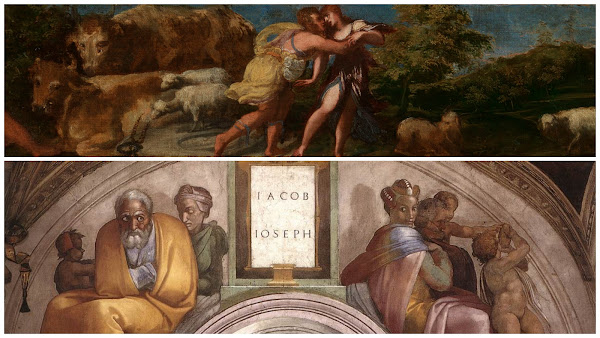
In addition to Laertes’ “double blessing” remark (1.3.58), which points to the biblical Jacob story ( as noted in a previous post ) [1], note how in both Hamlet and the biblical Jacob tale, “purposes mistook” fall on the “inventor’s heads” (Horatio in (5.2.426-427)): What goes around comes around. A perennial theme. As Shakespeare develops this theme richly, echoing biblical themes, we are right to ask if Shakespeare was influenced by the Jacob story - besides a myriad of others, including biblical teachings. [2] DECEIVER BECOMES DECEIVED IN THE JACOB TALES (Gen 25-33): 1.a. By pretending to be his brother, Jacob deceives his father to obtain the birthright. - Later, his father-in-law Laban deceives Jacob on the wedding night, substituting the older sister Leah for the agreed-upon bride of Rachel. [3] 1.b. Jacob who struggles with sibling rivalry is later burdened with two wives, sisters who struggle with sibling-rivalry. IN HAMLET : 2.a. Hamlet tries to deceive the court, pretending...

Fear, strangers as angels, (self-) transcendence, and the usefulness of failure

Image
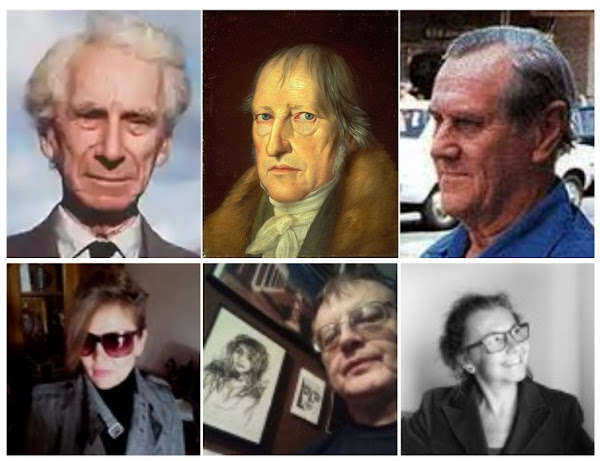
A number of weeks ago, three of my LinkedIn connections posted some passages from various sources that caught my attention and seemed somewhat related, as if belonging in a cluster - and to which I would add a fourth. 1) Gordana Lekovic shared the following quote from Bertrand Russell (British philosopher, 1872–1970), among other Russell quotes: “It is normal to hate what we fear, and it happens frequently that we fear what we hate. I think it may be taken as the rule among primitive men, that they both fear and hate whatever is unfamiliar.” This seems natural or normative, like a survival instinct: We hate and fear our enemies, as we often do strangers. 2) But this brought to mind Hamlet’s words to Horatio: Late in 1.5, upon seeing the ghost again, Horatio says, “this is wondrous strange!” Hamlet replies, “And therefore as a stranger give it welcome.” Hamlet seems to be thinking of the biblical injunctions to welcome the stranger: Hebrews 13:2 (in the Geneva translation wi...

Why mention a Lunar eclipse in Hamlet 1.1?

Image
Imagine that you have been teaching Hamlet this week, and a student notices not only last night’s lunar eclipse, but also the lunar eclipse mentioned in Hamlet 1.1: …the moist star, Upon whose influence Neptune’s empire stands, Was sick almost to doomsday with eclipse. (1.1.130-132) The "moist star" that rules the tides - "Upon whose influence Neptune's empire stands" - is the moon. [1] [Images, L-C-R: Left: An image of a lunar "blood moon" eclipse. Source: NASA . Cropped. Fair use. Center: Folding almanac, 15th century. Diagrams of solar and lunar eclipses: British Library Harley MS 937, f. 8r . Cropped. Fair use. Right: God creating the Sun and the Moon: British Library Additional MS 18856, f. 5v . Cropped. Fair use.] Perhaps after some digging, your students also find that Shakespeare scholars like Naseeb Shaheem identified a possible connection (for comparison or contrast) to events including a solar eclipse (real, or fictional) at noon...

Hamlet, beggar-prince: Horatio's allusion to Lazarus and requiem Mass in 5.2 (part 15)

Image
After Hamlet dies in 5.2, Horatio alludes to the requiem Mass text, “In Paradisum,” used as a prayer for the dead as the body is taken from the church: Good night, sweet prince, And flights of angels sing thee to thy rest! (5.2.3848-50) Most audiences unfamiliar with the text alluded to would miss it. The translated Latin text reads, May the angels lead you into paradise; may the martyrs receive you at your arrival and lead you to the holy city Jerusalem. May choirs of angels receive you and with Lazarus, once (a) poor (man), may you have eternal rest. This is the only allusion to both Lazarus and liturgical rites that England omitted from older Catholic rites. English or Protestant scholars may ignore or downplay this allusion to the requiem Mass. Catholic scholars perhaps prematurely accept this as evidence of a secretly Catholic Shakespeare. Saxo Grammaticus and Belleforest do not allude to Lazarus or the requiem Mass; why would Shakespeare include this, wh...