Posts

Showing posts with the label Hypocricy

In Hamlet, is "Lenten entertainment" oxymoron, royal hypocrisy, or foreshadowing?

Image
"LENTEN ENTERTAINMENT": OXYMORON, ROYAL HYPOCRISY, OR FORESHADOWING?  Rosencrantz says to Hamlet,  To think, my lord, [...]  what Lenten entertainment the players shall receive from you. (2.2.339-341).  Students unfamiliar with Christian liturgical seasons may skip over the word “Lenten.”  The more curious may look it up: A solemn season of fasting and repentance before Easter.  So what does “Lenten entertainment” imply?  1. Does “Lenten entertainment” pleasantly break up the drudgery of Lent?  - In 1598, Elizabeth I issued an edict prohibiting public theatrical performances during Lent, while privately still sponsoring such entertainment at court.   - Was Shakespeare subtly drawing attention to the hypocrisy of Elizabeth’s policy?  2. If taken literally, while the opening scene of the play (1.1) was cold at night, perhaps in winter (with Christmas mentioned), does 2.2 occur later during Lent? (Too literal?)  3. In 1.2, Hamle...
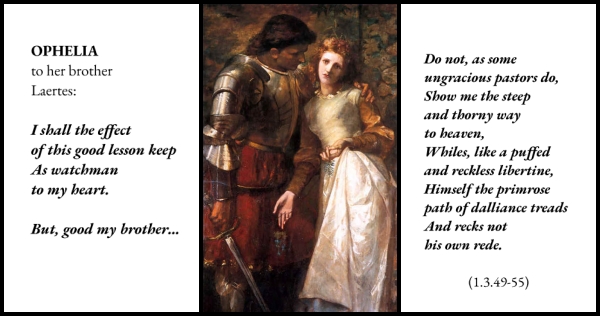
Part 54: Ophelia, like Jesus, preaching against hypocritical libertines (deconstructed?)

Image
Ophelia’s first biblical allusion made her sound, to Elizabethan ears, like Jesus condemning hypocrisy and corruption of authorities. She targets her brother as a potential hypocrite and “libertine.” Laertes warns her not to get too close to Hamlet, that he is above her station, warning her not to lose her chastity to him. Ophelia responds kindly but strongly: I shall the effect of this good lesson keep As watchman to my heart. But, good my brother, Do not, as some ungracious pastors do, Show me the steep and thorny way to heaven, Whiles, like a puffed and reckless libertine, Himself the primrose path of dalliance treads And recks not his own rede.[1] In Matt. 7:13-14, Jesus’ cautions: Avoid the “wide gate” (of too much freedom). “Straight and narrow” for Ophelia becomes “steep and thorny.” In Matt. 23:1-4 Jesus says, do all that “teachers of the law” and Pharisees teach, as they sit in the “seat of Moses” as authorities, but not to do as they do, for they are hypocrites.[2]  ...

Two things I'd change in how people think about Romeo & Juliet...

Image
ROMEO & JULIET: If I could change just two things about how most people think about the play (and how it is sometimes taught) what would they be? 1. IT'S NOT MERELY ABOUT YOUNG LOVE, but also about how little chance young love has when families are stuck in old grievances. 2. JUST BECAUSE IT'S SET IN VERONA DOESN'T MEAN IT'S ABOUT VERONA. Shakespeare often used far-off settings to talk about things in his own England that were prohibited or difficult to address directly. - Shakespeare's England was torn by religious feuding between Catholics and Protestants (& other factions). - Shakespeare's family is believed by some to have had strong Catholic sympathies, but not many years after he wrote the play, his daughter Suzanna married a Puritan, John Hall, perhaps bridging a denominational divide. - When early audiences heard "Capulet & Montague," the syllables may have prompted more than a few to think: "Catholic & Protestant....