Posts

Showing posts with the label Incest

Bullough, Jenkins, Asimov on Claudius as changed name of Hamlet's uncle Feng (Part 13, Claudius series)

Image
Geoffrey Bullough (1957-1972), Isaac Asimov (1970), and Harold Jenkins (1982) all noted Shakespeare having changed the name of Hamlet's uncle “Feng” to “Claudius”: Asimov: "The reigning King of Denmark, who has succeeded the elder Hamlet[...] is Claudius. Shakespeare has chosen an aristocratic Roman name for the purpose. (It was the name of a patrician family in the time of the Republic and one from which several of the early emperors were descended—including Claudius, the fourth Emperor, under whom Britain was conquered in the years following Cymbeline's death.[1]) In Saxo Grammaticus' original tale, the new King was named Feng, and perhaps Shakespeare did well to change that." (87)  [2] Jenkins: "The King's name is knows from his first entry-direction and first speech-heading, after which, however, it is never used again."  [3] Jenkins continues: "It was evidently suggested by that of the Roman emperor who married Agrippina, his niece and th...

Part 39: Ophelia, Gertrude, Hamlet: three damned souls as saved Christ-figures

Image
Shakespeare’s Hamlet is radical in a religious sense. Shakespeare hints that Ophelia, Gertrude, and Hamlet—apparently damned for different reasons—are not only saved, but in fact are Christ-figures [1]. The texts support such a reading. Yet even if Shakespeare uses religion mostly for dramatic (not religious)  purposes [2], it is safe to say that a majority of scholars today might reject this idea, or at least be quite disinterested in it. Ophelia is apparently damned as a suicide [3], but Gertrude blames her death in part on an “envious sliver” of willow [4], envious — like Claudius — that it didn’t get a crown. Ophelia was generous in bestowing crowns (coronets) [5], like Christian scriptures which claim that all people can be adopted sons and daughters of God, and can inherit a heavenly crown [6]. Gertrude is apparently damned for her “incestuous marriage” to her dead husband’s brother [7], scandalous and forbidden, especially after the divorce of Henry VIII from his first wife ...

Part 14: Ophelia's figuratively incestuous family

Image
Ophelia’s brother and father are overly protective of her chastity [1], too suspicious that Hamlet might take advantage of her. Like a lover or spouse, Laertes leaving for France tells Ophelia, “do not sleep, But let me hear from you” [2]. Biblical sayings urge welcome for strangers, which involves risk; but they also discourage fear [3]. Laertes, in contrast, repeatedly urges Ophelia to fear Hamlet [4]. After warning her to be chaste, Laertes tells Ophelia to remember his advice. Ophelia replies, "'Tis in my memory lock'd, / And you yourself shall keep the key of it."[5] Chastity can be a virtue, keeping something of great value secret, disclosed only in an intimate, faithful relationship. Ophelia’s promise to Laertes is analogous: she has the feminine lock and he the masculine key, suggesting a figuratively incestuous relationship. Polonius mistrusts his children’s secret, so he figuratively rapes Ophelia's memory by demanding she disclose it. [6] Ten lines ea...

The Affair of Gertude and Claudius in light of Anne Boleyn

Image
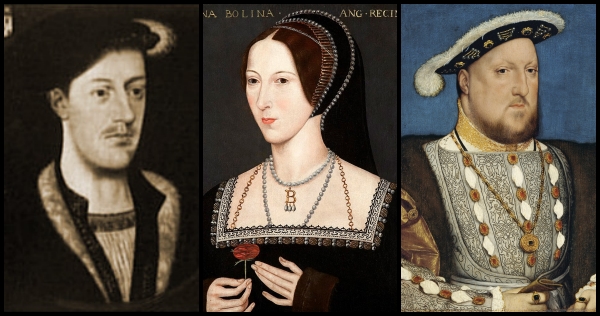
When audiences and readers in our time encounter Hamlet, they may wonder: What is the fuss about a royal affair, and a queen marrying the brother of her dead husband? Royals had affairs often, and it’s now legal in many places to marry the sibling of a deceased spouse. I have blogged in the past about Claudius, Gertrude, and the adulteries and alleged incest of Henry VIII [1], but it is also important to consider Gertrude and Claudius in light of the accusations of adultery and incest against Anne Boleyn. Many know that Henry’s second wife, Anne Bolelyn, was accused of adultery, incest, and treason, and beheaded for it. Fewer are aware that five men were accused of various things in association with Anne’s scandal (adultery, incest, treason, plotting assassination), and were also executed. These included George Boleyn, Viscount Rochford (the Queen’s brother); Henry Norris, Mark Smeaton (musician at court), William Brereton, and Francis Weston (thought to be his image at left). So not o...

Three challenges to teaching about incestuous marriage in Hamlet

Image
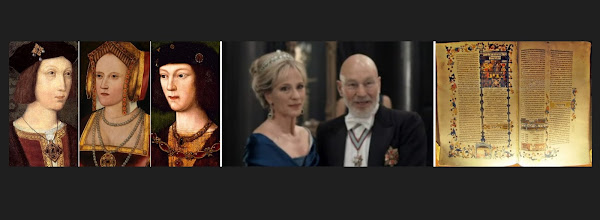
There are always challenges to teaching Hamlet, in part due to the historical and cultural gaps between the original audiences for whom Shakespeare was writing, and that of today’s students. When teaching about the “incestuous” marriage of Claudius and Gertrude, one may find challenges especially in at least three areas: Definitions, religious considerations, and trigger warning issues. [Left to right: Arthur Tudor, Prince of Wales (1486-1502), "regarded as the only surviving contemporary portrait"; circa 1500. Anglo-Flemish School. Private collection, Hever Castle, Kent. Public domain. Image via Wikimedia. Catherine of Aragon (1485–1536), originally identified as Catherine Parr, but now recognized as Catherine of Aragon. Unidentified painter. 16th Century. Lambeth Palace. Public domain, via Wikimedia. Henry VIII of England (1491-1547), circa 1509. Attributed to Meynnart Wewyck. Denver Art Museum. Public domain. Image via Wikimedia. Penny Downie as Gertrude, and Patri...

How Hamlet toyed with Elizabethan expectations: Incestuous marriage, adultery, right succession

Image
If Londoners in Shakespeare’s England heard that his play, Hamlet, was in part about the incestuous marriage of a king, what did they expect? Elizabeth was still queen when it was first performed, and still remembered long after James took the throne. Some thought she was only legitimate if her father, Henry VIII, had been right to divorce his first wife, Catherine of Aragon, over claims that the marriage violated biblical laws.[1] There had been a popular earlier play, A Looking Glass for London, about a king saved from an incestuous marriage by an act of God (lightning bolt). The king heeds a prophet sent by God and repents. Happy ending. Such a play could affirm Protestant Elizabethan hopes, that yes, biblically incestuous marriage is wrong, and Henry VIII was right to divorce Catherine, although the pope disagreed. And yes, he was right to break with Rome to get his divorce. Therefore, his second marriage was legitimate, Elizabeth was legitimate, and all was right with the ...

"Alas, poor Yorick! I knew him..." (Nicholas Cage with junk football helmet)

Image
If you ask people to identify the six most famous words from Hamlet, most might reply, "To be or not to be" (from Act 3, scene 1), but a close contender would probably be, "Alas, poor Yorick! I knew him" from Act 5, scene 1. [Nicholas Cage in Prisoners of the Ghostland, 2021, directed by Sion Sono. Screen capture image (cropped) from YouTube. Fair use.] In a 2021 horror film, Prisoners of the Ghostland (which received many negative reviews), Nicholas Cage, in the starring role, has a brief Hamlet moment in which he is given a beat-up football helmet from a pile of junk, and he addresses it the way that Prince Hamlet addressed the skull of his beloved court jester in the graveyard in 5.1. You can view the 17-second clip from Youtube at this link < https://youtu.be/FbPZC8V8TnE > or here: What about "Alas, poor Henry VIII! I knew him!"? Earlier this week (on June 28 and June 30), I did two posts related to the allegedly "incest...

"Incestuous" marriages of Henry VIII and Claudius: two relevant biblical passages

Image
What Bible verses relate to the allegedly incestuous marriages of Henry VIII and Claudius in Shakespeare’s Hamlet? Mainly two. These may seem contradictory, but examined carefully, make sense. [Image: Mishneh Torah (Maimonides), Perugia, c. 1400 (Elie Kedouri, The Jewish World, 1979, p. 193). Illuminated Hebrew manuscript. National Library of Israel, Jerusalem. Photo is from replica at the Diaspora Museum, Tel Aviv. Fair use. Via Wikimedia.org .] First, Arthur Tudor died without any children, so Deuteronomy 25:5-10 seems to apply: Verse 5 explains: If a brother dies without children (especially a male child in Hebrew biblical culture), his widow should not marry a “stranger” outside the family; a surviving brother should take the brother’s widow as a wife. (This is called "levirate marriage.") Verse 6: The first child she bears by this new marriage will be considered the child of the dead brother, to carry on his line and legacy. (Yes, very patriarchal.) Verses 7...

Hamlet and the Incestuous Marriages of Claudius and Henry VIII - via John Erskine Hankins

Image
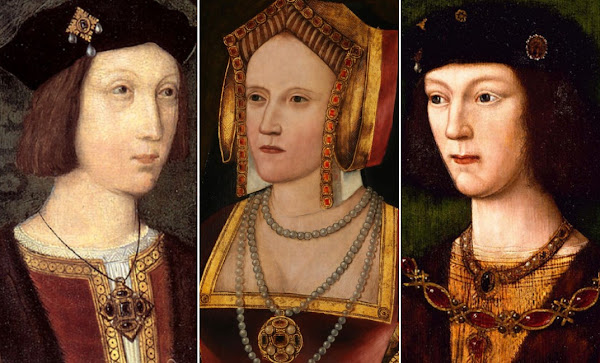
Shakespeare certainly wrote of Claudius and Gertrude’s “incestuous” marriage with Henry VIII in mind. Early audiences recognized it. In teaching the play, is it a mistake to omit that context? [Left: Arthur Tudor, Prince of Wales (1486-1502), "regarded as the only surviving contemporary portrait"; circa 1500. Anglo-Flemish School. Private collection, Hever Castle, Kent. Public domain. Image via Wikimedia . Center: Catherine of Aragon (1485–1536), originally identified as Catherine Parr, but now recognized as Catherine of Aragon. Unidentified painter. 16th Century. Lambeth Palace. Public domain, via Wikimedia . Right: Henry VIII of England (1491-1547), circa 1509. Attributed to Meynnart Wewyck. Denver Art Museum. Public domain. Image via Wikimedia ]. From “The Character of Hamlet,” by John Erskine Hankins* (1941), p.101: ~~~ It will be remembered that Henry VII's eldest son Arthur was married to Katherine of Aragon to cement an alliance between England and Spa...

Two Late-Elizabethan Plays with Royal Incest & Jonah Themes

Image
[1] THE THEME OF SCANDALOUS ROYAL INCEST was to people of that late Elizabethan times something like the themes of resource wars and government lies about weapons of mass destruction after the US invasion of Iraq in 2003: The blockbuster film, Avatar, was released in December of 2009, about earthlings fighting a resource war for an energy source against the native population of a distant planet. About five months later, in May of 2010, Disney released the film, Prince of Persia, which was rightly criticized for casting too many Caucasian actors as the main characters and not enough of Middle Eastern descent; but a notable aspect of the plot involved lies about weapons of mass destruction possessed by a country that Persia would invade. The folly of corrupt government was on people’s minds, and therefore became a topic of popular entertainment. [2] IN THE LAST DECADE of the life of Elizabeth I , there were two very popular plays with a theme of incestuous royalty. Both of these...