Posts

Showing posts with the label Virgin Mary

Part 55: Ophelia's Overlapping Biblical allusions and plot echoes

Image
Many biblical allusions (or biblical plot and theme echoes) associated with Ophelia overlap in her character. All of these were well-known in Elizabethan times. (Not an exhaustive list): 1. Hebrews 12: 6-11 (suffering as a sign of God’s love for the “chosen” who will be “saved).[1] 2. JACOB, ESAU, AND RACHEL (lower right): the “double blessing” for Laertes, and the frustration of Hamlet and Ophelia’s hopes for a match, point to the bible tale of how Jacob wins the birthright by deceit, Esau gets the second blessing, and Jacob’s hopes to marry Rachel are at first frustrated.[2] 3. SALOME (top left): Claudius wants Ophelia and her brother Laertes to dance to his tune and serve his purposes: He uses Ophelia a bait to spy on Hamlet, and Laertes as co-conspirator to to kill Hamlet, who protests the incestuous marriage. Salome danced pleasingly for her stepfather, Herod Antipas, who offered almost any reward. His wife, Salome’s mother (divorced wife of his brother) told her to ask for the he...

Rethinking Ophelia and the Virgin Mary

Image
It is said that in the patriarchy of Shakespeare’s world, characters like Hamlet sort women into two categories: Virgin or whore. Ophelia and Gertrude can’t live up to an iconic model like the Virgin Mary. [1] In this way, we may view the Virgin Mary in a class by herself, sinless “Mother of God” who conceived Jesus by the Holy Spirit, and not by any man, and therefore to view Ophelia and Gertrude as far lesser mortals. [2] I will focus this post on Ophelia. I have come to believe, however, that it’s better to consider some of the many things Ophelia has in common with the Virgin Mary story rather than how Mary is in a class by herself. The story claims that Joseph, after a dream, did the honorable thing and married her (Matt 1:18-25). So the story is not merely about virginity, but also about treating a pregnant woman with compassion. If Hamlet had learned that he had made Ophelia pregnant, would he have acted in love to marry her? From his graveside declaration of his love (5.1.285...

(Part 8) Hamlet in 3.2 as the boy Jesus: Why has this been missed?

Image
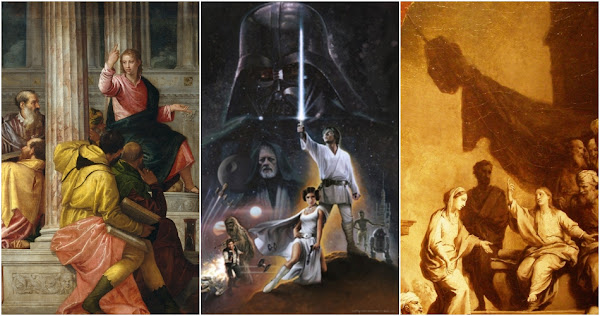
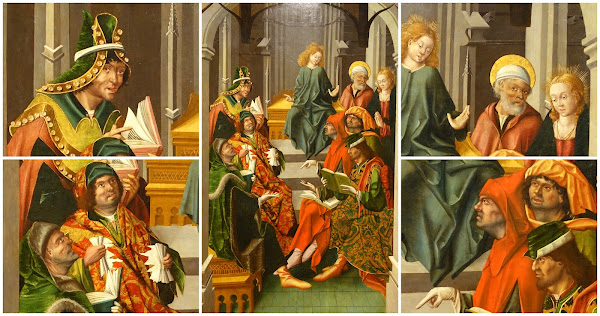
~~~~~~~~~~~~~~~~~~~~~~ INDEX OF POSTS IN THIS SERIES: https://pauladrianfried.blogspot.com/2023/01/index-hamlet-in-32-as-boy-jesus-lost.html ~~~~~~~~~~~~~~~~~~~~~~~~~~~~~~~~~~~~~~~~~~~~~~~~ In previous parts of this series,[1] I have explored Hamlet’s allusion in 3.2 to himself and his mother Gertrude [2] as like the boy Jesus, found in the temple by an astonished mother Mary among the elders.[3]  This allusion was missed by all major writers of reference books on Shakespeare and the Bible through at least the late 20th century [4]. Why have these scholars in this specialty field missed this allusion? Possibilities: 1. THE BIAS OF SCHOLARS: Perhaps many critics have preferred to imagine Hamlet as either not religious, or as a virtuous hero, rather than as one who would gloat after The Mousetrap and compare himself, perhaps blasphemously, to the boy Jesus? [5] And perhaps some scholars, especially in the last half century, simply resisted viewing Hamlet as a Christ fig...

(Part 7) Hamlet’s allusion in 3.2 to the boy Jesus: Hamlet as Abbott, Rosencrantz and Guildenstern as Costellos?

Image
~~~~~~~~~~~~~~~~~~~~~~ INDEX OF POSTS IN THIS SERIES: https://pauladrianfried.blogspot.com/2023/01/index-hamlet-in-32-as-boy-jesus-lost.html ~~~~~~~~~~~~~~~~~~~~~~~~~~~~~~~~~~~~~~~~~~~~~~~~ Hamlet’s allusion to himself and his mother as like the boy Jesus and his mother Mary is delivered, couched inside of a kind of comedy routine, not unlike Abbott and Costello’s “Who’s on First?” [1] This is great fun but makes it easier to miss the allusion. Rosencrantz and Guildenstern are being serious with Hamlet, trying to convey messages about the king’s “distemper” and the queen’s “affliction of spirit,” but Hamlet keeps joking. Even Hamlet’s final allusion line, “O wonderful son that can so ’stonish a mother!” is delivered as a joke. Note this section of the scene: ~~~~~ GUILDENSTERN  Good my lord, vouchsafe me a word with you. HAMLET  Sir, a whole history. GUILDENSTERN  The King, sir— HAMLET  Ay, sir, what of him? GUILDENSTERN  Is in his retirement marvelou...

(Part 5) The targets of Hamlet's 3.2 ironic allusion to Luke 2:46-52

Image
~~~~~~~~~~~~~~~~~~~~~~ INDEX OF POSTS IN THIS SERIES: https://pauladrianfried.blogspot.com/2023/01/index-hamlet-in-32-as-boy-jesus-lost.html ~~~~~~~~~~~~~~~~~~~~~~~~~~~~~~~~~~~~~~~~~~~~~~~~ As previously suggested in this series (especially Part Four),[1] Hamlet’s subtle allusion [2] to the boy Jesus among the temple elders [3] is an ironic allusion, perhaps deeply ironic, rich and complex. But who is the target of this irony, and who is aiming it? AIMED BY HAMLET AT ROSENCRANTZ Rosencrantz had been sent to tell Hamlet that his uncle is angry and his mother is upset that Hamlet angered his uncle. So Hamlet jokes that he amazed and astonished his mother Gertrude, like Jesus did his parents and the temple elders. Eager to please king and queen, Rosencrantz may not get the joke. (More irony.) BY HAMLET, AT HIMSELF Hamlet may be aware that as a revenger, perhaps called to his task by heaven and hell [4], he is no Jesus among temple elders. BY HAMLET, AT MOTHER & UNCLE Hamlet...

(Part 4 ) Dissonance and Irony in Hamlet's 3.2 Allusion to Luke 2

Image
~~~~~~~~~~~~~~~~~~~~~~ INDEX OF POSTS IN THIS SERIES: https://pauladrianfried.blogspot.com/2023/01/index-hamlet-in-32-as-boy-jesus-lost.html ~~~~~~~~~~~~~~~~~~~~~~~~~~~~~~~~~~~~~~~~~~~~~~~~ IRONY: In the third act, Hamlet makes a subtle allusion, implying that he astonishes his mother like the boy Jesus astonished his mother the Virgin Mary and amazed the temple elders. - But in spite of all the points of similarity listed in my last post [1] regarding Hamlet’s allusion, there may be even more ways in which Hamlet is quite different from the boy Jesus. The tension or dissonance between these similarities and differences is an important source of irony. (For a comparison of the relevant Hamlet text [2] to the relevant gospel text from Luke, [3], see Part 1 of this series [4].) HOW IS HAMLET UNLIKE THE BOY JESUS? A non-exhaustive list: 1. Hamlet is a revenger. Audiences may assume that a revenger is so controlled by passion for revenge that he risks his own damnation. Not like Jes...