Posts

Showing posts with the label Herod

What was Termagant to Hamlet - and to Shakespeare?

Image
When Hamlet mentions “Termagant” in advice to the players, he says it as if “everybody there would know exactly what [he] was talking about” [1]. What did Shakespeare assume his audience would know about Termagant, and why would dropping his name fit this play? The earliest known mention of Termagant is from “The Song of Roland” (an 11th-century work about a Frankish warrior, Roland (archetype of a Paladin) who fought in AD 778 under Charlemagne [2]. Termagant was a fictional god, assumed to be violent, falsely associated with Muslims by Christians who feared and did not understand their Saracen enemies [3].  The tale of Roland resembles aspects of Hamlet, in that Roland dies a martyr’s death in what seems in the end a suicide mission. Roland had a horn made of an elephant (oliphant) tusk that he was reluctant to blow for fear of being cowardly and dishonorable [4].  In Shakespeare's Henry IV, Part 1, after cowardly faking death in battle, Falstaff calls Hotspur a "hot te...

Herod in Shakespeare

Image
The word “Herod” [1] occurs NINE times in Shakespeare, in four plays:  Once in in 𝘛𝘩𝘦 𝘔𝘦𝘳𝘳𝘺 𝘞𝘪𝘷𝘦𝘴 𝘰𝘧 𝘞𝘪𝘯𝘥𝘴𝘰𝘳;  twice in 𝘏𝘢𝘮𝘭𝘦𝘵 (“out-herod’s Herod,” 3.2.14-15, and given the name of the player queen, “Baptista,” also a nod to Herod Antipas [2], who had John the Baptist beheaded for condemning his incestuous marriage);  and once in 𝘏𝘦𝘯𝘳𝘺 𝘝 as a reference to Herod the Great’s slaughter of innocents:  “Your naked infants spitted upon pikes Whiles the mad mothers with their howls confused Do break the clouds, as did the wives of Jewry At Herod’s bloody-hunting slaughtermen (3.3.38-41). “Herod” occurs five times in 𝘈𝘯𝘵𝘰𝘯𝘺 𝘢𝘯𝘥 𝘊𝘭𝘦𝘰𝘱𝘢𝘵𝘳𝘢 (Cleopatra lived at the same time as Herod the Great.) In the second scene, a servant says, “Let me be married to 𝘁𝗵𝗿𝗲𝗲 𝗸𝗶𝗻𝗴𝘀 in a forenoon, and widow them all: let me have a child at fifty, to whom 𝗛𝗲𝗿𝗼𝗱 of Jewry may do homage.” (1.2.27-30) We hear not only “Herod” bu...

The Fourth Day of Christmas in churches of Shakespeare's time - The Innocents' Day (Series, Part 4)

Image
On the 4th day of Christmas, December 28, Shakespeare’s England observed “Innocents’ Day,” Feast of the Holy Innocents, the tale of Herod the Great ordering the killing of all boys 2-years and younger, a gospel tale designed to echo Pharaoh of Egypt ordering the killing of Hebrew infant boys, and to paint Jesus as the new Moses [1]. Why does Herod do this? To remove prospective heirs or competitors for his throne. Such killing is a repeated theme in Shakespeare, in Richard III with the killing of the princes in the tower, in Richard II and other history plays, in Hamlet, Macbeth, and more. The slaughter of innocents is part of the general cultural-religious backdrop for the killing of Lady Macduff and son in Macbeth. Killing competitors for a throne was not restricted to biblical texts in Shakespeare’s time, but the Bible tales were the only ones required by law for hearing in churches, with legally enforced attendance during which this text was read. By the numbers: The word “Herod” o...

That season... Wherein our Saviour's birth is celebrated

Image
“...that season … / Wherein our Saviour's birth is celebrated…” There is a tendency at times for some to approach the Christmas reference in Hamlet as if it is merely about Catholic superstition. But it’s far richer than that. The ghost appears; the cock crows; the ghost disappears (an allusion to Peter’s denial during the passion [1]). Then: MARCELLUS: Some say that ever ’gainst that season comes Wherein our Savior’s birth is celebrated, This bird of dawning singeth all night long; And then, they say, no spirit dare stir abroad… (1.1.173-176) The cock crowing and season of Christmas point to a large sweep of Christian salvation history.   Even regarding the Christmas reference alone, we might treat it as an invitation to view the play in the mirror of the Christmas season tales, which are in part hospitality tales: Some welcome guests and strangers; others inconvenience, neglect, or kill them. There is a similar contrast in Hamlet : — The Christmas tale requires Annunciation and...

TRANSCRIPT: Presentation for Post Graduates, N.S.S. College, Kerala, India, 7 December, 2023

Image
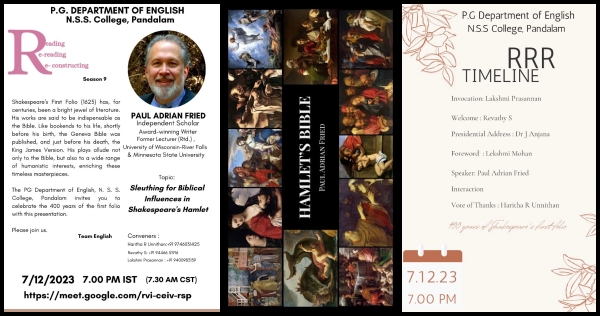
TRANSCRIPT: Presentation for Post Graduates, N.S.S. College, Kerala, India, 7 December, 2023 Edited planned transcript of remarks delivered on 7 December, 2023, in an online presentation for the Post Graduate program, N.S.S. College, Kerala, India, 7 P.M. IST, 7:30 A.M. CST. (A few words and points below were cut from the live presentation for time considerations, and I made a few additional extemporaneous remarks, but for the most part, this is the transcript.) (I did not have time to talk about allusions that fit into the theme of orphaned children who find transcendent parents in others or in a heavenly parent, but perhaps some other time....) ~~~~~~~~~~~~~~~~~~~~~~~~~~~~~ Informal outline (followed by transcript): INTRODUCTION: [Disclaimers] - Contested times, contested scripture LIST OF BOOKS cataloging Bible allusions in Shakespeare, some open-access: Sleuthing scripture allusions in Hamlet CHANGE THOSE NAMES WITH YOU: Servant-Prince, & Renunciation of Fruits DOUBTING ...

Christmas and the sweep of the incarnation narratives in Hamlet

Image
It is often noted that in its first scene, Shakespeare's Hamlet contains one of the only explicit references to Christmas: Some say that ever ’gainst that season comes Wherein our Savior’s birth is celebrated, This bird of dawning singeth all night long; And then, they say, no spirit dare stir abroad, The nights are wholesome; then no planets strike, No fairy takes, nor witch hath power to charm, So hallowed and so gracious is that time. (1.1.173-179) [1] But the Christmas narrative is actually much longer than merely the story of Jesus' birth. It includes numerous other stories or episodes, each celebrated in gospel readings assigned to particular days in the church calendar. If we don't include all of Judaeo-Christian salvation history but merely the conception, birth, and childhood of Jesus, it begins with Mary being told by the Angel Gabriel that she has conceived by the Holy Spirit. This is called the Annunciation. Shakespeare's Hamlet alludes t...

Does Shakespeare’s Hamlet depict religiously shaped or motivated regicide?

Image
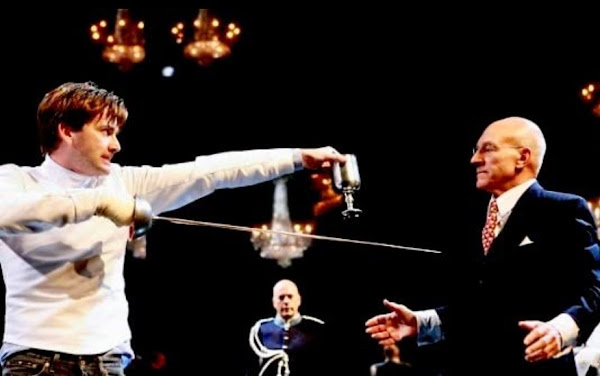
Does Shakespeare’s Hamlet depict religiously shaped or motivated regicide? [1] Given its many religious and biblical allusions and plot echoes, I would argue that it does. [David Tennant (L) as Hamlet and Patrick Stewart (R) as Claudius in the 2009 film, Hamlet , dir. Gregory Doran. Source: IMDB . Fair use.] Dr. Arthur F. Marotti gave a talk at Fordham in late October of 2013 in which he noted, “In the last years of Elizabeth’s rule people believed something was rotten in England—though perhaps not rotten enough to justify regicide. ” [2] Marotti has written numerous books [3] about Early Modern literature and religion, including a 2004 essay with Ken Jackson on “The Turn to Religion” in Shakespeare studies. In an abstract for a more recent (2017) essay [4], Marotti notes that “Shakespeare's plays may not stage religiously motivated regicides…,” with “may” being the operative word here: Scholars may disagree on this point. But what about Hamlet? Recognizing that H...