Posts

Showing posts with the label Executions

Hamlet, hero to the English for Rosencrantz and Guildenstern's deaths?

Image
English audiences - after recent attempted invasions by the Spanish Armada, and anticipating more - may have felt Hamlet was their hero, to change Claudius’ secret letter that ordered Hamlet's death so that Rosencrantz and Guildenstern are executed instead. Early audiences may have opposed any suggestion of oppression by a foreign power, Spanish or Danish. Hamlet and his former school-friends-turned-spies had been sent by Claudius, who claimed they must collect England’s "neglected tribute" (3.1), like insurance payments to organized crime: Pay, and we won't hurt you. It may have seemed to them satisfying that the rebellious, "mad" Danish prince would change the letter intended to bring about his own death, so that Rosencrantz and Guildenstern would be executed by the very English from whom the three were told to collect this tribute. Although Elizabeth prohibited speculation about her successor, many knew that James of Scotland, who had married Princess A...
The Affair of Gertude and Claudius in light of Anne Boleyn

Image
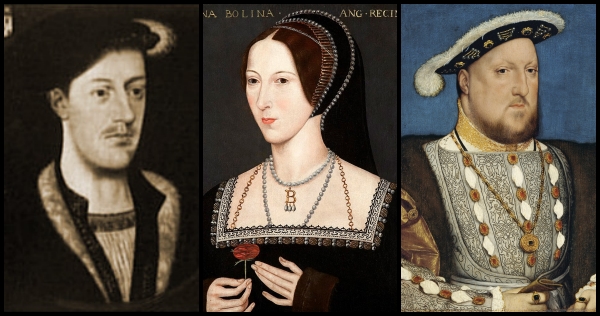
When audiences and readers in our time encounter Hamlet, they may wonder: What is the fuss about a royal affair, and a queen marrying the brother of her dead husband? Royals had affairs often, and it’s now legal in many places to marry the sibling of a deceased spouse. I have blogged in the past about Claudius, Gertrude, and the adulteries and alleged incest of Henry VIII [1], but it is also important to consider Gertrude and Claudius in light of the accusations of adultery and incest against Anne Boleyn. Many know that Henry’s second wife, Anne Bolelyn, was accused of adultery, incest, and treason, and beheaded for it. Fewer are aware that five men were accused of various things in association with Anne’s scandal (adultery, incest, treason, plotting assassination), and were also executed. These included George Boleyn, Viscount Rochford (the Queen’s brother); Henry Norris, Mark Smeaton (musician at court), William Brereton, and Francis Weston (thought to be his image at left). So not o...

"See the inmost part of you": Gertrude's literalism, fear of evisceration in 3.4

Image
In Hamlet 3.4, the scene in Gertrude's closet, Hamlet tells her that he will show his mother her "inmost part," and it's clear to the audience or readers that he's talking about her conscience. But she quickly jumps to the conclusion that perhaps he is going to kill her: "What wilt thou do? Thou wilt not murther me? Help, help, ho!" This scene is often played with some violence by Hamlet toward his mother, throwing her on her bed, to help explain why she jumps to this conclusion. But this is not in the stage directions, and perhaps there are other reasons why she jumps to this conclusion. ~~~~~~~~~~~~~~~~~~~~~~~~~~~~~~~~~~~~~~~~~~~~~~~~~~~ With me in the "Rethinking Science and Religion" seminar at Shakespeare Association of America this spring, there were two members who wrote about Renaissance anatomists and drawings of the dissected human body. This made me think about Elizabethan public executions of Catholics and others, sometimes inv...

The Elizabeth Jonas, and Hamlet's sea-voyage: Other Considerations

Image
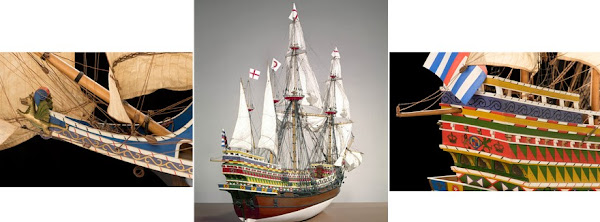
In my previous post , I connected the Jonah echo in Hamlet’s sea voyage to Elizabeth I having christened a navy ship “Elizabeth Jonas,” saying how God had saved her from her enemies - although the only enemy of Jonah is Jonah himself, fleeing his divine calling. The records have more echoes of Hamlet : "The 3 day of July, 1559, the Queen's Grace took her barge at Greenwich unto Woolwich to her new ship, and there it was named Elizabeth Jonas, and after her Grace had a goodly banquet, and there was great shooting of guns, and casting of fire about made for pleasure ' (Diary of Henry Machin, Camden Society, p. 203). The ship ' was so named by her Grace in remembrance of her own deliverance from the fury of her enemies, from which in one respect she was no less miraculously preserved than was the prophet Jonas from the belly of the whale' (Egerton MS. 2642, f. 150). This refers, of course, to the Jonas." [1] In Hamlet, there are also references to banqueting...

Hamlet’s Unnamed Ghost of Jonah, and Elizabethan Executions

Image
In Hamlet, Shakespeare adapts the Saxo Grammaticus source tale by shortening the hero’s sea-voyage to England, having Hamlet change mode of transportation mid-sea to a pirate ship, like Jonah changing from a ship to the belly of a fish. I have written about this before , and about the Christian typology that viewed Jonah as prefiguring Jesus in the tomb . [Image: Pieter Lastman (1583–1633), "Jonah and the Whale," 1621. Museum Kunstpalast. Public domain. Via Wikipedia .] Yet in Hamlet , Jonah goes unnamed. Shakespeare is more explicit about other allusions in the play, as to Jephthah and other biblical figures. Yet he is strangely silent/implicit on others such as Jonah. Why leave Jonah unnamed? Is this merely an aesthetic/dramatic choice, or more? (More on that later.) Shakespeare also combines these Jonah elements of the sea-voyage with other elements, such as Hamlet’s discovery of Claudius’ letter ordering England to execute him, and his changing of the lette...