Posts

Showing posts with the label scholarly tradition

Peter Milward on academic "gobbledygook" (jargon) in Shakespeare scholarship

Image
Peter Milward (1925-2017) makes an interesting point about the growth of academic jargon ("gobbledygook") in scholarly writing. Milward is the author of Biblical Influences in Shakespeare's Great Tragedies (1987), which is helpful in some ways that similar books by other authors sometimes are not. The following quote is from Milward's review of a book by Gillian Wood (whose work I've enjoyed), Shakespeare's Unreformed Fictions: ...maybe she is content, or her publisher is content, with a readership of like-minded scholars as being (in Milton’s words) a ‘fit audience, though but few’. All too evidently, she likes to puzzle or muddle the general reader with such phrases as ‘characterological interiority’ (p. 129), ‘disjunctions in the drama’s representational logic’ (p. 170), ‘the ontological confusion inherent in the moment of animation’ (p. 181), and ‘the axiomatic knowledge of the binary distinction’ (p. 201). Admittedly, these phrases make more sense in thei...

Frank Kermode on New Historicism and Stephen Greenblatt

Image
Stephen Greenblatt is the author of a number of books, one of them 𝘏𝘢𝘮𝘭𝘦𝘵 𝘪𝘯 𝘗𝘶𝘳𝘨𝘢𝘵𝘰𝘳𝘺 (2001), an important book in Hamlet studies and also in Shakespeare and Religion. He is also one of the scholars most associated with New Historicism. Greenblatt's approach in this book, exploring many manifestations of the long history of the idea of purgatory in literature and art, influenced my own approach in many ways: - When I go digging for historical associations that could have made very meaningful the choice of sentinel names (Francisco and Bernardo), this is like Greenblatt's approach. - When I dig for famous examples of "poison cup" known in Elizabethan times, like King Aegeus knocking from his son's hand the cup poisoned by Medea, this follows a well-worn path that Greenblatt trod before me. - When I explore various pre-1600 paintings of the boy Jesus, lost in Jerusalem, found astonishing the elders in the temple - to shed light on a Hamlet allusion...

INDEX: Religious Biases in Hamlet Scholarship

Image
Series on Religious (and a few other) Biases in Shakespeare Scholarship: In 2022, I did a series exploring the biases of various Shakespeare and Hamlet scholars, many of them Protestant or Catholic. The first post in the series includes a more thorough introduction: 1. Biases & Assumptions Influence What We Notice, Seek, or Neglect - 11 January, 2022 https://pauladrianfried.blogspot.com/2022/01/biases-assumptions-influence-what-we.html 2. Religious Bias in Shakespeare/Hamlet Scholarship - 18 January, 2022 https://pauladrianfried.blogspot.com/2022/01/part-2-factors-contributing-to.html 3. Victors Wrote the Histories of Shakespeare and Francis of Assisi - 25 January, 2022 https://pauladrianfried.blogspot.com/2022/01/victors-wrote-history-of-shakespeare.html 4. Biblical Seeds of Secular Shakespeare Bias - 1 February, 2022 https://pauladrianfried.blogspot.com/2022/02/biblical-seeds-of-secular-shakespeare.html 5. Catholic Bias in Simon Augustus Blackmore - 8 February,...

Hamlet and scholarly paradigm conditioning

Image
Insights from scientists who study paradigm shifts and scientific revolutions that might shed light on confirmation bias [1] in Shakespeare scholarship: In his famous 1963 book on scientific revolutions, Thomas Kuhn tells of an experiment where subjects were asked to view playing cards for brief, controlled amounts of time, and identify them. Many were normal; a few were “made anomalous, e.g., a red six of spades and a black four of hearts.” Some had trouble with the anomalies, but as the time to view each card increased, subjects were more able to correctly notice and identify even the anomalies. “Further increase of exposure resulted in still more hesitation and confusion until finally, and sometimes quite suddenly, most subjects would produce the correct identification without hesitation. Moreover, after doing this with two or three of the anomalous cards, they would have little further difficulty with the others.” [Most, but not all?] “A few subjects, however, were never able to ma...

John Yamamoto-Wilson on "Quietus" and Suicide in Hamlet

Image
One of my favorite things about the following video by John R. Yamamoto-Wilson is that he challenges prevailing scholarly and performance assumptions about what Hamlet means in his “To be or not to be” speech, and in particular, that he expands popular understanding of what Hamlet means by “quietus.” (3.1.64-96; 3.1.83.). [1] John points out very clearly that Hamlet already considered suicide in Act 1, scene 2: O, that this too, too sullied flesh would melt, Thaw, and resolve itself into a dew, Or that the Everlasting had not fixed His canon ’gainst self-slaughter! 1.2.133-136 Later, in Act 1, scene 5, Hamlet had already promised the ghost that he will avenge his murder, so there is little dramatic purpose in Act 3 to considering suicide yet again. Importantly, John points out that the word “quietus” has a more primary meaning as found in the Oxford English Dictionary (OED) than the one Shakespeare scholars and directors often assume. They wrongly assume that the phrase,...

Tanya Pollard's "What's Hecuba to Shakespeare?"

Image
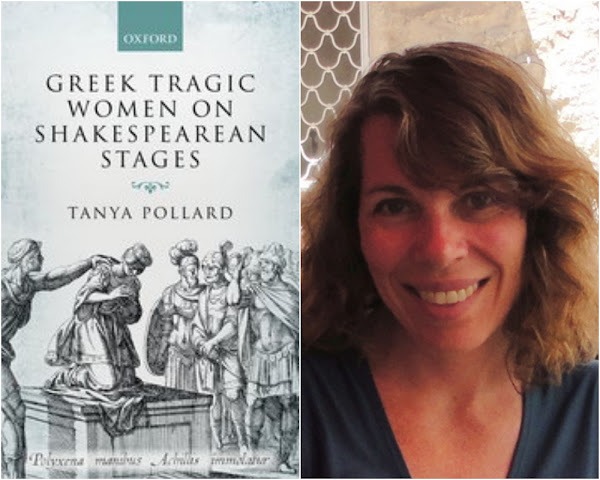
In her helpful essay, "What’s Hecuba to Shakespeare?" [1], Tanya Pollard does a remarkable job showing how the critical trend in Shakespeare scholarship goes wrong in assuming that tragedy is usually, mostly, about male tragic figures. Pollard notes, “in the early modern period, Hecuba was the established icon of Greek tragedy [....] by far the most popular of the Greek plays printed, translated, and performed in sixteenth-century Europe.” (1064) Hamlet wrestles with the genre: “Hamlet has more to say about his mother’s failure to grieve than about his own grief. His preoccupation with Gertrude has been widely read as a sign of his misogyny, and his Oedipal fixation on her sexuality. But in the context of Shakespeare’s interest in Hecuba, it might be more fruitfully understood as representing a confrontation with the genre’s conventions.” (1079) Hamlet is frustrated that Gertrude fails to live up to the ideal represented by Hecuba. Pollard notes other examples of t...

Peter Brook on how Victorian traditions get in the way of Shakespeare, & on cultural appropriation

Image
Excerpts from LA Times article:   In an interview with director Richard Eyre, Brook explained what he was after: “I think that what was quite clear was that ‘Lear’ had suffered like all the other plays from tradition. … Because we hadn’t got a true Elizabethan tradition: we had at that time a very, very bad Victorian tradition that took you far away from the plays," Brook said. "It had put a wrong pictorial stamp on the plays and a wrong moral stamp, because the Victorian tradition told you very strongly who were the good and who were the bad people.”   [PF notes: This is often still true of other plays, including Hamlet , where performance- and critical traditions get in the way of new. insightful interpretations.]   [...]    "The Mahabharata,'' Brook's epic production created with co-director Marie-Hélène Estienne and dramatist Jean-Claude Carrière, theatricalized for Western audiences the vast Hindu epic. The nine-hour work, a culminat...