Posts

Showing posts with the label Nietzsche

INDEX: Holding up The Odyssey as mirror in Hamlet

Image
From August 4-23, 2022, I did a series exploring how Shakespeare seems to have had The Odyssey in mind when he named Ophelia's brother Laertes (the father of Odysseus also had that name): In the same way that the family of Odysseus tries to defend his wife Penelope against suitors while he is away at war, Polonius and Laertes try to defend Ophelia against suitors. This was prompted in part by Asimov's book on Shakespeare, in the section on Hamlet , where he briefly mentions this name, Laertes, which stand out like a sore thumb, and which does not sound very Danish. Below is the INDEX to these posts: 1. Laertes in Hamlet & the Odyssey - Part 1: https://pauladrianfried.blogspot.com/2022/08/laertes-in-hamlet-odyssey-part-1.html 2. Laertes in Hamlet & the Odyssey - Part 2: https://pauladrianfried.blogspot.com/2022/08/laertes-in-hamlet-odyssey-part-2.html 3. Seeking Penelope in Ophelia & Hamlet: Laertes & The Odyssey - Part 3: https://pauladrianfried...
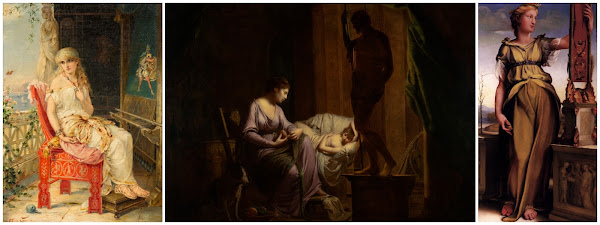
Hamlet's Nietzschean madness, via M. Grenke - Hamlet & the Odyssey - Part 5

Image
Perhaps one way to view the corruption in Denmark in Shakespeare's Hamlet, and to view Hamlet's madness as well, is that it has to do with slavery to time and to impatience. As I mentioned in my previous post, Hamlet makes some of his worst mistakes (killing Polonius), not because he delays, but because he is impatient. Claudius kills his brother, not only because he wants the throne, and wants Gertrude for his wife, but because he is impatient. Michael Grenke's Fall 2016 essay, “Penelope: The Odyssey’s Creative Thinker,” includes rich reflections on the character of Penelope from Homer's Odyssey, and about Nietzsche and the madness of impatience, or slavery to time. I would suggest that Hamlet feels a similar pressure and impatience about revenge due to images of masculinity that he has learned from his father and his culture, and which he has internalized. Grenke writes: ~~~ Human beings become slaves to the clock mostly because other human beings put them on...

Nietzschean & Christian-Mythical Bias in G. Wilson Knight (Part 6: Religious Bias in Shakespeare Scholarship)

Image
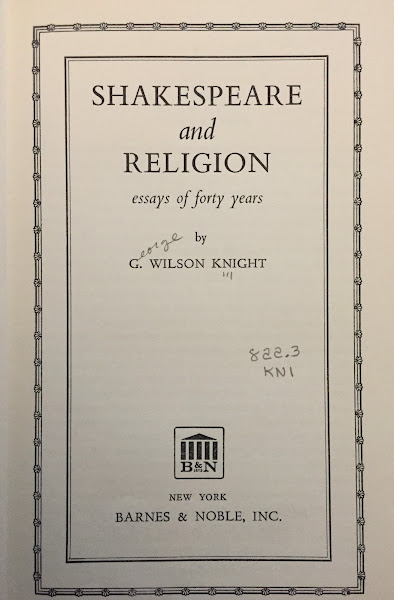
If all one knew of G. Wilson Knight (1897-1985) was that Roland Frye (1921–2005), a Folger Shakespeare Library scholar, once accused him and others of too-easy “theologizing” of too many Shakespeare plays, one might think Knight was a Christian evangelical, and Frye a champion of secular humanism. Both assumptions would be wrong. Knight was a disaffected English Protestant who admired Nietzsche and noticed archetypal trends in literature, including Christ-figures. But as such, he was painting with a broad brush, not as exacting as Protestant scholars like Frye would have preferred. In 1948, Knight wrote of Nietzsche’s idea of the “Avenging Mind”: “Hamlet… is an archetypal play, where Shakespeare watched his hero trying, sometimes successfully, more often [not], to transmute this dark thing through his own dramatic personality” (184).* [* G. Wilson Knight, Shakespeare and Religion (1967)] On Protestantism: “...perhaps our traditional Christianity leaves today a want [...] t...
"WHOEVER FIGHTS MONSTERS should see to it that in the process he does not become a monster. And if you gaze long enough into an abyss, the abyss will gaze back into you.” ― Friedrich Nietzsche Nietzsche may at least in part have been thinking of Hamlet after he accidentally kills Ophelia's dad, or of the central problem of the play: Can Hamlet kill Claudius without becoming a murderous usurper like Claudius? ~~~~~~~~~~~~~~~~~~~~~~~~~~~~~~~~~~~~~~~~~~~ Links to a description of my book project: On LinkedIn : https://lnkd.in/eJGBtqV On this blog : https://pauladrianfried.blogspot.com/2017/05/hamlets-bible-my-book-project-im.html [Originally posted around the week of 12/19/17 on LinkedIn ]