Posts

Showing posts with the label Jonah

SOME HISTORICAL BACKGROUND OF THE JONAH ECHO in HAMLET

SOME HISTORICAL BACKGROUND OF THE JONAH ECHO in HAMLET The Jonah echo is perhaps better understood with consideration for the following (not an exhaustive list):  a) The success of A Looking Glass for London and England (c. 1590); see Hannibal Hamlin, Staging prophecy: A Looking Glass for London and the Book of Jonah,"Part III, chapter 10 in Enacting the Bible in Medieval and Early Modern Drama, Eds. Eva Von Contzen and Chanita Goodblatt, Manchester University Press, 2020. b) Elizabeth’s having dedicated one of her naval ships “Elizabeth Jonas” (1559) with a speech that exhibited poor biblical exegesis than propaganda;  "The 3 day of July, 1559, the Queen's Grace took her barge at Greenwich unto Woolwich to her new ship, and there it was named Elizabeth Jonas, and after her Grace had a goodly banquet, and there was great shooting of guns, and casting of fire about made for pleasure ' (Diary of Henry Machin, Camden Society, p. 203). The ship ' was so named by her ...

Shakespeare's Hamlet, Jonah, and Looking Glass as cultural conversation

Image
When Shakespeare has his Hamlet abbreviate his sea voyage to England (compared to the Saxo Grammaticus source c. 1185–1208) and change mode of transportation mid-sea, it seems an implied allusion to Jonah not present in Saxo. Jonah also changed mode of transport mid-sea, swallowed by a fish doing the will of a merciful God; Hamlet was figuratively swallowed by a pirate ship; they imprisoned him, but he described the pirates as "thieves of mercy" [1] Shakespeare's Hamlet never mentions Jonah explicitly, and neither does the Disney film, Pinocchio (1940) [2], but Pinocchio and Geppetto are actually swallowed by a whale, whereas the pirate ship only figuratively swallows Hamlet, so critics (who are, yes, sometimes far too literal) have been more likely to see Jonah in Pinocchio than in Hamlet's sea voyage. One might ask: Why was Shakespeare being so subtle instead of being more explicit about his Jonah echo? Was it an artistic/aesthetic choice? Or were there other fact...

Delay in four Hamlet biblical echoes

Image
At least four biblical echoes in Hamlet besides the fall of Adam and Eve involve delay, and Elizabethans would have known each story[1]: 1. After King David’s affair with Bathsheba and arranging for the death of her husband, the prophet Nathan could have simply confronted David with his sins, but delayed to use a story to catch the king’s conscience (2 Sam 12:1-7). [2] - This is echoed in Hamlet’s use of the play to catch the conscience of the king [2.2.634]. ~~ 2. David spared King Saul when he had two chances to kill him, which delayed David’s ascension to the throne [3]. - These David-Saul tales are echoed (with a dark twist) in Hamlet’s choice not to kill Claudius at prayer [3.3.80-100]. ~~ 3. Jonah fled west to Tarshish when he was called to prophesy to Nineveh (Jonah 1:1-3), delaying his prophecy. After a storm and being thrown overboard, Jonah is swallowed by a fish God sends to take him back east to do his task [4]. - Jonah’s westward voyage and east-bound transfer from ship ...

Hamlet's worms and Jesus as Worm in Ps 22 and the Ordinary Gloss

Image
Some may feel squeamish when Hamlet speaks of how the body of Polonius is at a feast, not where he eats but where he is eaten - by worms (4.3.19-27). Scholars note that this is a Eucharistic analogy [1]. Worms have had interesting meanings since medieval times. The Glossa Ordinaria (1480), or Ordinary Gloss, collected insights from many bible scholars. I have compared Hamlet's sea voyage to that of Jonah; it turns out that in The Ordinary Gloss on the Book of Jonah [2], a worm plays a key role: While Jonah is angry and hoping still to witness the destruction of Nineveh, God makes a gourd plant sprout up to give Jonah shade in the hot sun (a mercy). Later God sends a worm to eat the gourd plant. This frustrates Jonah. Reading figuratively, ancient commenters viewed the gourd plant as Israel, which for a time flourished, but was eclipsed by Christianity converting the Gentiles, a new "chosen people." Jesus in Matthew 27:46 and Mark 15:34 quotes Psalm 22 from the cross, ...

Jonah swallowed by Fish, Hamlet by Pirate Ship, Christ by Tomb

Image
Years ago, prompted by a student question, I noticed that Hamlet’s westward sea-voyage toward England - and change of mode of transportation mid-sea - was like Jonah’s. I thought others had probably noticed and considered this at length, but never found any. Hannibal Hamlin notes that a popular play, “A Looking Glass for London and England,” featured the prophet Jonah [1] (performed when Shakespeare was with The Lord Strange's Men), and that Elizabeth I named one of her ships Elizabeth Jonas, with a speech that (strangely?) read the Jonah story as a triumph over enemies [2]. Two gospels quote Jesus speaking of the “sign of Jonah” [3]. English citizens were required to attend church, and would have heard these every year of their lives [4]. Many people only know that Jonah was swallowed by a fish. Fewer know that, even after being saved from the fish’s belly, Jonah would rather witness the destruction of Nineveh than see them repent and be saved by God’s mercy. Dennis Taylor notes t...

Hamlet as Jonah desiring Nineveh's destruction instead of repentance (Jonah Postlude)

Image
HAMLET OBSERVING CLAUDIUS AT PRAYER IN 3.3 ACTS LIKE A VENGEFUL JONAH, according to Dennis Taylor’s recent book [1]: After Jonah delivers prophecy to Nineveh and they repent [2], Jonah is ungrateful for the gourd plant that God makes spring up to give him shade, and disappointed: He’d hoped to witness Nineveh’s destruction [3]. Hamlet is similarly disappointed to find Claudius at prayer and perhaps repenting (or trying to [4]). Jonah lacks mercy and wants to be an instrument of God's vengeance; before his sea-voyage, a "distracted" Hamlet is perhaps made mad by the desire for revenge, killing Polonius mistakenly [5], declaring that all his thoughts should be bloody or "nothing worth" [6], similarly dedicated (for a time) to being an instrument of vengeance. But in Hamlet “the time is out of joint” [7]: - Jonah first embarks on his sea-voyage and then changes mode of transport mid-sea for his ride in a fish’s belly; only later, when Nineveh repents, does he sul...

INDEX of posts on Jonah in Hamlet

Image
In 2018, I posted about how the ghost of Jonah haunts the play, Hamlet. I came to this realization a few years earlier while teaching a college literature course: I was talking to the class about Hamlet's westward sea-voyage, and a student asked me to put up on the screen a map showing the relationship between Denmark and England, Hamlet's destination. Then it occurred to me: Hamlet goes west on a ship, like Jonah (another prophetic soul), and changes mode of transportation mid-sea (like Jonah, who is swallowed by a fish, while Hamlet is swallowed by a pirate ship). Below are the main posts related to Jonah and Hamlet, in chronological order, although they leap a bit through time: INDEX OF MAIN POSTS ON JONAH AND HAMLET: 1. THE GHOST OF JONAH HAUNTS SHAKESPEARE’S HAMLET - 23 April, 2018 https://pauladrianfried.blogspot.com/2018/04/the-ghost-of-jonah-haunts-hamlet.html 2. Hamlet's Sea-voyage, Christ in the Tomb, and "the Sign of Jonah" - 16 April, 2022 h...

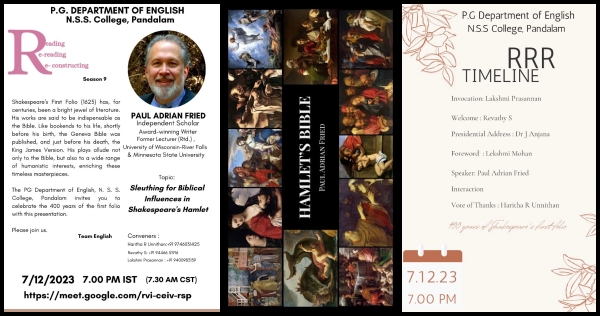
TRANSCRIPT: Presentation for Post Graduates, N.S.S. College, Kerala, India, 7 December, 2023

Image
TRANSCRIPT: Presentation for Post Graduates, N.S.S. College, Kerala, India, 7 December, 2023 Edited planned transcript of remarks delivered on 7 December, 2023, in an online presentation for the Post Graduate program, N.S.S. College, Kerala, India, 7 P.M. IST, 7:30 A.M. CST. (A few words and points below were cut from the live presentation for time considerations, and I made a few additional extemporaneous remarks, but for the most part, this is the transcript.) (I did not have time to talk about allusions that fit into the theme of orphaned children who find transcendent parents in others or in a heavenly parent, but perhaps some other time....) ~~~~~~~~~~~~~~~~~~~~~~~~~~~~~ Informal outline (followed by transcript): INTRODUCTION: [Disclaimers] - Contested times, contested scripture LIST OF BOOKS cataloging Bible allusions in Shakespeare, some open-access: Sleuthing scripture allusions in Hamlet CHANGE THOSE NAMES WITH YOU: Servant-Prince, & Renunciation of Fruits DOUBTING ...