Posts

Showing posts with the label Holy Fool

Yorick, the Gravedigger, Emmaus, and St. George (Emmaus Postlude, Part 8)

Image
The name Yorick [1] may come from the same root as St. George [2], patron saint of England since 1348 : from the Greek “Georgios”: from ge (γῆ)  - 'earth, soil' - and ergon (ἔργον), 'work' [3]. Yorick, as “earth worker.”   The gravedigger in Shakespeare’s Hamlet is called “Goodman Delver” by his friend (5.1.14). - So the gravedigger and Yorick echo one another in more ways than foolery… This relates also to my series on the Emmaus echo in 5.1, the graveyard scene: the story of Jesus’ appearance to the disciples on the road to Emmaus [4] was a gospel read in church on the first Monday after Easter every year of Shakespeare’s life [5]. In that gospel, two disciples on the road are mourning the death of Jesus. They meet a stranger (somehow a real or figurative Jesus, unrecognized [6]) who shows them compassion, listens, scolds them for their flawed thinking, and gives them hope, explaining the scriptures to them. These are all things Jesus had done for them. The disciple...

Part 9: Ophelia, "mad rogue" court fool

Image
When Hamlet acts mad like a court fool during The Mousetrap , he talks so much that Ophelia says he is “as good as a chorus” [1]. After he kills Polonius and is sent to England, Ophelia starts acting mad in Hamlet’s absence. Ophelia becomes like a mad fool-queen regent in the fool-king’s absence, the most verbose person among the court; she commands its attention like a court fool. Long (1971), Holleran (1989) and Olivas (2015) have recognized Ophelia in the role of the fool. Holleran cites Long who “suggests that in her madness Ophelia plays the traditional role of the 'fool' (a role she shares with Hamlet), whose songs serve as mirrors to reflect the personality of the listener” [2]. Olivas notes that Ophelia’s madness seems to free her up to be more outspoken, and through songs and symbolic gifts of flowers with traditional meanings, she speaks uncomfortable truths about the court. Court fools were not obligated to flatter members of the court, but rather, obligated by tradi...

"The rest is silence": Musical Notation, Nihilism, and Ambiguity

Image
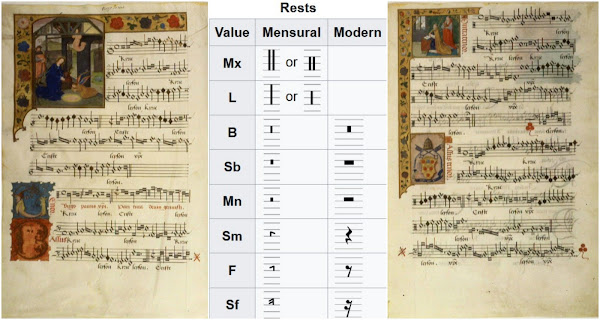
"The rest is silence." When Shakespeare scholars write about Hamlet's last words, more often than not, their focus is that Hamlet is being serious, even nihilistic. Too few critics and scholars consider that Hamlet is making a musical pun for Horatio (and for theater audiences) with his last breath: The rest (in musical notation) is silence. Hamlet is, after all, not only the son of King Hamlet and Queen Gertrude, but also the spiritual offspring of Yorick the fool. His first words in the play involve a sarcastic pun: His uncle Claudius calls Hamlet his son, and Hamlet says he is “too much in the sun.” (1.2.69) [1] He makes fun of Polonius, who deserves it: POLONIUS: What do you read, my lord? HAMLET: Words, words, words. POLONIUS What is the matter, my lord? HAMLET Between who? POLONIUS I mean the matter that you read, my lord. HAMLET Slanders, sir; for the satirical rogue says here that old men have gray beards, that their faces are wrinkled,...

Heresy in Hamlet 5.1 Emmaus figures: Part 2

Image
My last post explained potentially blasphemous implications of offering a fool (Yorick or the gravedigger) as the Emmaus figure in Hamlet 5.1. I will explore other heretical or atheistic implications of the graveyard scene’s Emmaus echo in this post. [Image: Painting by Caravaggio(1571–1610) "Supper at Emmaus," 1606. Collection: Pinacoteca di Brera. Pubic domain, via Wikipedia .] If you missed that previous post, you can find it here : https://pauladrianfried.blogspot.com/2022/05/blasphemy-and-heresy-in-hamlets-emmaus.html In Shakespeare’s time (as now), the tale of Jesus’ appearance to the disciples on the road to Emmaus after his crucifixion [1] was commonly read as a tale of miraculous power. This Jesus, supernaturally and gloriously resuscitated, was one with God, omnipotent and capable of anything: to appear in a locked room, or to prevent disciples from recognizing him. This may have distorted the original meaning of the tale: The disciples may have met a st...

Blasphemy in Hamlet 5.1 Emmaus figures: Part 1

Image
I’ve posted recently about biblical allusions in Hamlet related to Holy Week and the season of Easter ( here and here and here ). Another important Easter allusion in Hamlet 5.1 involves Jesus appearing to disciples on the road to Emmaus. [Image:Caravaggio, "Supper at Emmaus," 1601, in the National Gallery, London. Public domain, via Wikipedia .] I have blogged about this before , but it is worth another look: The allusion is hidden in plain sight in plot elements, but never explicitly named. Four years ago I wrote this: ~ ~ ~ In the Luke 24:13-35 Emmaus story: (1) mentor and fearless leader Jesus is crucified; (2) two troubled disciples head to Emmaus (D to E); (3) a stranger joins them, cheers them, explains scripture; (4) they recognize the stranger as Jesus in breaking of bread. In Hamlet, (1) mentor and fearless leader King Hamlet is murdered; (2) two troubled Danes (Hamlet and Horatio) head to Elsinore (D to E); (3) a stranger/gravedigger chee...