Posts

Showing posts with the label Revenge

Hamlet as Jonah desiring Nineveh's destruction instead of repentance (Jonah Postlude)

Image
HAMLET OBSERVING CLAUDIUS AT PRAYER IN 3.3 ACTS LIKE A VENGEFUL JONAH, according to Dennis Taylor’s recent book [1]: After Jonah delivers prophecy to Nineveh and they repent [2], Jonah is ungrateful for the gourd plant that God makes spring up to give him shade, and disappointed: He’d hoped to witness Nineveh’s destruction [3]. Hamlet is similarly disappointed to find Claudius at prayer and perhaps repenting (or trying to [4]). Jonah lacks mercy and wants to be an instrument of God's vengeance; before his sea-voyage, a "distracted" Hamlet is perhaps made mad by the desire for revenge, killing Polonius mistakenly [5], declaring that all his thoughts should be bloody or "nothing worth" [6], similarly dedicated (for a time) to being an instrument of vengeance. But in Hamlet “the time is out of joint” [7]: - Jonah first embarks on his sea-voyage and then changes mode of transport mid-sea for his ride in a fish’s belly; only later, when Nineveh repents, does he sul...

The 12th Day of Christmas in Churches of Shakespeare's Time (Series, Part 12)

Image
ON THE 12TH DAY OF CHRISTMAS IN CHURCHES OF SHAKESPEARE’S TIME, JANUARY 5, here are the scriptures congregations would have heard: In Psalm 5, David again assumes that God is vengeful and will come to his aid [1]. In Romans 4 we hear of works vs. faith, and again, of circumcision of the heart, a topic repeated in church every day since the Feast of the Circumcision [2]. (How does a character in a play outwardly manifest inner change?) Genesis 7 and 8 continue the Noah tale, referenced in at least two Shakespeare plays [3]. In Gen 7, the flood comes, 40 days and nights of rain. In Gen 8, rains stop, floods subside; all on the ark are saved. From December 30 (Paul’s shipwreck, with echoes of Pericles ) [4], to January 4-5, we get perils on water, a theme in many Shakespeare plays in which the sea features prominently [5]. Shakespeare had many sources for his plays, but the scriptures stories read in church that involved water – Noah, Moses parting the Red Sea, Jonah, Jesus walking on w...

LAMETH and the 10th Day of Christmas in Churches of Shakespeare's Time, January 3 - Series, Part 10

Image
10TH DAY OF CHRISTMAS IN SHAKESPEARE’S TIME, JANUARY 3: Matthew 2 revisits the Epiphany’s wise men, star, and Herod, from the December 28 gospel [1]; Genesis 3 tells of the serpent deceiving Adam and Eve, a Hamlet theme [2]; Romans 2 repeats “circumcision of the heart” (v.29), already heard on January 1. Two readings involve vengeance: - David in Psalm 3 calls upon a vengeful God (has avenged him before) to save him from the rebellion of his son, Absalom [3]. - One mentions a descendant of Cain whose name is an anagram for Hamlet: Genesis 4, at evening prayer, mentions Lamech/Lameth [4], who boasts of his vengeance, and in legend, accidentally kills his ancestor Cain, triggering God’s curse [5]. The Danish source for Hamlet has the prince named Amleth. “Amleth” an anagram of “Hamlet,” but so is “Lameth.” In 5.2, Hamlet regrets acting badly toward Laertes at Ophelia’s grave, and tries to apologize for blindly killing Polonius behind the arras, without publicly admitting his intended ...

Titus Andronicus, revenge, and child-eating in Shakespeare's Bible

Image
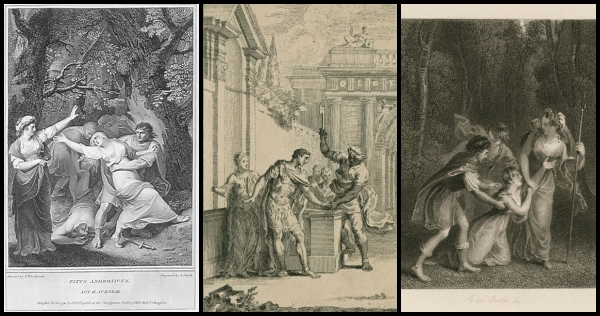
In Titus Andronicus, Titus has Chiron and Demetrius restrained and killed, to be baked up and served to their mother for revenge, a deception of cannibalism (vaguely similar to the deception at the end of The Spanish Tragedy). In The Bloody Banquet, by T.D., as punishment, an adulterer must eat the flesh of her lover.   Why the fascination with revenge and cannibalism? CANNIBALISM: Many Catholics believed in transubstantiation (that the bread and wine actually became the body and blood of Christ). Protestant polemics claimed it was a form of cannibalism, which Catholics denied. “EAT THEIR OWN CHILDREN” Deut 28:54-57 (Bishop’s Bible trans.) notes note people who are “delicate and tender” (entitled, pampered, spoiled), who - if the city were under siege and food limited - would eat their own children. [1] When Hamlet calls Fortinbras a “delicate and tender prince,” it is not a compliment, but a reference to this passage. Titus stabs his own daughter, and Tamora wants the mixed-race c...

Tanya Pollard's "What's Hecuba to Shakespeare?"

Image
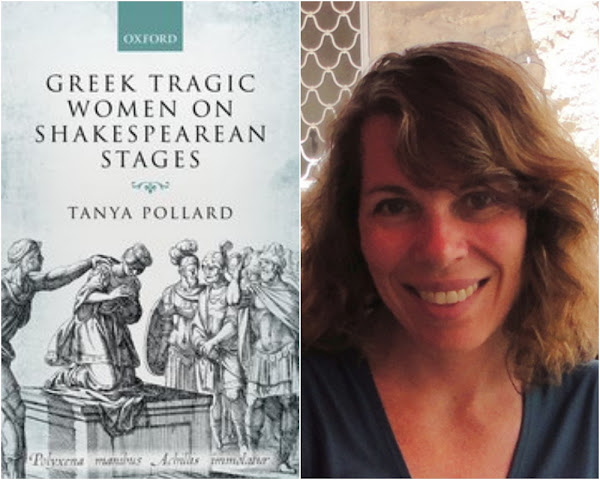
In her helpful essay, "What’s Hecuba to Shakespeare?" [1], Tanya Pollard does a remarkable job showing how the critical trend in Shakespeare scholarship goes wrong in assuming that tragedy is usually, mostly, about male tragic figures. Pollard notes, “in the early modern period, Hecuba was the established icon of Greek tragedy [....] by far the most popular of the Greek plays printed, translated, and performed in sixteenth-century Europe.” (1064) Hamlet wrestles with the genre: “Hamlet has more to say about his mother’s failure to grieve than about his own grief. His preoccupation with Gertrude has been widely read as a sign of his misogyny, and his Oedipal fixation on her sexuality. But in the context of Shakespeare’s interest in Hecuba, it might be more fruitfully understood as representing a confrontation with the genre’s conventions.” (1079) Hamlet is frustrated that Gertrude fails to live up to the ideal represented by Hecuba. Pollard notes other examples of t...

Peter Lake on the four genres represented in Hamlet

Image
If Hamlet is NOT a revenge tragedy, what is it? Peter Lake [1] shares his ideas on this topic and more in his 2020 book, Hamlet’s Choice: Religion and Resistance in Shakespeare's Revenge Tragedies .[2] Lake claims Hamlet is not *merely* a revenge tragedy, but much more, bending and mixing genres. If Hamlet is not *merely* a revenge tragedy, what is it? In a (Senecan, or heroic/Homeric) revenge tragedy like The Spanish Tragedy (1587, Thomas Kyd), injustices occur, and a victim of wrongs decides to take revenge. Eventually there’s a lot of plotting of violence, and the revenge is worse than the original injustice. Not in Hamlet, Lake observes. Shakespeare had already written the successful Titus Andronicus (1594), a more traditional revenge tragedy, which ends like The Spanish Tragedy, with the main character killing the heirs of the villains and cooking them, and then making the villains eat it. Yuck. Nothing like that happens in Hamlet. Lake observes: By the tim...

Begging & Poor, Dust & Stones in Titus Andronicus (1593)

Image
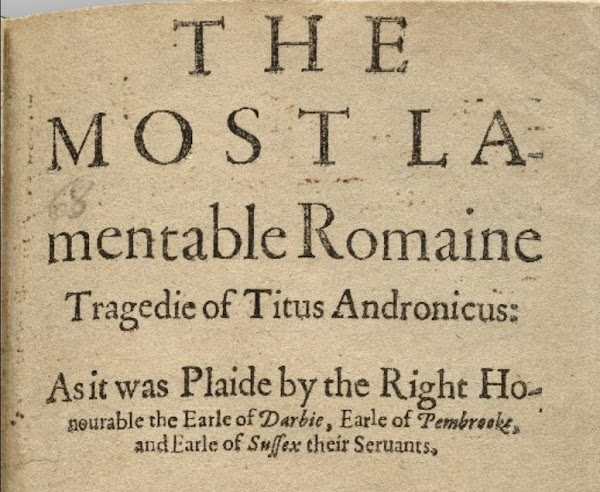
"Poor" occurs 16 times in Titus Andronicus (1593): - Titus speaks of "the poor remains": only four of his 25 "valiant sons" survived battle with the Goths (1.1). - He speaks of himself and his daughter Lavina as "poor creatures," and of his "poor right hand" (3.2) after he was deceived to have the left cut off to ransom two sons. [Cover page from the 1594 Quarto of [Titus Andronicus] The most lamentable Romaine tragedie of Titus Andronicus As it was plaide by the right honourable the Earle of Darbie, Earle of Pembrooke, and Earle of Sussex their seruants. Image via Wikipedia and the Folger Shakespeare Library . Public Domain.] "Beg" occurs 10 times, including Lavina in 2.3 begging Tamora to kill her: Her beloved Bassianus had been slain; she'd rather be killed than raped by Tamora's sons. They rape her, cut out her tongue, and cut off her hands in hope that she can't identify her attackers. But later she d...

Three Questions Inspired by PBS Romeo & Juliet

Image
In a recent National Theater/PBS production of Shakespeare's Romeo and Juliet , some of the most demanding, harsh lines scripted for Juliet's father, addressing Tybalt (1.5) and Juliet (3.5), were reassigned to her mother. [Screenshot from "The Making of Romeo and Juliet via PBS. Fair use.] - In 1.5, when Tybalt at the Capulet masque sees/hears Romeo, Tybalt says he wants to kill him on the spot. Instead of Juliet's father confronting him, her mother does, demanding Tybalt show better civility on this occasion, in her house. - In 3.5: Instead of Juliet's father demanding that Juliet (who has secretly married Romeo) must marry Paris or be disowned, again, Juliet's mother gets these lines; in the original text, Lady Capulet was merely given the chance to briefly assent to her husband's harsh castigation of the daughter. [Photo by Rob Youngson via PBS .] - The scenes were played convincingly, I thought. - On the one hand, Shakespeare would ...

Two things I'd change in how people think about Romeo & Juliet...

Image
ROMEO & JULIET: If I could change just two things about how most people think about the play (and how it is sometimes taught) what would they be? 1. IT'S NOT MERELY ABOUT YOUNG LOVE, but also about how little chance young love has when families are stuck in old grievances. 2. JUST BECAUSE IT'S SET IN VERONA DOESN'T MEAN IT'S ABOUT VERONA. Shakespeare often used far-off settings to talk about things in his own England that were prohibited or difficult to address directly. - Shakespeare's England was torn by religious feuding between Catholics and Protestants (& other factions). - Shakespeare's family is believed by some to have had strong Catholic sympathies, but not many years after he wrote the play, his daughter Suzanna married a Puritan, John Hall, perhaps bridging a denominational divide. - When early audiences heard "Capulet & Montague," the syllables may have prompted more than a few to think: "Catholic & Protestant....