Posts

Showing posts with the label hold the mirror up to nature

Hamlet-Claudius, Romulus-Remus, Cain-Abel (Part 11, Claudius series)

Image
Last week I posted [1] about a 1948 journal article by E. G. Berry [2], arguing that Shakespeare’s Hamlet resembled Roman Emperor, Claudius I. [3]. Berry argued that these resemblances are stronger in Shakespeare than in the 1200 A.D. source story from Saxo Grammaticus. What Berry doesn’t emphasize, but makes clear: 1. Saxo did not fashion his prince as a mirror image of his murderous uncle, although Amleth does resemble aspects of Claudius I. No similarity between prince and uncle is emphasized by Saxo. 2. By naming the uncle “Claudius,” Shakespeare invites audiences to view the prince and uncle in a radically revised relationship. Instead of a simple opposition between hero and villain, by changing the uncle’s name from “Feng” to “Claudius,” Shakespeare creates a new mirror effect between the two that was not present in Saxo’s older source tale. By pointing to Claudius I, Shakespeare points to Rome, which has an origin story involving a twin, Romulus, who kills his brother Remus [4...

Hamlet and Claudius I as nearly mirror images (Part 10, Claudius series)

Image
CLAUDIUS I, EMPEROR OF ROME, IS IN MANY WAYS A MIRROR IMAGE OF HAMLET, making “Claudius” a fascinating name choice for Hamlet’s uncle. In 1948, E. G. Berry explained this, drawing on Suetonius [1]: Claudius, like Hamlet, pretended to be mad or stupid as a survival strategy (74). [2] “Like Hamlet, Claudius is delayed and obstructed in his coming to his rightful authority [...]; Claudius has to remain in a state of pupillage to a late age, kept in that state by his uncle Tiberius, and Hamlet [...] spent a longer time than usual at Wittenberg and then [...] is detained a virtual prisoner by his uncle Claudius.” (76) Hamlet’s “extraordinarily loose, even obscene language in addressing Ophelia in III, i  and in the play scene” resembles Suetonius’ description of Claudius’ behaviors. (76) “In [...] ability and scholarship there is [...] likeness between Hamlet the scholar and the talented and scholarly Claudius. [...] denied authority and recognition by the usurping emperor.” (76-77) “...

Seven ways Hamlet might see a mirror of himself in Laertes

Image
It is often said that Laertes is a foil for Hamlet. Hamlet says he sees his own image in Laertes: But I am very sorry, good Horatio, That to Laertes I forgot myself, For by the image of my cause I see The portraiture of his. (5.2.85-88) Later in the scene, the word “foil” is used five times, usually by Hamlet, punning on foil as weapon and as mirror image. Jesus claimed that the greatest commandment is to love God, and the second, "like it," to love neighbor as self (Mark 12:28-31; Matthew 22:34-40). One’s neighbor may be a sort of concrete local manifestation of God, “the least of these,” or of transcendence and mystery. To love neighbor as self, it helps to look with compassion, willing and able to see oneself in one’s neighbor, and one's neighbor in oneself. But how might Hamlet see his image in Laertes? How might we? Consider seven ways, the last of which Hamlet may recognize only too late: 1. Both have fathers unjustly killed, and both are inclined toward revenge. 2....

Part 53: When a Queen defends Ophelia as saved

Image
WHAT DOES IT MEAN for Elizabethan England, and for its queen and head of England’s church, that Shakespeare’s Hamlet portrays a queen defending Ophelia’s death as not of her own choosing, but fearless and accepted in faith? The play portrays two main attitudes about suicide: Christianity condemned it, while “antique Romans” embraced it as an option for honorable death. Hamlet prevents Horatio from drinking poison [1]; some scholars and productions have proposed that Hamlet offers Claudius the poison cup, and he takes it of his own volition.[2] The play presents gravediggers [3] and a “churlish priest” [4] who assume Ophelia killed herself; before these, no eyewitness accounts, but a queen who asks all to believe that Ophelia’s fall into the brook was not of her own choosing (but due to the crown-envy of a sliver of willow, like the crown envy of Claudius), and that Ophelia accepted her approaching death fearlessly, and in faith. Significantly, this play was written at the end of Eli...

Part 25: Ophelia's Self-Catching Conscience in the Mirror of her Arts

Image
Unlike Claudius, who ignored qualms of conscience to murder his brother and usurp the throne, Ophelia’s relationship to her conscience is more healthy, rich, and self-directed.   Claudius just doesn’t get it, so he needs Hamlet to catch his conscience in The Mousetrap, [1] which reenacts Claudius poisoning his brother and wooing his victim’s wife. Hamlet says playing holds a mirror up to the age [2], and he uses the playlet to hold a mirror up to Gertrude and Claudius, showing what they’ve done. But Ophelia gets it, and doesn’t need someone to hold up a mirror for her conscience. She chooses her own songs, stories, and allusions to reflect upon her sadness and conscience. [3] She knows her father died, but doesn’t know that Hamlet killed him thinking it was Claudius. She sings songs of mourning for perhaps her father and/or the dead king [4], songs of her own choosing. Ophelia knows Hamlet made to her “almost all the holy vows of heaven” [5] perhaps the equivalent of a handfast w...

Begging and Poor in The Comedy of Errors (1594)

Image
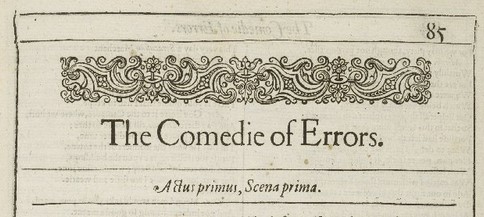
In The Comedy of Errors, "beg" occurs only four times; "poor," 10. The story contains two sets of twins, and each set bears the same name: Two of Antipholus, two of Dromio, the former raised to be masters, the latter bought and raised to be servants (slaves). - Because "their parents were exceeding *poor*," the Dromio twins were "bought and brought up to attend" Egeon's sons (1.1, an act of charity, or exploitation, or both). - But Egeon of Syracuse has traveled to Ephesus as a refugee to find his later-separated sons, risking death by execution because Syracuse and Ephesus are at war. - Solinus, Duke of Ephesus, tells Egeon to *beg* or borrow the money for his ransom to spare his life (1.1). - Luciana, sister-in-law to Antipholus of Ephesus, tells her sister that the love she *begged* for her sister from the Antipholus she believed was her sister's husband, he begged of her (4.2, because unknown to her, the Antipholus who begged lov...

Begging and Poor in Richard III (1592–1593)

Image
The word "beg" occurs 13 times, and "poor," 25 times in Richard III . On the lips of Richard, Duke of Gloucester, when it is not disparaging, it is often dishonest and manipulative. The Princes in the Tower (among others) are very concerned with avoiding the appearance of begging as a mark of weakness. A failed assassin claims conscience leaves him a beggar (a theme that comes up again in Hamlet). In comparison, when Prince Hamlet and others refer to him as “poor” and “beggar” (more often than any other character in that play) the contrast between Hamlet and these other royals is stark and significant. [From title page, Richard III (cropped), from the second folio of 1632. Image via Folger Shakespeare Library . Creative Commons.] Nizar Zouidi of the University of Hail has noted the performative aspect of Richard III : He performs the roles of script writer, actor, and director in his own show ( See Nizar's abstract for his essay/chapter here .) R...