Posts

Showing posts with the label Luke 2:46-52

CORDELIA ABOUT HER FATHER’s BUSINESS (LUKE 2:41-52) - Series

Image
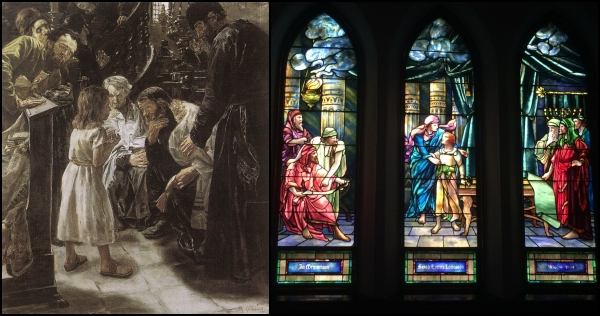
With more foresight, if Shakespeare had wanted to be more accessible for all ages, he might have realized that once Protestants questioned the Catholic idea of Eucharist as “transubstantiation,” religion would be on its way out (especially in some countries), and he might not have included as many as 1,300 biblical references in his plays [1]. 😉 One example is in King Lear 4.4.  Cordelia, newly returned to England from France, alludes to Luke 2:41-52:  CORDELIA: O dear *father,* It is thy *business* that I go about.    (4.4.26-27)  (*emphasis* mine) This alludes to the tale of the boy Jesus, lost in Jerusalem, later found in the temple, conversing with, astonishing, and amazing temple elders.  Shakespeare also has Hamlet in 3.2 allude to this with his former school friends after The Mousetrap, with his mother amazed and “astonied” [2]. Yes, spelled “astonied” in Shakespeare and in the 1599 Geneva translation:  47 And all that heard him, were astonie...

On the Significance of Hamlet as Boy Jesus in 3.2, Lost and Found in Luke 2

O n the Significance of Hamlet as Boy Jesus in 3.2, Lost and Found in Luke 2 Here are some of the possibilities for this allusion’s significance:  - Hamlet jokes that he is a wonderful son like the boy Jesus, amazing and astonishing elders and parents.  - A proud, blasphemous, “mad” Hamlet dares to compare himself to Jesus, blind to his own faults (like his blind stabbing of Polonius in the closet scene).  - Hamlet feels he “must go about [his] father’s business,” and feels “Prompted to [his]  revenge by heaven and hell” (2.2.613). - There is irony in the fact that the allusion equates Hamlet with the boy Jesus who was conceived by the Holy Ghost, with the Virgin Mary as mother and Joseph as his stepfather; Gertrude (“whored” by Claudius, her second husband) parallels the Virgin Mary, and stepfather Claudius parallels St. Joseph, perhaps an ironic probing of the Protestant questioning the Catholic tradition of the perpetual virginity of Mary. - Hamlet wants very...

Rethinking Ophelia and the Virgin Mary

Image
It is said that in the patriarchy of Shakespeare’s world, characters like Hamlet sort women into two categories: Virgin or whore. Ophelia and Gertrude can’t live up to an iconic model like the Virgin Mary. [1] In this way, we may view the Virgin Mary in a class by herself, sinless “Mother of God” who conceived Jesus by the Holy Spirit, and not by any man, and therefore to view Ophelia and Gertrude as far lesser mortals. [2] I will focus this post on Ophelia. I have come to believe, however, that it’s better to consider some of the many things Ophelia has in common with the Virgin Mary story rather than how Mary is in a class by herself. The story claims that Joseph, after a dream, did the honorable thing and married her (Matt 1:18-25). So the story is not merely about virginity, but also about treating a pregnant woman with compassion. If Hamlet had learned that he had made Ophelia pregnant, would he have acted in love to marry her? From his graveside declaration of his love (5.1.285...

(Part 12) TRY THIS: One Method for Considering Biblical Allusions

Image
~~~~~~~~~~~~~~~~~~~~~~ INDEX OF POSTS IN THIS SERIES: https://pauladrianfried.blogspot.com/2023/01/index-hamlet-in-32-as-boy-jesus-lost.html ~~~~~~~~~~~~~~~~~~~~~~~~~~~~~~~~~~~~~~~~~~~~~~~~ In this recent series,[1] I’ve explored one scripture allusion in a Shakespeare play (Hamlet in 3.2 alluding to the boy Jesus among temple elders from Luke 2). Readers of literature can explore allusions on their own, or instructors can do so with their students. There are many ways to do this, many possible starting points. Below is an outline of the method I used in this series. In many ways I only scratched the surface. Some tasks listed below might benefit from working on as a whole group. Then a class might divide tasks # 3 - # 7 among groups, and then later meet to discuss results, before # 8. 1. IDENTIFY what seems to be a scripture allusion. - People long familiar with a religion’s sacred texts may have an advantage, but religious belief is not required to identify allusions. Fa...

(Part 11) Cordelia is about her father's business in Shakespeare's King Lear

Image
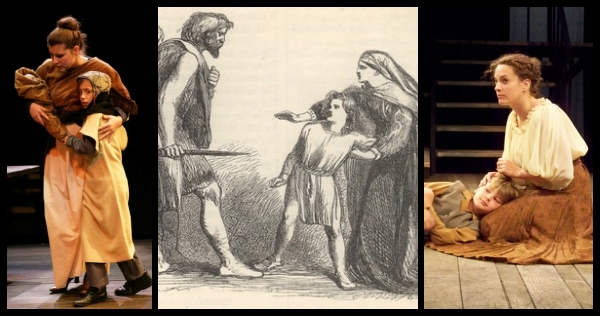
~~~~~~~~~~~~~~~~~~~~~~ INDEX OF POSTS IN THIS SERIES: https://pauladrianfried.blogspot.com/2023/01/index-hamlet-in-32-as-boy-jesus-lost.html ~~~~~~~~~~~~~~~~~~~~~~~~~~~~~~~~~~~~~~~~~~~~~~~~ This series has considered Hamlet’s allusion to Luke 2:46-52, the tale of the boy Jesus amazing temple elders and his parents.[1] Last week we considered a similar thematic echo in Macbeth , when the son of Lady Macduff amazes and humors his mother with wit and grace while also catching her conscience, like a court fool. But Hamlet and Macbeth are not the only Shakespeare plays that echo or allude to the Luke 2 story: King Lear contains an allusion to this gospel story, spoken by Lear’s exiled daughter, Cordelia.[2] We might recall how in Luke 2, Jesus tells his parents that he went to the temple because he had to be about his (heavenly) “father’s business.” Hamlet also believes he must be about his father’s business, but he is confused, at first striving reluctantly to be about the ghost’...

(Part 10) Boy Amazes Mother in Shakespeare's Macbeth

Image
~~~~~~~~~~~~~~~~~~~~~~ INDEX OF POSTS IN THIS SERIES: https://pauladrianfried.blogspot.com/2023/01/index-hamlet-in-32-as-boy-jesus-lost.html ~~~~~~~~~~~~~~~~~~~~~~~~~~~~~~~~~~~~~~~~~~~~~~~~ When considering an allusion by an author, it’s often informative to check and see if that author has other works that make a similar allusion. With Hamlet’s allusion to the boy Jesus amazing his mother and the temple elders in 3.2, besides checking things such as homilies of the time (as I did in Part 9 of this series) [1], we might wonder: Did Shakespeare allude to this Bible tale in other plays? Naseeb Shaheen believes Shakespeare’s Cymbeline has a brief reference to this same gospel tale (1.1.47-52), and King Lear (more explicitly) in 4.4.26-32. Less explicitly - yet perhaps quite significantly - in Macbeth, the dynamics between Lady Macduff and her son have a strong thematic connection to the tale of the boy Jesus amazing and [a-]stonishing his parents (and especially his mother, as...

(Part 9) Twisting the tale of the boy Jesus in the temple: Bishop Jewell, official book of homilies

Image
~~~~~~~~~~~~~~~~~~~~~~ INDEX OF POSTS IN THIS SERIES: https://pauladrianfried.blogspot.com/2023/01/index-hamlet-in-32-as-boy-jesus-lost.html ~~~~~~~~~~~~~~~~~~~~~~~~~~~~~~~~~~~~~~~~~~~~~~~~ Most considerations of a biblical allusion in Shakespeare do well to consider whether, and how, official homilies of the time treated the biblical text. This applies to this series,[1] and Hamlet’s allusion [2] to Luke and the boy Jesus, amazing temple elders and his parents. People in Shakespeare’s England were required by law to attend church. They would hear Luke 2:46-52 every January on the Sunday after Epiphany.[3] Only one official homily [4], attributed to Bishop John Jewell, mentions these verses from Luke. The homily is called, “OF THE RIGHT USE OF THE CHURCH OR TEMPLE OF GOD, AND OF THE REVERENCE DUE UNTO THE SAME.”[5] EXCERPT 1: “In the second [chapter] of Luke it is written, how that the mother of Christ, and Joseph, when they had long sought Christ, whom they had lost, and could ...

(Part 8) Hamlet in 3.2 as the boy Jesus: Why has this been missed?

Image
~~~~~~~~~~~~~~~~~~~~~~ INDEX OF POSTS IN THIS SERIES: https://pauladrianfried.blogspot.com/2023/01/index-hamlet-in-32-as-boy-jesus-lost.html ~~~~~~~~~~~~~~~~~~~~~~~~~~~~~~~~~~~~~~~~~~~~~~~~ In previous parts of this series,[1] I have explored Hamlet’s allusion in 3.2 to himself and his mother Gertrude [2] as like the boy Jesus, found in the temple by an astonished mother Mary among the elders.[3]  This allusion was missed by all major writers of reference books on Shakespeare and the Bible through at least the late 20th century [4]. Why have these scholars in this specialty field missed this allusion? Possibilities: 1. THE BIAS OF SCHOLARS: Perhaps many critics have preferred to imagine Hamlet as either not religious, or as a virtuous hero, rather than as one who would gloat after The Mousetrap and compare himself, perhaps blasphemously, to the boy Jesus? [5] And perhaps some scholars, especially in the last half century, simply resisted viewing Hamlet as a Christ fig...