Posts

Showing posts with the label broken vows

Part 25: Ophelia's Self-Catching Conscience in the Mirror of her Arts
Image
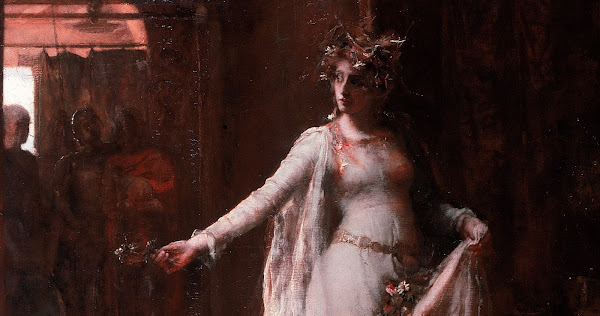
Unlike Claudius, who ignored qualms of conscience to murder his brother and usurp the throne, Ophelia’s relationship to her conscience is more healthy, rich, and self-directed.   Claudius just doesn’t get it, so he needs Hamlet to catch his conscience in The Mousetrap, [1] which reenacts Claudius poisoning his brother and wooing his victim’s wife. Hamlet says playing holds a mirror up to the age [2], and he uses the playlet to hold a mirror up to Gertrude and Claudius, showing what they’ve done. But Ophelia gets it, and doesn’t need someone to hold up a mirror for her conscience. She chooses her own songs, stories, and allusions to reflect upon her sadness and conscience. [3] She knows her father died, but doesn’t know that Hamlet killed him thinking it was Claudius. She sings songs of mourning for perhaps her father and/or the dead king [4], songs of her own choosing. Ophelia knows Hamlet made to her “almost all the holy vows of heaven” [5] perhaps the equivalent of a handfast w...

Part 24: Ophelia, Gertrude, and Shifting Narratives of Marital Betrayal via Cristina León Alfar

Image
Instead of reading Ophelia’s love for Hamlet as unwise, too “free” [1], and viewing Gertrude as adulterous [2], it is possible to read both characters very differently. We might be nudged in this direction by certain feminist readings, one being a book by Cristina León Alfar called Women and Shakespeare's Cuckoldry Plays: Shifting Narratives of Marital Betrayal [3]. Although the focus of her book is not Hamlet, many of her insights apply. Alfar’s focus involves six plays in which male claims of female adultery play a central role. These include Merry Wives of Windsor, Much Ado About Nothing, Othello, and The Winter’s Tale. Alfar carefully tracks a trend: Men (at times misled by men like Iago and Don John) make false claims of women’s infidelity, claiming wives or fiances have made them “cuckolds.” But these claims are fictions or lies based on male anxiety. Women, often with help of female allies, can shift these narratives, accusing the men of slander for their false claims. In ...

INDEX OF POSTS on Love's Labour’s Lost

Image
INDEX OF POSTS on Love's Labour’s Lost In 2021, I did a series of posts exploring a few religious and historical themes in Shakespeare's Love's Labour's Lost , with the second post in the series also dipping into the presence of the same theme in Henry V : Begging & Poor (& Chastity & Pregnancy) in Love's Labour's Lost (1594-1597) - October 12, 2021 https://pauladrianfried.blogspot.com/2021/10/begging-poor-chastity-pregnancy-in.html Good & Grace from Evil & Sin in Love's Labor's Lost & Henry V - October 24, 2021 https://pauladrianfried.blogspot.com/2021/10/good-grace-from-evil-sin-in-loves.html Women Priests Assigning Penance in Love's Labor's Lost? - November 02, 2021 https://pauladrianfried.blogspot.com/2021/11/women-priests-assigning-penance-in.html Elizabeth I, Popes, & Ferdinando I de' Medici in Love's Labor's Lost - November 09, 2021 https://pauladrianfried.blogspot.com/2021/11/is-loves-...