Posts

Showing posts with the label Christ Figure

Part 39: Ophelia, Gertrude, Hamlet: three damned souls as saved Christ-figures

Image
Shakespeare’s Hamlet is radical in a religious sense. Shakespeare hints that Ophelia, Gertrude, and Hamlet—apparently damned for different reasons—are not only saved, but in fact are Christ-figures [1]. The texts support such a reading. Yet even if Shakespeare uses religion mostly for dramatic (not religious)  purposes [2], it is safe to say that a majority of scholars today might reject this idea, or at least be quite disinterested in it. Ophelia is apparently damned as a suicide [3], but Gertrude blames her death in part on an “envious sliver” of willow [4], envious — like Claudius — that it didn’t get a crown. Ophelia was generous in bestowing crowns (coronets) [5], like Christian scriptures which claim that all people can be adopted sons and daughters of God, and can inherit a heavenly crown [6]. Gertrude is apparently damned for her “incestuous marriage” to her dead husband’s brother [7], scandalous and forbidden, especially after the divorce of Henry VIII from his first wife ...

Part 38: Christ figures in Hamlet: Ophelia, Gertrude, Hamlet (Good Friday 2024 post)

Image
Today is Good Friday. In Shakespeare’s England, church rituals spoke of baptism as a dying to self in Christ, so as to be made new in him [1]. Contrary to some Shakespeare scholars who explicitly resist the idea of Christ-figures in the plays (including Harold Jenkins, Arden editor), all the baptized are called to be Christ-figures [2], imitators of Christ. The spiritual rhythm in medieval mystery, morality and miracle plays assumes all are sinners, but if they express sorrow for their sins, they can know God’s mercy and be saved. [3] Any drama in which a person who dies is saved, is a comedy; the only tragedies are those in which a sinner resists salvation. In her madness, Ophelia expresses regret through her story of the baker’s daughter [4]. Gertrude explains that Ophelia falls in the brook because of an “envious sliver” of willow [5]. Willows in Psalm 137 were incorporated weekly in Christian vespers and associated by St Benedict of Nursia [6] and Martin Luther [7] with the cruci...

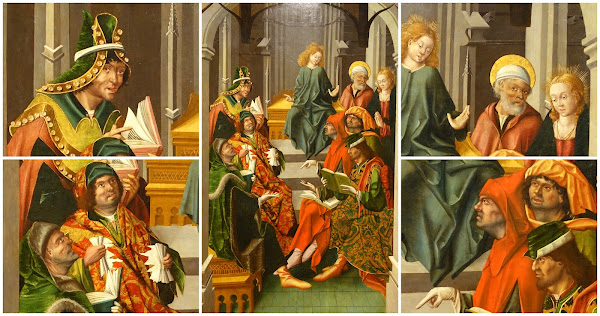
(Part 4 ) Dissonance and Irony in Hamlet's 3.2 Allusion to Luke 2

Image
~~~~~~~~~~~~~~~~~~~~~~ INDEX OF POSTS IN THIS SERIES: https://pauladrianfried.blogspot.com/2023/01/index-hamlet-in-32-as-boy-jesus-lost.html ~~~~~~~~~~~~~~~~~~~~~~~~~~~~~~~~~~~~~~~~~~~~~~~~ IRONY: In the third act, Hamlet makes a subtle allusion, implying that he astonishes his mother like the boy Jesus astonished his mother the Virgin Mary and amazed the temple elders. - But in spite of all the points of similarity listed in my last post [1] regarding Hamlet’s allusion, there may be even more ways in which Hamlet is quite different from the boy Jesus. The tension or dissonance between these similarities and differences is an important source of irony. (For a comparison of the relevant Hamlet text [2] to the relevant gospel text from Luke, [3], see Part 1 of this series [4].) HOW IS HAMLET UNLIKE THE BOY JESUS? A non-exhaustive list: 1. Hamlet is a revenger. Audiences may assume that a revenger is so controlled by passion for revenge that he risks his own damnation. Not like Jes...

Heresy in Hamlet 5.1 Emmaus figures: Part 2

Image
My last post explained potentially blasphemous implications of offering a fool (Yorick or the gravedigger) as the Emmaus figure in Hamlet 5.1. I will explore other heretical or atheistic implications of the graveyard scene’s Emmaus echo in this post. [Image: Painting by Caravaggio(1571–1610) "Supper at Emmaus," 1606. Collection: Pinacoteca di Brera. Pubic domain, via Wikipedia .] If you missed that previous post, you can find it here : https://pauladrianfried.blogspot.com/2022/05/blasphemy-and-heresy-in-hamlets-emmaus.html In Shakespeare’s time (as now), the tale of Jesus’ appearance to the disciples on the road to Emmaus after his crucifixion [1] was commonly read as a tale of miraculous power. This Jesus, supernaturally and gloriously resuscitated, was one with God, omnipotent and capable of anything: to appear in a locked room, or to prevent disciples from recognizing him. This may have distorted the original meaning of the tale: The disciples may have met a st...

Roland Frye's Protestant Bias (Part 7: Religious Bias in Shakespeare Scholarship)

Image
When he was a research professor at the Folger Shakespeare Library, Roland M. Frye wrote Shakespeare and Christian Doctrine (1963),* which criticizes Shakespeare scholars like G. Wilson Knight (the subject of last week’s post) and others who, according to Frye, offered too-simplistic or unsupported religious readings of the plays (4-6, 19-42). [* All quotes here are from my 1963 edition, published by Oxford University Press. Frye's Shakespeare and Christian Doctrine is still published through the Princeton Legacy Library .] Frye was a Protestant theologian and Presbyterian elder. Protestant writers believed in the utter depravity of humanity due to original sin since the fall of Adam and Eve; this could be overcome by “faith alone,” not by works. Frye stresses Protestant views throughout. Initially Frye notes that people in Shakespeare’s time who conformed outwardly may have privately held “heterodox, heretical, or… anti-Christian opinions” (4). Later he contradicts this...

Horatio's Gift-Dynamics & Christ-Figures Shifting Ground, 1.1: (Part 14) Labors of Gratitude and Regret in Hamlet

Image
This is the latest installment in a multi-part series examining how characters interact in Hamlet, offering opportunities, gifts, planting seeds for future inspiration, or for changes of heart & mind. It follows ideas from Lewis Hyde (“The Labor of Gratitude,” a chapter in his book, The Gift: Imagination and the Erotic Life of Property) . For more notes on the series and an index of previous posts in this series, see the end of this post. ~~~~~~~~~~~~~~~~~~~~~~~~~~~~~~~~~~~~~~~~~~~~~~~ Introduction: I have been writing a series of blog posts about characters in Hamlet who undergo change due to interactions or events that result in gratitude or regret. This has been inspired in part by Lewis Hyde’s chapter called “The Labor of Gratitude.” Yet in part it has also been inspired by my work on biblical allusions in Shakespeare. It sprang from a basic question: If Shakespeare quoted from scripture, paraphrased scripture, and also echoed biblical plots in various moments of his plays...