Posts

Showing posts with the label Plutarch

Why "Hugger Mugger" & "Impostume" are in Hamlet

Image
HUGGER-MUGGER: Shakespeare has Claudius use these words to describe the burial of Polonius in Hamlet 4.5. "Hugger-mugger" means "secret," "chaotic," "clandestine, sly," or "disorderly, chaotic" [1].  Shakespeare consulted the 1579 Thomas North translation of Plutarch, which used “hugger-mugger” to describe the burial of Julius Caesar [2]. Polonius once played Julius Caesar in a play production, as he reveals to Hamlet in 3.2.  HUGGER-MUGGER as HOARDING a SECRET:  To do something secretly is to hoard the knowledge of the thing: Claudius hoards not only knowledge of the secret burial of Polonius, but also of his murder of his own brother.  IMPOSTUME:  Observing Norway’s troops ready to invade Poland, Hamlet notes:  This is th’ impostume of much wealth and peace, That inward breaks and shows no cause without Why the man dies. (4.4.28-30) An impostume is an abscess, as if the body is secretly hoarding puss from an infection. Hamlet impli...
More Egyptian connections in Hamlet besides Herod tale

Image
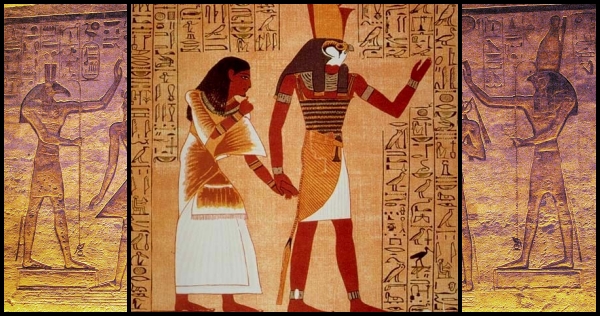
During the season (and "twelve days") of Christmas, it may be good to consider Egyptian connections in Shakespeare’s Hamlet. Prince Hamlet references “Herod,” one of whom (Herod the Great) supposedly precipitates the flight of Mary, Joseph, and Jesus into Egypt after Joseph was warned in a dream. Some Christians take this story as historically true, while others think the writer of the Matthew gospel wished to paint Jesus as a new Moses, so the story may likely be religious fiction that attempts to make a point for the sake of religious instruction (catechesis). Herod wishes to eliminate his successor, foreseen in prophecy, like Laius getting rid of his son Oedipus, and Claudius arranging for the death of Prince Hamlet. But the Egyptian connection may be much older than Herod. As some students and scholars of comparative literature have already noticed, the oldest sources for Shakespeare's Hamlet may be Egyptian, and much older than Saxo Grammaticus (1200 CE). Here'...