Posts

Showing posts with the label Eucharistic Controversy

John Drakakis on quasi-religious veneration of Shakespeare

Image
HAMLET  A man may fish with the worm that hath eat  of a king and eat of the fish that hath fed of that worm. KING  What dost thou mean by this? HAMLET  Nothing but to show you how a king may go a progress through the guts of a beggar. (4.3.30-35) (Some say this sounds like a threat, from Hamlet to Claudius; but it's also more simply a reminder to Claudius of his mortality....) In Shakespeare’s time, Protestants and Catholics still debated Eucharist. - Catholics are taught that in the prayers of the Mass, the Eucharistic bread becomes the “body of Christ,” but that this is not cannibalism. - Lutherans are taught that the bread becomes Christ but also remains bread, a position too Catholic for Calvin. - Calvinists believe those who eat of the Eucharistic received Christ spiritually, not physically. - Protestant polemics made fun of this, observing that if a church mouse ate crumbs of Catholic Eucharist, it would be ridiculous to claim that Christ, King of heaven, “m...

Hamlet, Emmaus, Eucharistic Controversy, and Semiotics (Emmaus series, Part 5)

Image
In Shakespeare’s time, people discussed and debated the Eucharistic controversy, and some think there are references to it in Hamlet (in things such as the chalice of poison wine as a "black mass"; or, as I have argued in this series, an Emmaus plot echo in the graveyard scene [1]).  In the biblical account, when Jesus at the Last supper told the twelve to eat and drink the bread and wine as his body and blood, what did he really mean? The way we choose to understand Jesus’ appearance to the disciples on the road to Emmaus might be viewed as resembling the Eucharistic controversy. Also, in some ways, debates about what the gospel writers meant by things like virgin births, Eucharist, resurrections, and resurrection appearances (as on the road to Emmaus) have been described as debates about semiotics [2]. [Image: Titian (1490–1576), "Pilgrims at Emmaus" (Français: LE SOUPER A EMMAUS), circa 1535. Louvre Museum. Public domain, via Wikipedia .] What had the dis...

Why Rhenish, not Bread? Emmaus in Hamlet 5.1, Part 4

Image
Bread and wine. Wine and bread. To-MAY-to, To-MAH-to. [1] Does it matter what we emphasize or begin with? In previous posts, I’ve explored echoes in Hamlet 5.1 of the Emmaus tale from Luke 24:13-35 [2]. [Image: Altar of the Sienese cathedral, reverse, main register with scenes from Christ's passion, scenes: Christ appears to two pilgrim apostles in Emmaus. 1308-1311. Artist: Duccio di Buoninsegna (1255–1319). Collection: Museo dell'Opera del Duomo, Siena. Public domain, via Wikipedia .] Between Luke’s version of the tale and Shakespeare’s in Hamlet, we noted a difference of bread and wine: In the original story from Luke, the stranger on the road to Emmaus is not recognized as an appearance of the risen Jesus until they break bread with him. But in Hamlet 5.1 we noted that broken bread is replaced with spilled wine: Hamlet had been holding an unrecognized skull, and asked the gravedigger whose it was. The gravedigger replied, saying it belonged to Yorick, and ...

The Black Rubric and Hamlet’s Feminizing of a Distant, Indifferent Divine

Image
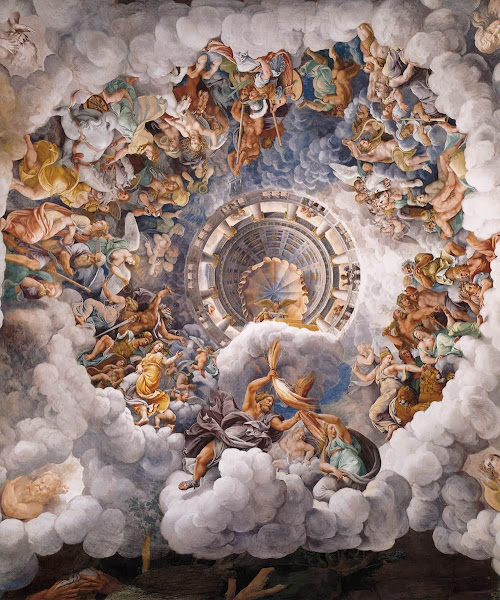
Consider two moments in Hamlet when it is made explicit: Maybe God is not paying attention to human suffering? THE FIRST is when the First Player tells the revenge tale of Priam’s death at the hands of Pyrrhus (2.2). Hecuba, Priam’s wife, watches. [See note #1 below: "Who in Shakespeare's England was like Hecuba, witness to a brutal killing of a loved one?"] The First Player says that the “synod” of the gods (like bishops and cardinals?) should take away the powers of the goddess Fortune (like an excommunicated Elizabeth I?), breaking her wheel, and “bowling” her “down the hill of heaven, / As low as to the fiends!” First Player: But if the gods themselves did see her [Hecuba] then, [/...] The instant burst of clamour that she made (Unless things mortal move them not at all) Would have made milch [milk] the burning eyes of heaven.... [In a fresco (circa 1532-1534) by Giulio Romano (1499–1546), the image above depicts the gods overcoming the titans. Public ...

Where's the body? Kings, Beggars, Worms, Excrement, Eucharist, Buddha Bunny, and Lazarus in Hamlet 4.3 (part 17)

Image
In Hamlet 4.3, Claudius is disturbed that Hamlet, for some inexplicable reason, has hidden the body of Polonius. Perhaps a main reason is to allow for some fascinating dialogue between Hamlet and Claudius about bodies, supper, worms, kings, and beggars, and to hint at more than this, regarding the Diet of Worms, and perhaps about Eucharist. The dialogue sounds a bit like a "Who's on First?" comic skit by Abbott and Costello: [Image from 1950s recording via Amazon.com , cropped. Fair use.] King: Now Hamlet, where's Polonius? Hamlet: t supper. King: At supper? Where? Hamlet: Not where he eats, but where 'a is eaten. A certain convocation of politic worms are e'en at him. Your worm is your only emperor for diet. We fat all creatures else to fat us, and we fat ourselves for maggots. Your fat king and your lean beggar is but variable service: two dishes but to one table. That's the end. King: Alas, alas! Hamlet: A man may fish with t...

Reactions to R. Chris Hassel, Jr.'s "Painted Women: Annunciation Motifs in Hamlet"

Image
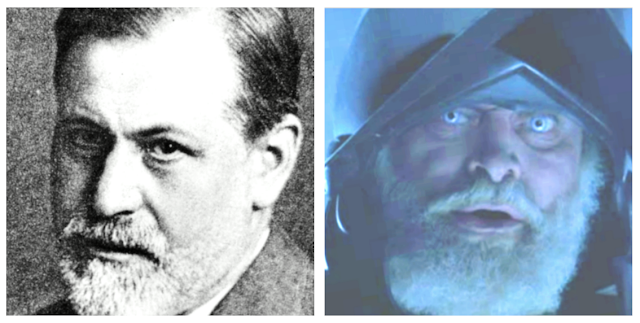
[MORE THAN A PASSING RESEMBLANCE? Was Freud reincarnated as Brian Blessed, who played the Ghost of Hamlet's Father in Branagh's 1996 Hamlet ? YOU DECIDE!] I had planned to blog this week about whether Horatio benefits from gratitude or regret (or whether he is more simply a foil for Hamlet) , and I still plan to blog on that topic soon. But I’m always looking for new books and articles to read about Shakespeare, Hamlet, and religious issues in the Early Modern period, and I came across the article, “Painted Women: Annunciation Motifs in Hamlet” by R. Chris Hassel Jr. It was published in the journal, Comparative Drama (Volume 32, Number 1, Spring 1998, pp. 47-84). I'll summarize some favorite ideas and use his essay as a spring-board for some of my own. I have been wrestling with Hassel’s insights, and there are many. As I’ve noted before in light of work by Katherine Goodland and Ruben Espinosa, when Polonius gives a prayer book to Ophelia, he wants her to appear li...