Posts

Showing posts with the label Churlish Priest

How is Shakespeare's Hamlet a Reformation play?

Image
HOW IS SHAKESPEARE’S HAMLET A REFORMATION PLAY, pointing to efforts by Catholics and Protestants to reform Christian institutions and hearts? 1. First on stage is Francisco. Francis of Assisi was a famous church reformer [1] (demonstrating that "reformation" - reforming the church - was a popular  topic centuries before Martin Luther). 2. Second is Bernardo. Bernard of Clairvaux was a famous Cistercian monastic reformer [2]. 3. Hamlet goes to university at Wittenberg, where Martin Luther nailed his theses to the door [3]. 4. The ghost tells Hamlet that he is being purged of sins (purgatory, believed in by many Catholics, doubted by many Protestants) [4]. 5. Hamlet tells the players not to overact. The actors say they have "reformed" that; Hamlet replies, "reform it altogether" [5], reformation wordplay. 6. Hamlet mentions a "convocation of politic worms," ‘your only emperor for diet” [6]: A council, the “Diet of Worms,” questioned Luther’s orthod...

Part 6: Ophelia's Long Purples

Image
In Act 4, scene 7, Gertrude mentions a particular purple flower that Ophelia includes in the garlands she hangs on the willow: “...long purples, That liberal shepherds give a grosser name, But our cold maids do dead men's fingers call them.” (4.7.193-196) [1] The Queen wishes to avoid saying the “grosser name” that “liberal shepherds” have for a purple flower that looks like “dead men’s fingers”: What might the grosser name be? Not too hard to guess: phallus flowers, purple penises. These “long purples” are not the only flower Ophelia includes in her “fantastic garlands,” but they are the only flowers Gertrude uses 19 words to describe instead of one. In a 1970 essay, J.G. McManaway [2] wrote of how Ophelia in her madness resembles Jephthah’s daughter “bewailing” her virginity, or in other words, mourning the fact that she would soon die childless, never having known the joys of being a spouse and mother. But Ophelia’s garlands with “long purples” are more festive than Jephthah’s d...

Part 4: Ophelia wronged by monarch, inquest, and priest

Image
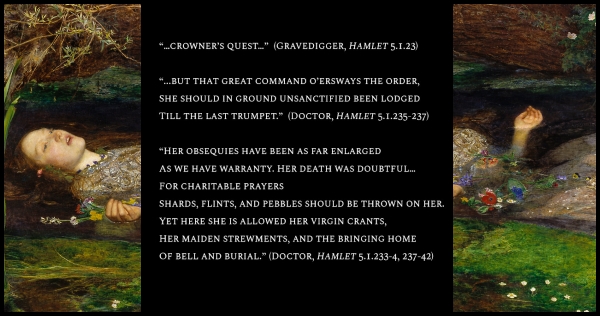
As the tale of Ophelia’s drowning is distorted in Hamlet , the funeral procession reaches the graveyard where the “churlish priest” claims that either Gertrude or Claudius had pressured the coroner’s inquest not to rule suicide. The priest is offended at the thought of burying a possible suicide on holy ground, and does only minimal rites required. This implies a dysfunctional Denmark, king, inquest, and priest, and implies a similarly dysfunctional England. 1. “GREAT COMMAND O’ERSWAYS THE ORDER” [1]: The priest claims either Gertrude or Claudius overruled the coroner’s inquest. Ideally, an impartial inquest should seek the truth. If it's a mystery (not enough evidence) it be better to reserve judgment, than to harshly judge a soul on whom God might be quite inclined to show mercy. For some reason the coroner's inquest was inclined to rule it a suicide (why?). Gertrude or Claudius made them change that, perhaps in compassion for Ophelia, or fearful of angering Laertes, or bot...

Part 2: Ophelia’s drowning shrouded in lies, like other deaths in Hamlet

Image
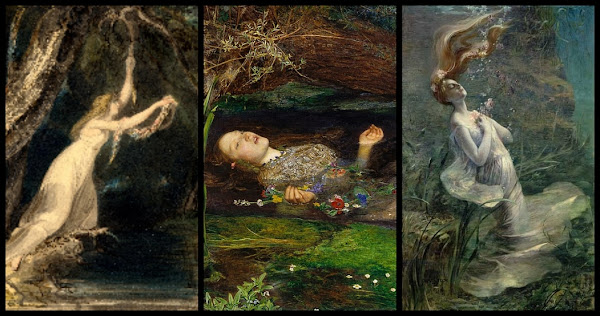
Deaths in Hamlet are shrouded in lies, including Ophelia’s. The play offers a king murdered by his brother, but the murderer’s lie claims it was by snake bite [1], and an Ophelia who died from the accident of a broken branch [2], but the “churlish priest” insists that she died by suicide.[3] The ghost says, "… the whole ear of Denmark Is by a forged process of my death Rankly abus’d Upon my secure hour thy uncle … … … in the porches of my ears did pour The leperous distilment Thus was I, sleeping, by a brother’s hand Of life, of crown, of queen at once dispatch’d (1.5.36–8, 61–4, 74–5) So the king was killed by Claudius with intent, but the truth was obscured by his murderer’s lies of accidental death. Ophelia drowned by accident, but the truth was obscured by claims that she died by intent, suicide. A reversed echo? One could say (paraphrasing), "… the whole ear of Denmark Is by a forged process of (Ophelia'sdeath Rankly abus’d..." I tend to believe Gertrude’s stor...

Part 1: The Controversy over Ophelia's Death in Hamlet

Image
If you ask an average Shakespeare reader or viewer to tell you how Ophelia dies in Hamlet, many might say “suicide,” or “she drowns herself.” But the play presents a controversy of at least seven interpretations of her death, ranging from accident to suicide. [1] These are represented by 1. Gertrude; 2. the king (implied); 3. the Coroner’s Inquest; 4. the Gravedigger-clowns; 5. Hamlet; 6. the “churlish priest”; and 7. Laertes. Some of these agree more with the others, some not. Educators often say it’s good to “teach the controversy,” so instructors might have students seek, document, and reflect on the position of each party, as well as other possibilities (with or without evidence). 1. GERTRUDE offers the earliest account of Ophelia’s death, saying Ophelia fell in the brook while decorating a willow with flowers, when an “envious sliver” of a bough broke [2]. Her garments helped her float for a while [3], but they became “heavy with their drink” and “Pulled” her “To muddy...

Historical Criticism & Michael MacDonald's essay, "Ophelia's Maimèd Rites"

Image
This past week, one generous reader on a FaceBook Shakespeare-related forum recommended a helpful essay by Michael MacDonald called "Ophelia's Maimèd Rites," published in Shakespeare Quarterly Vol. 37, No. 3 (Autumn, 1986), pp. 309-317 (9 pages). The recommendation was in response to my blog post from last week, "Coroner's Suicide Inquest as 'Crowner's Quest' in Hamlet" which quoted David Bevington's claim that coroner's inquests were pressured by the crown to rule questionable deaths as suicides, in which case the crown often took possession of the deceased's property, since suicide was considered sinful by the church and a crime by the state. It may also have tempted the crown to the sin or vice of greed. [ Painting by Benjamin West, 1789, Boydell Shakespeare Gallery ] MacDonald doesn't explicitly claim any support for a position like Bevington's regarding pressure on coroner's inquests; in fact, he takes a more ne...