Posts

Showing posts with the label Yorick

Hamlet's Transcendent paths of Francis, Bernard, & Yorick, vs. Freud's Oedipal path

Image
Shakespeare's Hamlet offers glimpses of two ways of transcending dysfunctional parentage: a) The limited path of Freud's Oedipal complex, or b) Yorick and the paths of Francis of Assisi and Bernard of Clairvaux. In the first, the son kills the father-figure to reclaim a lost closeness to the mother. If the father is a tyrant and the son resorts to violence to replace him, this is a very limited, temporary transcendence, with the son too much like the father he replaces [1]. Francisco and Bernardo are the names of sentinels, the first two characters on stage in the play. Together, they are the names of the Pazzi assassins [2], but individually they are names of saints: - Francis of Assisi and Bernard of Clairvaux didn't kill their fathers, but Francis famously renounced his abusive father before the bishop, stripping off his clothes and giving them back to his father, saying that he had a father in heaven. - St. Bernard’s biological father and brothers eventually joined t...

Yorick & I bid you Happy Halloween, All Souls, All Saints

Image
With, hoo! such bugs and goblins in my life... - Hamlet 5.2.25 [1] This is my favorite Halloween-themed line in Hamlet, from the last scene, at the start of which Hamlet describes to Horatio how he discovered the letter with orders from Claudius for England to execute Hamlet (by beheading) upon their ship's arrival there. Frightening stuff! In many places around the world, some people will observe Halloween, the evening of 31 October, "All Hallows Eve," with its roots in Christian tradition of celebrating All Souls this day, and anticipating the Feast of All Saints tomorrow, November 1. It is harvest time, and so we also consider death as a harvest of souls. It is a good time of year for such stuff, with cold weather, and with leaves changing color in the Northern Hemisphere approaching winter. Hamlet famously converses with an apparition that claims to be the ghost of his father, after the apparition had been previously seen a number of times by sentinels, finall...

Yorick, the Gravedigger, Emmaus, and St. George (Emmaus Postlude, Part 8)

Image
The name Yorick [1] may come from the same root as St. George [2], patron saint of England since 1348 : from the Greek “Georgios”: from ge (γῆ)  - 'earth, soil' - and ergon (ἔργον), 'work' [3]. Yorick, as “earth worker.”   The gravedigger in Shakespeare’s Hamlet is called “Goodman Delver” by his friend (5.1.14). - So the gravedigger and Yorick echo one another in more ways than foolery… This relates also to my series on the Emmaus echo in 5.1, the graveyard scene: the story of Jesus’ appearance to the disciples on the road to Emmaus [4] was a gospel read in church on the first Monday after Easter every year of Shakespeare’s life [5]. In that gospel, two disciples on the road are mourning the death of Jesus. They meet a stranger (somehow a real or figurative Jesus, unrecognized [6]) who shows them compassion, listens, scolds them for their flawed thinking, and gives them hope, explaining the scriptures to them. These are all things Jesus had done for them. The disciple...

Shepherds in Shakespeare, Oedipus, Hamlet, and the Bible

Image
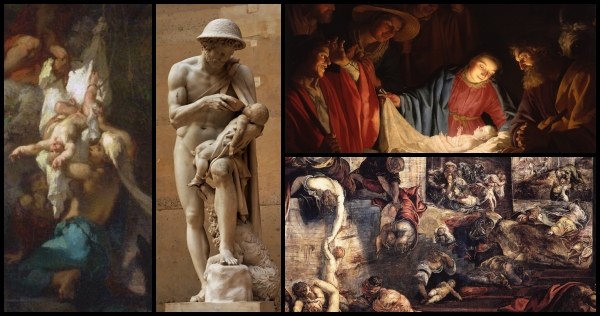
Shakespeare’s Hamlet is often analyzed in terms of Freud’s theories that draw upon the Greek tale of Oedipus. When Hamlet blindly stabs Polonius behind the arras, this may resemble Oedipus unknowingly killing his own estranged and bullying father on the road. Hamlet refers to Herod, possibly Herod the Great or his son, Herod Antipas. A few days after Christmas, Christian churches commemorate Herod the Great’s slaughter of innocent boys. The tale claims that Herod heard of the birth of a new king of Israel, so he tried to avoid being replaced by killing all young male infants (collage, bottom right) [1]. Shepherds in the gospel tale choose a different path: They hear from angels of the birth and go to adore the infant Jesus (collage, top right) [2]. The shepherds could be said to mediate between angels and Jesus, who will come to be called a “good shepherd.” . In the Oedipus tale, Laius, father of Oedipus, fears a prophecy that his son will one day kill him; he tells his wife Jocasta...

Part 13: Ophelia, Hamlet, and 13 ways of looking at madness

Image
Often we speak of Ophelia as having really gone mad, while Hamlet only pretends . But in fact the play uses the word “mad” in many ways, as do critics. So, with a nod to Wallace Stevens’ poem title [1], a list: MADNESS AS DEMONIC POSSESSION: Horatio worries that the ghost is demonic and “might deprive [Hamlet] sovereignty of reason / And draw [him] into madness” (1.4.77-82). MADNESS AS FEIGNED: After meeting with the ghost (1.5), Hamlet says he will “put on” “an antic disposition” (1.5.189-192), as did Odysseus, King David, and Amleth in the Saxo Grammaticus source; but Hamlet’s encounter with the ghost may actually be driving him insane… [Edit 9/24/2023: In 3.1.7-10, Guildenstern also comments on Hamlet's feigned madness: "Nor do we find him forward to be sounded, But with a crafty madness keeps aloof When we would bring him on to some confession Of his true state." ] MADNESS AS WHAT LOST LOVE CAN DO: Polonius believes Hamlet has been made insane by the los...

Part 9: Ophelia, "mad rogue" court fool

Image
When Hamlet acts mad like a court fool during The Mousetrap , he talks so much that Ophelia says he is “as good as a chorus” [1]. After he kills Polonius and is sent to England, Ophelia starts acting mad in Hamlet’s absence. Ophelia becomes like a mad fool-queen regent in the fool-king’s absence, the most verbose person among the court; she commands its attention like a court fool. Long (1971), Holleran (1989) and Olivas (2015) have recognized Ophelia in the role of the fool. Holleran cites Long who “suggests that in her madness Ophelia plays the traditional role of the 'fool' (a role she shares with Hamlet), whose songs serve as mirrors to reflect the personality of the listener” [2]. Olivas notes that Ophelia’s madness seems to free her up to be more outspoken, and through songs and symbolic gifts of flowers with traditional meanings, she speaks uncomfortable truths about the court. Court fools were not obligated to flatter members of the court, but rather, obligated by tradi...

"The rest is silence": Musical Notation, Nihilism, and Ambiguity

Image
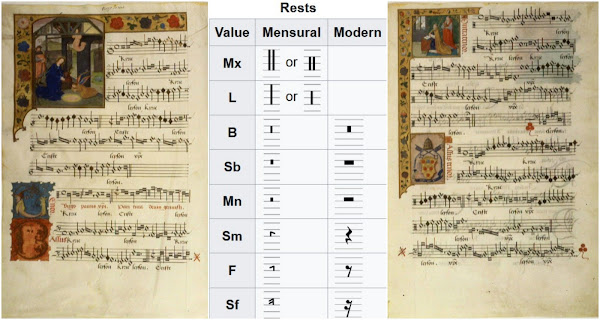
"The rest is silence." When Shakespeare scholars write about Hamlet's last words, more often than not, their focus is that Hamlet is being serious, even nihilistic. Too few critics and scholars consider that Hamlet is making a musical pun for Horatio (and for theater audiences) with his last breath: The rest (in musical notation) is silence. Hamlet is, after all, not only the son of King Hamlet and Queen Gertrude, but also the spiritual offspring of Yorick the fool. His first words in the play involve a sarcastic pun: His uncle Claudius calls Hamlet his son, and Hamlet says he is “too much in the sun.” (1.2.69) [1] He makes fun of Polonius, who deserves it: POLONIUS: What do you read, my lord? HAMLET: Words, words, words. POLONIUS What is the matter, my lord? HAMLET Between who? POLONIUS I mean the matter that you read, my lord. HAMLET Slanders, sir; for the satirical rogue says here that old men have gray beards, that their faces are wrinkled,...

Alcoholic Claudius? Jeffrey Wilson: Culture of Drunkenness in Shakespeare’s Hamlet

Image
In Shakespeare’s Hamlet, is Claudius an alcoholic? Jeffrey Wilson explores this possibility in his (open-access) essay, “Sigma Alpha Elsinore” [1] using the analogy of university fraternities and drinking culture, among other things. [Left: Alan Bates as Claudius (1990), dir. Franco Zeffirelli. Fair use. Cropped, via screen grab from YouTube . Center: Derek Jacobi as Claudius (1996), dir. Kenneth Branagh. Fair use. Cropped, via Shakespeare Wiki . Right: Patrick Stewart as Claudius (2009), dir. Gregory Doran. Fair use. Cropped, via BBC. ] Wilson is a lecturer at Harvard who has written and published frequently on Shakespeare-related topics. I follow him on Twitter <@DrJeffreyWilson> in part because he often advocates online open access, as well as the idea that scholars should share their ideas more freely to stimulate good thinking and collaboration, rather than hoarding their ideas in fear they might be stolen before publication. (As a blogger, I agree.) His essay remin...