Posts

Showing posts with the label The Owl was a Baker's Daughter

Keeping Mice Out with St. Gertrude

Image
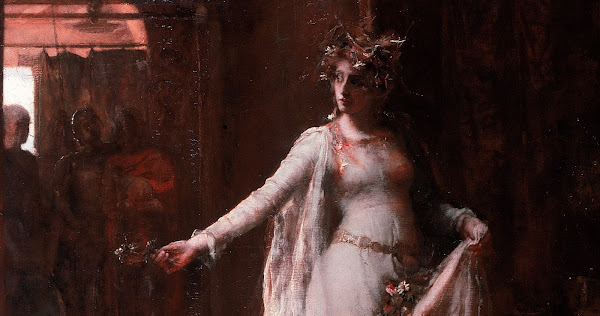
Shakespeare’s Hamlet famously contains a play-within-the-play, “The Mousetrap,” which (for some) calls to mind St. Augustine who said the cross of Christ was a mousetrap for the devil.[1] Ophelia refers to a folktale of a baker’s daughter changed into an owl, punishment for being ungenerous with a beggar (Jesus in disguise). Owls, as I have noted before [2], are living mousetraps. Shakespeare named Hamlet’s mother perhaps after St. Gertrude of Nivelles (c.628-659), famous for dealing with an infestation of mice in the convent’s larder [3]. I think of Gertrude at this time of year: Each autumn, we have had troubles with mice. We plugged holes, changed our cheap dryer vent years ago to an expensive one ($29-$39 - !) - which we assumed would keep mice out. We put heavy galvanized screen over a fireplace air intake, and checked the attached garage for openings where mice might get from the garage into the house. No luck. This fall, our expensive dryer vent cover had long since turned yel...

Ophelia, Baker's Daughters, and Prostitutes (Ophelia postlude)

Image
In 2020, Connor Hanratty [1] posted about “the owl was a baker’s daughter” [2], touching only briefly on the folktale allusion (not mentioning its strong resemblance to the gospel tale of Lazarus and the rich man [3]). Hanratty mentions an 1851 source about an ancient connection between baker's daughters and prostitutes. Presumably, prostitutes waited for customers at bakeries, and "On certain festivals, the master bakers sold nothing but sacrificial breads, and at the same time they had slave girls or servant maids who prostituted themselves day and night in the bakery.” [4] This, like many Freudian readings, may seem a sexually reductionist explanation. But note: Both the baker's daughter in the tale, and the prostitute, are concerned with monetary profit, when what they offer might also be considered a gift: In a healthy relationship, sexual pleasure might best be a mutual gift, not a for-profit exchange. In a healthy community, beggars get fed (as do potential prostitu...

Part 57: My favorite things about Ophelia

Image
My favorite things about Ophelia? 1. By obeying her father too much, she demonstrates the failure of over-valued Elizabethan parental [and political] authority, but also displays heroic patience and self-control. 2. She calls out the potential hypocrisy of her brother. 3. She understands (although her father and brother do not) that “almost all the holy vows of heaven” from Hamlet are most probably a marriage betrothal, and that she could be Denmark’s next queen. 4. She reveals her love for Hamlet even while giving back his love poems, obeying her father. 5. She talks back to Hamlet in the nunnery scene and at “The Mousetrap” play, bold to act this way with the prince. 6. She uses coded meanings of flowers to criticize her king and queen. 7. She sings a bawdy song, perhaps mourning her unspent virginity like Jephthah’s daughter, or mourning the loss of Hamlet as lover, expressing disappointment at being denied access to Hamlet by her father, and then by Hamlet as well.    8. S...

Part 55: Ophelia's Overlapping Biblical allusions and plot echoes

Image
Many biblical allusions (or biblical plot and theme echoes) associated with Ophelia overlap in her character. All of these were well-known in Elizabethan times. (Not an exhaustive list): 1. Hebrews 12: 6-11 (suffering as a sign of God’s love for the “chosen” who will be “saved).[1] 2. JACOB, ESAU, AND RACHEL (lower right): the “double blessing” for Laertes, and the frustration of Hamlet and Ophelia’s hopes for a match, point to the bible tale of how Jacob wins the birthright by deceit, Esau gets the second blessing, and Jacob’s hopes to marry Rachel are at first frustrated.[2] 3. SALOME (top left): Claudius wants Ophelia and her brother Laertes to dance to his tune and serve his purposes: He uses Ophelia a bait to spy on Hamlet, and Laertes as co-conspirator to to kill Hamlet, who protests the incestuous marriage. Salome danced pleasingly for her stepfather, Herod Antipas, who offered almost any reward. His wife, Salome’s mother (divorced wife of his brother) told her to ask for the he...

Part 50: Ophelia Pregnant with Mystery

Image
As I said at the end of Part 48 [1], I do like that a pregnancy for Ophelia is suggested but not conclusive in Hamlet, and that such mysteries and ambiguities may be something like a presence of God: "Who's there?" - the play’s opening question, would have been appropriate for the rich man who neglects the beggar Lazarus to whom the Ghost refers [2], as well as for the baker’s daughter referred to by Ophelia [3]. In both cases, those who neglect the beggar at the door neglect the presence of God. How do we face the presence of mystery in the beggar, the stranger? In Ophelia? Did Ophelia miscarry, and in postpartum depression, commit suicide, which Gertrude generously conceals in a story about an “envious sliver” and a death in faith [4]? Would the Ophelia we come to know in the play have killed herself and an unborn child? Can we know for certain, or is such a quest for certitude like a form of self-idolatry? How might we consider the mystery of Ophelia in the context of ...

Austin Tichnor on "Shakespeare’s sources transformed"

Image
Austin Tichenor offers a good, brief article on Shakespeare's repurposing of sources , available at the Folger Shakespeare Library website. He writes: "Charlotte Artese, author of Shakespeare and the Folktale, explained on the Folger’s Shakespeare Unlimitedpodcast that Shakespeare frequently refers to things that have little meaning to us now but would have been familiar to his audience then. Among her many examples, Artese cites Ophelia’s odd-seeming non-sequitur “They say the owl is a baker’s daughter” from her mad scene in Hamlet as referring to a folktale in which Jesus turns a baker’s daughter into an owl for giving him a meager portion of bread..." And as I've argued before, the tale of the baker's daughter changed to an owl might best be considered as a repurposing/transformation of the gospel tale about the rich man and the beggar Lazarus - which is referred to by the ghost regarding his "lazar-like" skin after poisoning - and also referred to...

Part 43: Ophelia's Owl and Hamlet's Mousetrap (cont.)

Image
Last week [1] I shared my belated realization that, after seeing Hamlet’s playlet that he calls “The Mousetrap” [2], Ophelia refers to a folktale in which a baker’s daughter is turned into an owl [3], and that an owl is a “living mousetrap.” For now, I’d like to call mousetraps masculine and externalizing, and owls, female and internalizing. In Shakespeare’s Elizabethan slang, a man had a “thing” between his legs, an external organ; a woman had a “nothing,” an “O,” which could potentially receive a man’s “thing” and which led to her womb, another “O” of potential.[4] Hamlet’s mousetrap analogy for a play to catch the king’s conscience [5] is an external thing, as the script and players (like moving parts of a mousetrap) are external to his body. One sets a mousetrap and waits.[6] In contrast, the owl, a living mousetrap, consumes mice, takes them inside itself, later regurgitating bones and hair. Mousetraps are externalizing and male, like rapiers that Hamlet and Laertes use ...

Part 42: A Living Mousetrap: Ophelia's Owl

Image
OPHELIA: “They say the owl was a baker’s daughter.” What are owls famous for eating — even a dozen in a single night? Mice. What does Hamlet call the play by which he hopes to catch the conscience of the king? “The Mousetrap” [1]. Ophelia sat with Hamlet at his playlet, heard him call it “The Mousetrap.” She soon references a folktale in which a baker’s daughter is ungenerous with a beggar at the door (Jesus or a fairy in disguise), and as punishment, is changed into an owl [2]. Into a living mousetrap. (And the owl asks, “Who? Who?” First words of the play: “Who’s there?”) The name “Gertrude” may point to a Christian saint famous for getting rid of mice [3]. I have argued that, by drinking the poison cup, Gertrude builds a better mousetrap, catching the conscience of Claudius [4]. So there is a trilogy of mouse-trapping characters in the play: Hamlet, Ophelia, and Gertrude. But Ophelia’s owl reference is usually not viewed by scholars, critics, teachers and students as a reference t...

Part 25: Ophelia's Self-Catching Conscience in the Mirror of her Arts

Image
Unlike Claudius, who ignored qualms of conscience to murder his brother and usurp the throne, Ophelia’s relationship to her conscience is more healthy, rich, and self-directed.   Claudius just doesn’t get it, so he needs Hamlet to catch his conscience in The Mousetrap, [1] which reenacts Claudius poisoning his brother and wooing his victim’s wife. Hamlet says playing holds a mirror up to the age [2], and he uses the playlet to hold a mirror up to Gertrude and Claudius, showing what they’ve done. But Ophelia gets it, and doesn’t need someone to hold up a mirror for her conscience. She chooses her own songs, stories, and allusions to reflect upon her sadness and conscience. [3] She knows her father died, but doesn’t know that Hamlet killed him thinking it was Claudius. She sings songs of mourning for perhaps her father and/or the dead king [4], songs of her own choosing. Ophelia knows Hamlet made to her “almost all the holy vows of heaven” [5] perhaps the equivalent of a handfast w...

Part 17: Ophelia's "Owl" and "False Steward" Allusions: Why in that order?

Image
In her alleged madness, Ophelia says things that seem merely mad ramblings. But to original audiences, these may have been allusions to well-known tales, and there may be a reason for their ordering. First: OPHELIA: They say the owl was a baker’s daughter. Lord, we know what we are but know not what we may be. God be at your table. (4.5.47-49) [1] Second: OPHELIA:  You must sing “A-down a-down”—and you “Call him a-down-a.”—O, how the wheel becomes it! It is the false steward that stole his master’s Daughter. (4.5.194-197) Consider: “THE OWL WAS A BAKER’S DAUGHTER” is a reference to a tale in which a baker’s daughter is turned into an owl after being repeatedly ungenerous with a beggar at the door - who was Jesus in disguise. This is a folktale retelling of the gospel tale of the Rich Man (Dives) and the beggar Lazarus.[2] Ophelia summarizes: “Lord, we know what we are but / know not what we may be.” Ophelia may feel punished, like the baker’s daughter, and as people in Denmark’s ...