Posts

Showing posts with the label Idolatry

“Words, words, words”: Hamlet, the Second Commandment & Idolatries of Reformation Literalism (series)

Image
“Words, words, words”: Hamlet, the Second Commandment & Idolatries of Reformation Literalism In Shakespeare’s lifetime, Protestants accused Catholics of idolatry, taking too literally their Eucharist (“this is my body”). Protestants claimed that more figurative meanings had been intended. To them, Catholics - like the ghost in Hamlet - went through the motions mechanically, without sincerity. To Protestants, this was artificial and idolatrous [1]. Shakespeare scholar Jennifer Rust (2003) [2] has noted that the mechanical reproduction of translated Bibles created new, similar problems of idolatry for Protestants, citing Greenblatt (1980) [3] regarding what he calls a fetishism of the printed word (94). Instead of a Latin Bible interpreted by the authority of bishops alone, greater access resulted in an exponentially higher number of contentious disagreements and potential idolatries [4]. Many factions claimed that they possessed true interpretations, and that others did not. B...

WHAT DO HAMLET'S DIVINE-FATHER ANALOGIES REVEAL? - Series

Image
Whether or not Hamlet violates the First or Second Commandment (or none at all) in comparing his father to classical gods, through these comparisons, what might Hamlet's analogies reveal? 1. By comparing his father to four classical gods, this implies that Prince Hamlet is like a son of a god [1]. 2. By starting with Hyperion – among the Titans whose divine reign was overthrown – this echoes his father having been killed by Claudius [2]. 3. The overturning of the old divine order – the rule of Hyperion and the Titans – also echoes the Reformation, which sought to break bonds with Rome and the old Christian order, and to embody a new, reformed order. In this way, English Renaissance fascination with Titans and gods may have been an analogical way to write about what was sometimes forbidden, restricted, discouraged [3]. 4. Comparing his father to Mars, god of war, makes sense, given the dead king’s reputation as a warrior; this also contrasts with Claudius, the cowardly...

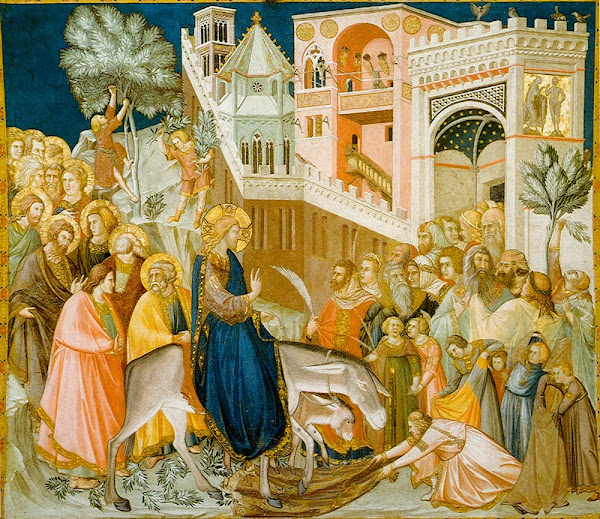
Hamlet's Palm Sunday Allusion & Cognitive Dissonance: "preaching to stones, Would make them capable."

Image
[This post was originally written in 2022, but substantially expanded and edited in 2026.] In Hamlet 3.4, the prince sees the ghost of his father, and tells his mother, HAMLET: On him, on him! Look you how pale he glares. His form and cause conjoined, preaching to stones , Would make them capable. (3.4.142-4) This recalls the Palm Sunday reading (Geneva trans.), Luke 19:39-41:  39 Then some of the Pharisees of the company said unto him, Master, rebuke thy disciples. 40 But he answered, and said unto them, I tell you, that if these should hold their peace, the stones would cry. Stone capable of speech? In fact, at the end of Shakespeare's  The Winter's Tale , what seems to be a statue of Hermoine comes to life and is able to speak, which Richard Strier compares to the Pygmalion myth [1]. Strier connects this also to a stone wall in Habakkuk 2:11, which speaks to rebuke the sins of the wicked.  One might also connect it to the writing on the wall in Daniel 5...

Shakespeare as Religion & as a Weapon

Image
This week I pull together various sources that may seem unrelated. A Facebook forum member * posted a link to a good essay in the Hudson Review that (somewhat tangential to its main topic, but not entirely) contained a number of references to Shakespeare as a kind of religion . This prompted me to think a bit more about my own work on Biblical allusions in Hamlet in the larger context of literary studies, specialists in the field, nationalism, and all of that within the context of religious reforms and reformation. On the topic of Shakespeare as religion, the essay quoted Arthur Murphy, Voltaire, and David Garrick: Here’s Brooke Allen, in Hudson Review , “The Shakespeareans,” referencing English playwright Arthur Murphy: “There had been a gradual elevation of Shakespeare from just one among several popular Elizabethan and Jacobean playwrights to the one and only national treasure: ‘a kind of established religion in poetry,’ as the playwright Arthur Murphy was already describin...