Posts

Showing posts with the label Elizabeth Jonas

SOME HISTORICAL BACKGROUND OF THE JONAH ECHO in HAMLET

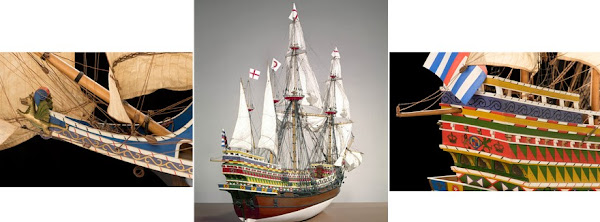
SOME HISTORICAL BACKGROUND OF THE JONAH ECHO in HAMLET The Jonah echo is perhaps better understood with consideration for the following (not an exhaustive list):  a) The success of A Looking Glass for London and England (c. 1590); see Hannibal Hamlin, Staging prophecy: A Looking Glass for London and the Book of Jonah,"Part III, chapter 10 in Enacting the Bible in Medieval and Early Modern Drama, Eds. Eva Von Contzen and Chanita Goodblatt, Manchester University Press, 2020. b) Elizabeth’s having dedicated one of her naval ships “Elizabeth Jonas” (1559) with a speech that exhibited poor biblical exegesis than propaganda;  "The 3 day of July, 1559, the Queen's Grace took her barge at Greenwich unto Woolwich to her new ship, and there it was named Elizabeth Jonas, and after her Grace had a goodly banquet, and there was great shooting of guns, and casting of fire about made for pleasure ' (Diary of Henry Machin, Camden Society, p. 203). The ship ' was so named by her ...
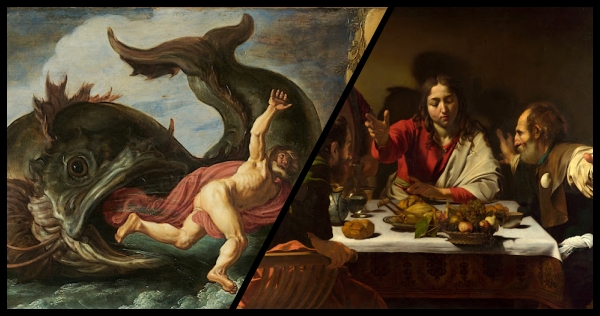
Hamlet's Emmaus in Jonah's Belly: Allusions inside of allusions

Image
HOW IS IT POSSIBLE that one allusion or plot echo might be encompassed inside of another? A playwright can begin one thread of a story with an allusion, have the action cut away to a sub-plot with a different allusion, and pick up later on the original story thread. This happens in Hamlet, with plot echoes of Jonah and Emmaus. JONAH [1]: Hamlet’s sea-voyage contains important similarities to the sea-voyage of Jonah.[2] Bits of this allusion or the plot echo begin early in the play, with Hamlet exclaiming to the ghost, “O my prophetic soul!” [3] Later there are repeated references to his upcoming sea-voyage to England. [4] On his sea-voyage, we don’t hear of his having been in the belly of the pirate ship until Horatio reads a letter in which Hamlet mentions pirates [5]. To Claudius, Hamlet writes how he was “set naked on your kingdom.” [6] EMMAUS: Before we hear details that complete the Jonah echo in 5.2, Hamlet and Horatio are two Danes on the road to Elisinore, stopping in a graveya...

The Elizabeth Jonas, and Hamlet's sea-voyage: Other Considerations

Image
In my previous post , I connected the Jonah echo in Hamlet’s sea voyage to Elizabeth I having christened a navy ship “Elizabeth Jonas,” saying how God had saved her from her enemies - although the only enemy of Jonah is Jonah himself, fleeing his divine calling. The records have more echoes of Hamlet : "The 3 day of July, 1559, the Queen's Grace took her barge at Greenwich unto Woolwich to her new ship, and there it was named Elizabeth Jonas, and after her Grace had a goodly banquet, and there was great shooting of guns, and casting of fire about made for pleasure ' (Diary of Henry Machin, Camden Society, p. 203). The ship ' was so named by her Grace in remembrance of her own deliverance from the fury of her enemies, from which in one respect she was no less miraculously preserved than was the prophet Jonas from the belly of the whale' (Egerton MS. 2642, f. 150). This refers, of course, to the Jonas." [1] In Hamlet, there are also references to banqueting...

Hamlet’s Unnamed Ghost of Jonah, and Elizabethan Executions

Image
In Hamlet, Shakespeare adapts the Saxo Grammaticus source tale by shortening the hero’s sea-voyage to England, having Hamlet change mode of transportation mid-sea to a pirate ship, like Jonah changing from a ship to the belly of a fish. I have written about this before , and about the Christian typology that viewed Jonah as prefiguring Jesus in the tomb . [Image: Pieter Lastman (1583–1633), "Jonah and the Whale," 1621. Museum Kunstpalast. Public domain. Via Wikipedia .] Yet in Hamlet , Jonah goes unnamed. Shakespeare is more explicit about other allusions in the play, as to Jephthah and other biblical figures. Yet he is strangely silent/implicit on others such as Jonah. Why leave Jonah unnamed? Is this merely an aesthetic/dramatic choice, or more? (More on that later.) Shakespeare also combines these Jonah elements of the sea-voyage with other elements, such as Hamlet’s discovery of Claudius’ letter ordering England to execute him, and his changing of the lette...