Posts

Showing posts with the label impatience

Hamlet delays to help Shakespeare write his play

Image
The main reason for Hamlet's delay: So that Shakespeare could write his play. Joking, of course. But absolutely serious. We can say we're impatient because we love quick and bloody revenge plots. ACTION FIGURE HAMLET! But if that's what we want, we're at the wrong play. Instead, we might choose not to be impatient because at least sometimes, we might prefer for princes to be careful to discern the truth about whether ghosts are honest, and whether kings are guilty, and whether princes who contemplate revenge are bound for heaven or “th’ other place”, as Hamlet calls it [4.3.38-9]. We might find that we like Hamlet humbly scolding himself for his own delay, and laugh at all the critics who take his impatient self-scolding too seriously, or too literally - as if Hamlet should act more quickly. Such critics may not notice how necessary it is for the play, to have Hamlet delay while Shakespeare explicates his character and that of others, and develops his plot. THE STORY:...

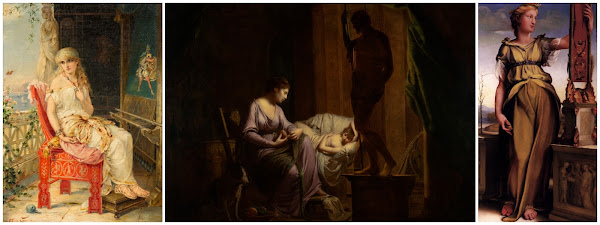
Hamlet's Indecision and Shakespeare's Mousetrap for Impatience

Image
Shakespeare catches the conscience of audiences impatient for action: 1. Speaking to the ghost, Hamlet says he’ll act with wings swift as... lightning? Nope. As “meditation or thoughts of love” [1.5.36]. In other words, NOT SWIFT. He's not planning swiftness but caution. 2. After the players arrive, Hamlet scolds himself for cowardice: "O, what a rogue and peasant slave am I! [...] A dull and muddy-mettled rascal, [...] I am pigeon-livered" [2]. Whether or not we condone revenge, we may admire Hamlet scolding himself for apparent cowardice.  3. Hamlet ends this speech saying he needs to be more certain of the ghost’s honesty and Claudius’ guilt, so he’ll put on a play to catch the conscience of the king [3]. This may inspire a public confession from Claudius. If not, then what should Hamlet do?  4. Next act: To be or not? Should Hamlet patiently tolerate the scandal of his father's murder and his mother's hasty remarriage - "suffer / The slings and arrows o...

Hamlet's Nietzschean madness, via M. Grenke - Hamlet & the Odyssey - Part 5

Image
Perhaps one way to view the corruption in Denmark in Shakespeare's Hamlet, and to view Hamlet's madness as well, is that it has to do with slavery to time and to impatience. As I mentioned in my previous post, Hamlet makes some of his worst mistakes (killing Polonius), not because he delays, but because he is impatient. Claudius kills his brother, not only because he wants the throne, and wants Gertrude for his wife, but because he is impatient. Michael Grenke's Fall 2016 essay, “Penelope: The Odyssey’s Creative Thinker,” includes rich reflections on the character of Penelope from Homer's Odyssey, and about Nietzsche and the madness of impatience, or slavery to time. I would suggest that Hamlet feels a similar pressure and impatience about revenge due to images of masculinity that he has learned from his father and his culture, and which he has internalized. Grenke writes: ~~~ Human beings become slaves to the clock mostly because other human beings put them on...

Hamlet's Delay, Penelope's Weaving, via M. Grenke - Hamlet & the Odyssey - Part 4

Image
Many people ask regarding Shakespeare's Hamlet , "Why does the prince delay for so long to kill Claudius?" In a number of places in the play, Hamlet scolds himself for delaying his killing of Claudius. These include his "To be or not to be" speech (3.1.64-96), and also in his speech, "How all occasions do inform against me" (4.4.34-69). In 2.2 (577-634), he is especially harsh with himself. By the end of the speech, he weaves his way to a solution. He is held back by conscience: He wants wants to be more sure that Claudius is guilty of murder, and that the ghost is being honest. In the fall of 2016, Michael Grenke published an article about the character of Penelope from Homer's Odyssey, and about the significance of her patient weaving and unweaving. [1] Some scholars [2] have suggested that Hamlet is right to delay, and at his worst when he impatiently scolds Ophelia, worried perhaps for her eternal fate, telling her to get to a nunner...