Posts

Showing posts with the label Luke 1:26-38

Religious and Political Meanings of the Annunciation and Susanna Allusions in Hamlet 3.1
Image
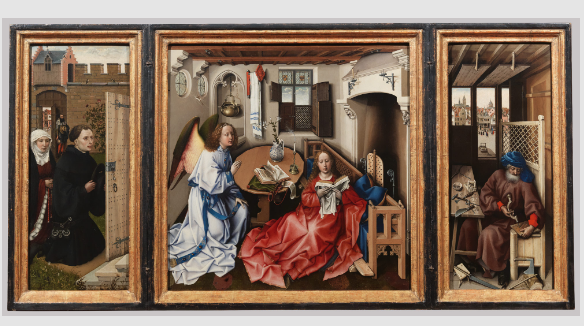
To prepare Ophelia as bait for eavesdropping, Polonius in 3.1 tells her, Read on this book, [...] [....] We are oft to blame in this, [...] that with devotion's visage And pious action we do sugar o'er The Devil himself. (49-55) So just look as if you’re devoted to reading, not bait for spying. But why “devotion's visage / And pious action”? “The Devil”? I’ve posted before about how Katharine Goodland (2006) [1] and Ruben Espinoza (2011) recognized that Polonius made Ophelia resemble a common image from old prayer books: the Virgin Mary is portrayed as reading a book of psalms when the angel Gabriel tells her that she is pregnant with Jesus (Lk 1: 26-38). [Robert Campin, Annunciation Triptych (Merode Altarpiece) in the MET museum (ca. 1427–32). Public domain. Image via Google Arts and Culture .] In Catholic prayer, the "Hail Mary" says, “Holy Mary, mother of God, pray for us sinners....” On seeing Ophelia, Hamlet says (aside), “in thy orisons...

Ophelia's Prayer Book & the Annunciation of Mary

Image
In Hamlet act 3, scene 1, Ophelia's father Polonius asks her to read a book so that she might project "devotion's image" and "pious action" as well as her own loneliness when Prince Hamlet first sees her. In other words, he is using her for bait to trap Hamlet into conversation while Claudius and Polonius eavesdrop. I have written about this scene in a previous blog post regarding the echoes of the story of Suzannah and the Elders , from the book of Daniel. But today I want to note a visual echo of the Annunciation of Mary, when an angel visits to tell her that she is to bear a son, Jesus. [See Bridget Gellert Lyons, "The Iconography of Ophelia," page 61: "The woman with a book was reminiscent of countless representations of the Virgin, who was most commonly shown reading when the Angel of the Annunciation came to visit her." ELH , Spring, 1977, Vol. 44, No. 1, pp. 60-74 https://www.jstor.org/stable/2872526 ] In her remarka...