Posts

Showing posts with the label Ghost

Holy Saturday and Harrowing of Hell in Shakespeare and Christianity

Image
Today is Holy Saturday, traditionally a day Jesus spends in the underworld, the “Harrowing of Hell,” referenced in the Apostles Creed: “He descended into hell,” or “to the dead.” Ancient sources claimed that after his death, Jesus went to the underworld to free the souls of the just, all who died in faith before the life and death of Jesus. The use of the word “harrowing” has old English roots [1]. Shakespeare parodies a medieval Mystery play based on the harrowing of hell in the porter scene of Macbeth [2] [3]. He uses the word “harrow” three times, once in Coriolanus, and twice in Hamlet, first by Horatio (1.1.51), and second, by the ghost (1.5.21). Some might claim that this was quite nice of Christians. Although to them, salvation and eternal life are only through Christ, how generous to say that Jesus descended to the dead to free the souls of the just. How inclusive. But this warrants greater scrutiny. The Christian claim that eternal life can only be obtained through Christ is...
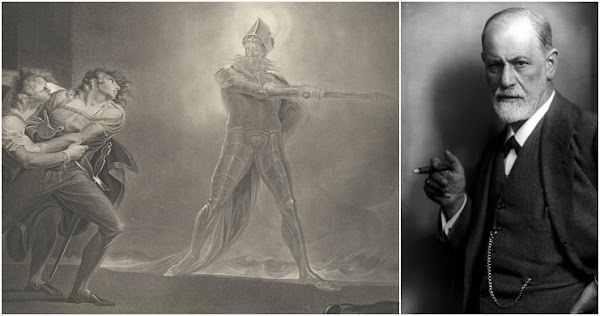
Part 1: Hamlet Before Freud ("Tough Love" for Gertrude and Ophelia)

Image
If we take seriously that Hamlet, Horatio and the sentinels saw a ghost from purgatory, [1] then we have to consider this possibility: Hamlet is harsh with his mother and Ophelia because he thinks he has seen his father’s ghost from purgatory who claims to be there because he had sinned, committed foul crimes. Hamlet doesn’t want the two women he loves most to end up in purgatory like his father, or worse, in hell. He scolds Ophelia and tells her to get to a nunnery; he scolds his mother, tells her to repent of her incestuous marriage, a relationship that began, according to the ghost, with adultery when his father was still alive. Hamlet feels a duty to be harsh with them because he fears for their eternal fate. If one encountered a ghost from purgatory as Hamlet did, and loved his mother and Ophelia, it makes sense that one might want to warn them, to spare them such a fate. [2] To be clear, while many in Shakespeare’s time believed in ghosts [3], there were also those who did not,...

Emmaus Key Change in Hamlet & Merchant of Venice (Emmaus in Hamlet, part 6)

Image
When a song or orchestral piece changes keys, we not only hear it with our ears, but also feel it in our bodies, our bones, vibrating at a new frequency. Shakespeare accomplishes something similar, not only in Hamlet , but also in The Merchant of Venice when he sets up one character as a Christ-figure, then changes key, shifting to a new (improved) Christ figure. [Image: “Supper at Emmaus” (French: Le Repas d'Emmaüs), 17th century, by Matthias Stom (1615–1649). Collection: Museum of Grenoble. Public domain, via Wikimedia .] In Luke 24:13-35, after Jesus dies and rises, he later appears as a stranger on the road to Emmaus. I’ve noted previously how in Hamlet , biblical allusions suggest the ghost is a flawed Christ-figure/victim, with divine attributes.[1] But in the graveyard scene (5.1), instead of the ghost appearing as the stranger[2], our expectation is redirected: Yorick’s skull and the gravedigger-clown fill the role of the stranger in whom divine "infinite jest...

Christopher Devlin's Catholic Bias in Hamlet's Divinity (part 13)

Image
Hamlet’s Divinity and Other Essays (Christopher Devlin, 1963) contains two chapters relating to Hamlet as well as a chapter making a case for Shakespeare’s Catholicism. Devlin was a Jesuit priest, and while I was raised Roman Catholic, I find him to be a bit too certain about plucking the heart of the mystery of Shakespeare’s faith. Yet Devlin demonstrates a great knowledge of history and literature, and in a field where for too long Protestants advanced too many of their own assumptions about Shakespeare’s faith, Catholic voices like Devlin’s opposing the status quo played a helpful role. [Image: Author photo. Hamlet's Divinity and Other Essays by Christopher Devlin (d.1961), with an introduction by C.V. Wedgwood. Published 1963. This book is out of print but still available at libraries and in used copies.] In his title chapter, “ Hamlet ’s Divinity” (30-43), Devlin argues that there are various ways he finds divinity to be present in the play. A major element for him is ...

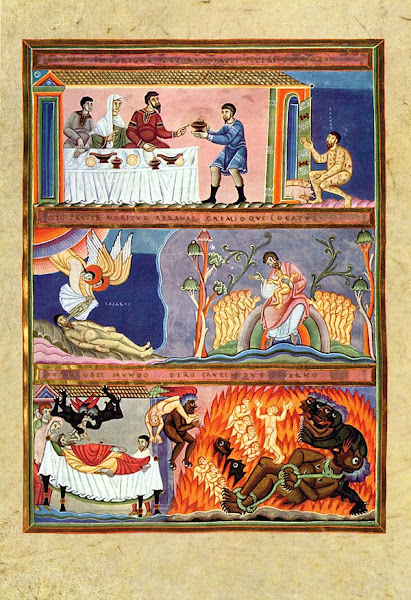
If the Ghost was like the Rich Man, who was his Lazarus? (Part 2)

Image
It is easy to be confused when the ghost in Shakespeare's Hamlet says that the poison his brother Claudius poured in his ear made King Hamlet's skin all "lazar-like." There are many possible sources of confusion: LAZAR-LIKE? LAZAR-HOUSE? LEPROSY? - First, many modern readers and potential audience members of the play don't know what leprosy is, or that a "lazar-house" was a hospital for lepers. This was common knowledge in Shakespeare's time, but is much less familiar to modern readers and playgoers. SORRY TO DISAPPOINT SCHOLARS OF EARLY MODERN SCIENCE We might imagine at this point that there may be a scientist or botanist who is also a Shakespeare fan, and who wonders if there may have been some poison known in Shakespeare's time that had the ability to curdle the blood and change the victim's skin so quickly to be entirely covered in crust. I hate to disappoint those scientists whose inclination might be to start at the literal...

Gertrude, Ghost, & Claudius on a Long List of Jephthah Figures in Hamlet

Image
My readers might paraphrase Polonius and ask: "Still harping on Jephthah?" I am approaching the end of a series of blog posts on Polonius and Jephthah, and for those of you who have tolerated all of my posts in this series, I am most grateful for your interest and patience. I have noted in other posts of this series that consideration of the Jephthah allusion is too often limited mostly to Polonius and his willingness to sacrifice his daughter's interests to his ambitions, or to the idea of hasty and unwise vows. Sometimes this is expanded to include Hamlet's vow to avenge his father, and Laertes'. Sometimes it is expanded to include the Bond of Association . But in general, we do well to consider even more ways that the Jephthah story resonates with Hamlet . IN BRIEF: This week I will focus briefly on four things: 1. Gertrude can be seen as a Jephthah for being too hasty and unwise in making new marriage vows after her husband's death, and perhaps sacrifici...

Hamlet, PTSD, & Entitlement (Part 4: Who am I to interpret Hamlet?)

Image
~~~~~~~~~~~~~~~~~~~~~~~~~~~~~~~~~~~~~~ This is the last in a four-part series of blog posts, “Who am I to interpret Hamlet ?” June 16, 2019:  To be or not? (Part 1: English Studies & Teaching) June 23:  How Literally Did Shakespeare Take the Bible? (Part 2: Religious Studies & Assumptions) July 30:  Reading Hamlet through personal & national traumas (Part 3: Lies & PTSD) August 6:  Hamlet , PTSD & Entitlement (Part 4) ~~~~~~~~~~~~~~~~~~~~~~~~~~~~~~~~~~~ In act 1, scene 5 of Shakespeare’s Hamlet , an apparition claiming to be the ghost of Hamlet’s father explains to Hamlet that his brother poisoned him while he was sleeping in his garden, and the poison made his skin “Most lazar-like.” This is a reference to the Gospel of Luke (Luke 16:19–31), a tale of a rich man who acts selfishly, as if entitled to his riches, as if entitled to repeatedly ignoring the beggar Lazarus at his door, whose skin is covered with sores licked by dogs. Thi...