Posts

Showing posts with the label Prodigal Son

Hamlet, Prodigals, Fatted Calves, and Caesar as Capital Calf

Image
References to Julius Caesar in Shakespeare’s “Hamlet” from Horatio (1.1) and from Polonius (3.2) may remind us that Shakespeare’s play, Julius Caesar (published 1599), only shortly preceded his Hamlet (published 1603-4); the earlier play may still have been in the company’s repertoire. But besides good advertising, why mention Julius in this play? HORATIO: “In the most high and palmy state of Rome, A little ere the mightiest Julius fell, The graves stood tenantless, and the sheeted dead Did squeak and gibber in the Roman streets” (1.1.125-8) Horatio is at first a doubting Thomas, yet he mentions not graves opening after Jesus’ death (Matt 27:51-53), but another J.C.: Julius Caesar, tyrant who crossed the Rubicon with his army, violating the social order. Polonius mentions playing Caesar at university, killed in the capital: “Brutus killed me.” HAMLET: It was a brute part of him to kill so capital a calf there.” (3.2.111-2) This foreshadows that Hamlet will stab Polonius in a later sce...
Halloween Hamlet and SCSC conference in Minneapolis

Image
With, hoo! such bugs and goblins in my life... Hamlet 5.2.25 [1] This is my favorite Halloween-themed line in Hamlet , from the last scene, at the start of which Hamlet describes to Horatio how he discovered the letter with orders from Claudius for England to execute Hamlet (by beheading) upon their ship's arrival there. In the USA, we are approaching Halloween, the evening of 31 October, "All Hallows Eve," before All Saints Day. Children dress in costumes, go door to door and ask, "Trick or treat?" and often receive a treat of some kind. Usually too much manufactured sugary-candy (one of the reasons the USA has so many diabetics...). 2022 SCSC, Minneapolis: This Year, the Sixteenth Century Society and Conference has its convention in Minneapolis, Minnesota, only about an hour's drive from where I live. I will be giving a paper/presentation touching on how Shakespeare had to carefully encode his critique of government and the state religion, and h...

Lazarus & prodigals in Henry IV, Part I, & Hamlet

Image
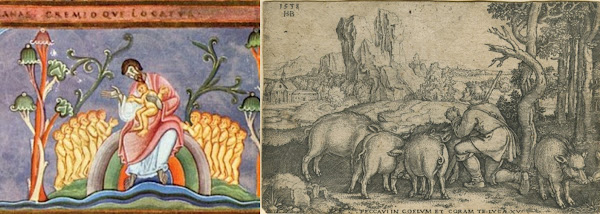
Before I conclude my series on the Lazarus allusion in Hamlet , let’s step back and consider his use of “Lazarus” and related terms in other plays. For today, consider: Shakespeare only uses the full word "Lazarus" once,* on the lips of Falstaff in Henry IV, Part I (1613). [* According to the Advanced Search Engine at OpenSourceShakespeare .] This single instance of "Lazarus" comes in a soliloquy in which Falstaff also happens to mention "prodigal," a reference to another tale from Luke's gospel. [Left: Detail from Lazarus and the Rich Man, Meister des Codex Aureus Epternacensis (1035-1040), via Wikipedia . Public domain. Right: Der verlorene Sohn beim Schweinehüten (The Prodigal Son tending the Swine), 1538, by (Hans) Sebald Beham (1500-1550), via Wikipedia . Public domain.] It so happens that there are allusions in Hamlet to both Lazarus ("lazar-like," 1.5.79, Folger) and the prodigal (Laertes 1.3.40, Polonius 1.3.1...

Shaming Ophelia: Getting the Prodigal Wrong in Hamlet 1.3

Image
In Hamlet 1.3, both Laertes and Polonius use the word “prodigal” to dissuade Ophelia from a romantic relationship with Hamlet: —Laertes warns her about opening her “chaste treasure” to Hamlet and twice tells her, “Fear it”: The chariest maid is prodigal enough, If she unmask her beauty to the moon —Polonius tells her not to believe Hamlet’s vows of love to her, implying that such vows are "prodigal" and not to be believed, and that perhaps Polonius had once made such false vows in his youth, so he assumes that Hamlet was being a kind of prodigal by making such vows: I do know, When the blood burns, how prodigal the soul Lends the tongue vows But both Laertes and Polonius miss the heart of the prodigal son story from in Luke 15:11–32: It’s not about fear, or fearing being prodigal, but rather, about the generous mercy of the father in the parable who welcomes home the son, shadowed a bit by the self-righteous envy of the brother. The prodigal son story perhaps ap...