Posts

Showing posts with the label Eliz I

Hamlet and the Incestuous Marriages of Claudius and Henry VIII - via John Erskine Hankins
Image
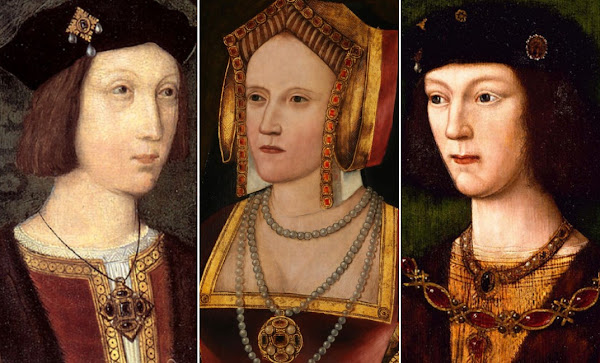
Shakespeare certainly wrote of Claudius and Gertrude’s “incestuous” marriage with Henry VIII in mind. Early audiences recognized it. In teaching the play, is it a mistake to omit that context? [Left: Arthur Tudor, Prince of Wales (1486-1502), "regarded as the only surviving contemporary portrait"; circa 1500. Anglo-Flemish School. Private collection, Hever Castle, Kent. Public domain. Image via Wikimedia . Center: Catherine of Aragon (1485–1536), originally identified as Catherine Parr, but now recognized as Catherine of Aragon. Unidentified painter. 16th Century. Lambeth Palace. Public domain, via Wikimedia . Right: Henry VIII of England (1491-1547), circa 1509. Attributed to Meynnart Wewyck. Denver Art Museum. Public domain. Image via Wikimedia ]. From “The Character of Hamlet,” by John Erskine Hankins* (1941), p.101: ~~~ It will be remembered that Henry VII's eldest son Arthur was married to Katherine of Aragon to cement an alliance between England and Spa...

Why mention a Lunar eclipse in Hamlet 1.1?

Image
Imagine that you have been teaching Hamlet this week, and a student notices not only last night’s lunar eclipse, but also the lunar eclipse mentioned in Hamlet 1.1: …the moist star, Upon whose influence Neptune’s empire stands, Was sick almost to doomsday with eclipse. (1.1.130-132) The "moist star" that rules the tides - "Upon whose influence Neptune's empire stands" - is the moon. [1] [Images, L-C-R: Left: An image of a lunar "blood moon" eclipse. Source: NASA . Cropped. Fair use. Center: Folding almanac, 15th century. Diagrams of solar and lunar eclipses: British Library Harley MS 937, f. 8r . Cropped. Fair use. Right: God creating the Sun and the Moon: British Library Additional MS 18856, f. 5v . Cropped. Fair use.] Perhaps after some digging, your students also find that Shakespeare scholars like Naseeb Shaheem identified a possible connection (for comparison or contrast) to events including a solar eclipse (real, or fictional) at noon...

The Elizabeth Jonas, and Hamlet's sea-voyage: Other Considerations

Image
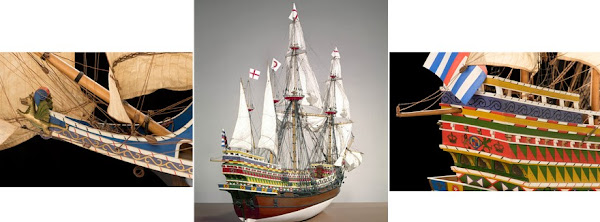
In my previous post , I connected the Jonah echo in Hamlet’s sea voyage to Elizabeth I having christened a navy ship “Elizabeth Jonas,” saying how God had saved her from her enemies - although the only enemy of Jonah is Jonah himself, fleeing his divine calling. The records have more echoes of Hamlet : "The 3 day of July, 1559, the Queen's Grace took her barge at Greenwich unto Woolwich to her new ship, and there it was named Elizabeth Jonas, and after her Grace had a goodly banquet, and there was great shooting of guns, and casting of fire about made for pleasure ' (Diary of Henry Machin, Camden Society, p. 203). The ship ' was so named by her Grace in remembrance of her own deliverance from the fury of her enemies, from which in one respect she was no less miraculously preserved than was the prophet Jonas from the belly of the whale' (Egerton MS. 2642, f. 150). This refers, of course, to the Jonas." [1] In Hamlet, there are also references to banqueting...

Hamlet’s Unnamed Ghost of Jonah, and Elizabethan Executions

Image
In Hamlet, Shakespeare adapts the Saxo Grammaticus source tale by shortening the hero’s sea-voyage to England, having Hamlet change mode of transportation mid-sea to a pirate ship, like Jonah changing from a ship to the belly of a fish. I have written about this before , and about the Christian typology that viewed Jonah as prefiguring Jesus in the tomb . [Image: Pieter Lastman (1583–1633), "Jonah and the Whale," 1621. Museum Kunstpalast. Public domain. Via Wikipedia .] Yet in Hamlet , Jonah goes unnamed. Shakespeare is more explicit about other allusions in the play, as to Jephthah and other biblical figures. Yet he is strangely silent/implicit on others such as Jonah. Why leave Jonah unnamed? Is this merely an aesthetic/dramatic choice, or more? (More on that later.) Shakespeare also combines these Jonah elements of the sea-voyage with other elements, such as Hamlet’s discovery of Claudius’ letter ordering England to execute him, and his changing of the lette...

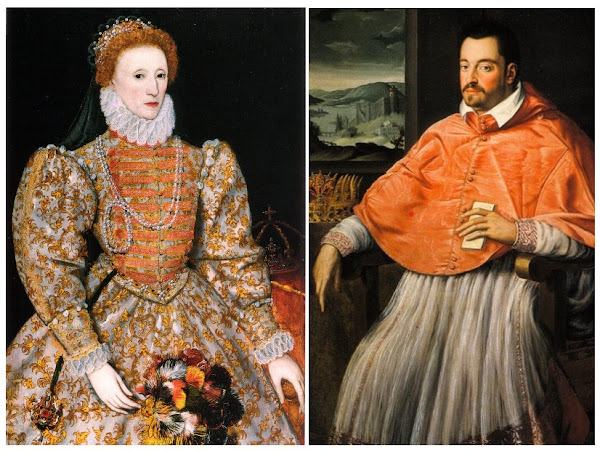
Elizabeth I, Popes, & Ferdinando I de' Medici in Love's Labor's Lost

Image
Love’s Labor’s Lost was Christmas entertainment (1593) for Elizabeth I and her court. It's about a bunch of guys who try to be celibate, and who keep a princess and her attending ladies locked out of their castle. The men fall in love with the women, but the women get the last word. Sort of like popes (some who failed at the celibacy thing) who excommunicated Elizabeth, keeping her out of the “castle” of the Roman Church, but never getting what they desired of her. Many scholars note that the character of King Ferdinand is based on King Henry III of Navarre, who had been raised Protestant, and who Elizabeth I had supported in French wars of religion. He converted to Catholicism (“Paris is worth a mass”) to consolidate his power as the next king of France, disappointing Elizabeth. Of the nine popes during Elizabeth’s reign,* one of them, Gregory XIII (1572-85), had a child out of wedlock (like Armado and Jaquenetta in the play) before his ordination. In their oaths and the...

Begging & Poor (& Chastity & Pregnancy) in Love's Labour's Lost (1594-1597)

Image
Love's Labour's Lost has an earliest recorded performance before Queen Elizabeth as part of the court's Christmas festivities in December, 1597. [Title page from the 1598 first quarto, cropped, via Wikipedia . Public domain.] Elizabeth had been promoted as "Virgin Queen," but was rumored to have had affairs, and many in England were anxious about the fact that she had not married and produced an heir; so it is interesting and significant that the play has a theme of how difficult and impractical chastity can be. It's as if Shakespeare said: Court Christmas play? Virgin queen? Rumored affairs? No heir? How about a comedie about failing at chastity, pregnancy before marriage, falling in love, and reforming bad habits? (Let’s face it: Life is not all about work, even for a monarch! It’s about love. Right?) The play preempts heckling from the court by including a masque, which members of the court heckle; it preempts criticism of its playwright for having ...

Begging and Poor in Richard III (1592–1593)

Image
The word "beg" occurs 13 times, and "poor," 25 times in Richard III . On the lips of Richard, Duke of Gloucester, when it is not disparaging, it is often dishonest and manipulative. The Princes in the Tower (among others) are very concerned with avoiding the appearance of begging as a mark of weakness. A failed assassin claims conscience leaves him a beggar (a theme that comes up again in Hamlet). In comparison, when Prince Hamlet and others refer to him as “poor” and “beggar” (more often than any other character in that play) the contrast between Hamlet and these other royals is stark and significant. [From title page, Richard III (cropped), from the second folio of 1632. Image via Folger Shakespeare Library . Creative Commons.] Nizar Zouidi of the University of Hail has noted the performative aspect of Richard III : He performs the roles of script writer, actor, and director in his own show ( See Nizar's abstract for his essay/chapter here .) R...

Plague, Pox, & Disease in Shakespeare

Image
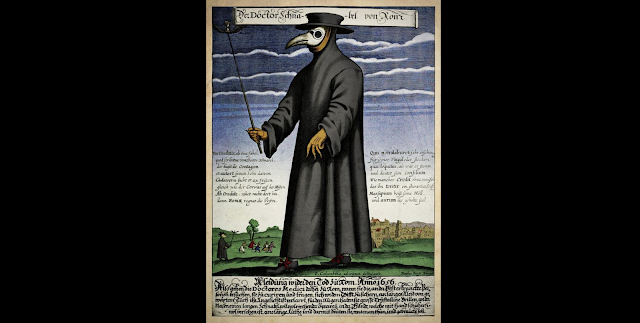
Words like “Plague,” “Contagion” and “Pestilence” occur in Shakespeare’s works a surprising number of times, and that includes Hamlet. Because of the Covid-19 crisis, my readers may already have noticed that media outlets and Shakespeare organizations are sharing and re-publishing articles about black plague and smallpox in Shakespeare’s lifetime. [Copper engraving of Doctor Schnabel (i.e., Dr. Beak), a plague doctor in seventeenth-century Rome, circa 1656, public domain, Wikipedia ] With all of the changes in the world and in my state of Minnesota, with school closings, and conferences and sporting events canceled, I decided it was time to do a little research about Shakespeare and the plague and the pox, as well as some research about occurrences of these words often associated with them. Web Resources Among the many good web resources on plague, smallpox, and diseases mentioned in Shakespeare, here are a few of my favorites: James Shapiro: “How Shakespeare’s great escape f...

ELIZABETH I & HAMLET

Image
Elizabeth, who often referred to herself as a "prince": "I may not be a lion, but I am a lion's cub, and I have a lion's heart." Like Hamlet, Elizabeth I was (figuratively) haunted by her father: Henry VIII broke from Rome to obtain an annulment from his first wife so that he could marry Elizabeth’s mother Anne; he later had Anne executed (on trumped-up charges? Bored with her, tired of her assertiveness, already courting a replacement). Called by some a "bastard queen," conceived before her parents' marriage, Elizabeth spoke highly of her father in public but wore a locket with her mother’s picture. Laertes says that if he doesn’t avenge his father, he proclaims himself bastard. - If Elizabeth didn’t adhere to her father’s separation from Rome, she would have proclaimed herself bastard: her legitimacy depended to some extent on her father’s break from Rome to get his first marriage annulled. Hamlet says to Ophelia, “we will have no...

HAMLET & OLIVIA: Mourning too long?

Image
Stephen Greenblatt ("Shakespearean Negotiations") is among those scholars who note that Twelfth Night 's Olivia is a caricature of Elizabeth I, mourning the death of her father (HenryVIII, whom she idolized) and brother (young King Edward), and making excuses to avoid being courted for marriage. https://en.wikipedia.org/wiki/Twelfth_Night_(1996_film) Olivia's steward, Malvolio, may therefore be a caricature of William Cecil, Lord Burghley, who in the play is toyed with as being possessed and gets a mock-exorcism (!), which (in the eyes of some, like Essex) Cecil deserved, of course. If the unnaturally mourning Olivia can be Eliz I, what about Hamlet? If Viola, and MofV's Portia, and AYLI's Rosalind, etc., can disguise themselves as males, then Hamlet can stand (at least in part) for an idealized Elizabeth, a recipe for how Elizabeth I might end her life and reconcile with James, that prince from the north, the son of her enemy, as Hamlet does with Fo...