Posts

Showing posts with the label St. Paul

St. Paul and Twelfth Night

Image
February 2 is the anniversary of the 1602 first public performance of Twelfth Night. Consider the influence of St. Paul on the play: St. Paul was in at least three shipwrecks [1]. - One account from Acts 27 was read at morning prayer on the Sixth Day of Christmas, December 30, every year of Shakespeare’s life [2]. - Although there would be many tales of shipwrecks, these familiar Bible readings would have offered a persistent religious association. - Twelfth Night begins with a shipwreck. Every January 21st at morning prayer [3], churchgoers would hear St. Paul’s letter, 1 Cor 3, which reads as if it’s speaking of the fool Feste, and Malvolio’s vanity, in Twelfth Night: 18 …If any man among you seem to be wise in this world, let him be a fool, that he may be wise. 19 For the wisdom of this world is foolishness with God: for it is written, He catcheth the wise in their own craftiness. 20 And again, The Lord knoweth that the thoughts of the wise be vain. Twelfth Night revelry was like ...

Is Twelfth Night a Christmas - Epiphany season play?

Image
If Shakespeare’s Twelfth Night is related to Christmas and Epiphany, how so? Some would say only by title [1] and only in a secular sense for having Sir Toby Belch as a “Lord of Misrule,” a secular Christmas tradition [2]. There’s no baby Jesus, no shepherds, no angels, no Magi.  But consider: Viola and Sebastian come from far away, like the Magi. They are shipwrecked, like St. Paul, saved from water, or like the inhabitants of Noah’s ark (which Sir Toby mentions) after storms and flood. The scripture readings for both St. Paul’s shipwreck and Noah’s ark were read every year in English churches during the Christmas season [3]. The twins are refugees in enemy land, like the Holy Family in Bethlehem under Herod the Great [4]. “Wise men/man” is spoken six times in the play by various characters [5].   The use of Sir Toby Belch as “Lord of Misrule,” and the downfall of the proud and Puritanical Malvolio, echo what the Virgin Mary says in reply to the angel Gabriel on being told ...

The 9th Day of Christmas in Shakespeare's Time, January 2 (Series, Part 9)

Image
FOR THE 9TH DAY OF CHRISTMAS IN SHAKESPEARE’S TIME, the church assembly would hear the next [1] consecutive psalm, Psalm 2, for which the Geneva translation introduction reads: “David …exhorteth kings and rulers, that they would humbly submit themselves under God’s yoke, because it is in vain to resist God. Herein is figured Christ’s kingdom.” - Many of Shakespeare’s plays involve monarchs and rulers who resist, if not God, at least circumstances, ill fortune, and sometimes their own foolishness. Today begins a cycle with Genesis 1, God shaping creation. - Christian doctrine taught that God made creation out of nothing: This may remind us of King Lear, telling Cordelia in 1.1. that the “nothing” of her refusal to play his game is unacceptable, because “"Nothing will come of nothing.” It may also remind us of “Much Ado About Nothing” [2]. Matthew 1 tells of the genealogy of Jesus, Mary’s pregnancy by the Holy Spirit, and Joseph’s dream in which he is told to marry her in spite of...

The 7th day of Christmas, December 31, in churches of Shakespeare’s time (Series, Part 7)

Image
The 7th day of Christmas (December 31 in Shakespeare’s time as now, also St. Sylvester’s Day [1]), used these Bible readings: Psalm 30 (repeated from previous): House of David, prayer in prosperity, trouble, and restoration (not exactly King Lear, but implied character arc) [2]. MORNING PRAYER Isaiah 65 - the prophet is sought by Gentiles, condemns sins; “seed of Jacob” (a name used five times in two plays); new heaven and new earth (Antony: “Then must thou needs find out new heaven, new earth” [3]); four animals with rich associative meanings whose names appear in Shakespeare: wolf (38 times), lamb (59), lion (224), serpent (39) [4]. Acts 28 - The shipwrecked prisoner Paul and others are shown kindness by "Barbarians" of Malta: - hospitality for strangers, key theme in Greek and biblical literature, and in Shakespeare as for example in King Lear, A Winter’s Tale, Hamlet, and others (violated hospitality, a strong theme in Macbeth). - 12 “at Syracuse, we tarried… three da...

Sixth Day of Christmas: Paul's shipwreck, Pericles (Series, Part 6)

Image
On the 6th day of Christmas (December 30) if Shakespeare attended church for morning or evening prayer, what Bible passages would he have heard? MORNING: Psalm 30 - The House of David [1]. Isaiah 63 - A vengeful God [2]. Acts 27 - Paul shipwrecked.* EVENING: Isaiah 64 - Divine intervention [3]? 3 John 1 - Welcome strangers [4]? “Demetrius” [5]? * Acts 27 is about St. Paul and a shipwreck, reminding us of Shakespeare’s Twelfth Night , but also of the Shakespeare collaboration, 𝘗𝘦𝘳𝘪𝘤𝘭𝘦𝘴, which echoes the geography of Paul’s travels. Hannibal Hamlin refers to the play as “The Acts of 𝘗𝘦𝘳𝘪𝘤𝘭𝘦𝘴” for all of its resemblances to Paul’s journeys [6]. After Paul’s shipwreck, Roman soldiers at first want to execute all prisoners so they don’t escape, but one wants Paul to be spared, an act of mercy. Paul argues that they can all swim to shore: Paul takes the gift of the soldier’s mercy and expands it to include all of the prisoners, not just himself (like a figurative multiplica...

Fifth Day of Christmas, Paul and Agrippa, Dec 29 (Series, Part 5.c.)

Image
Paul and Agrippa, not Becket? Fifth Day of Christmas, December 29: Bible readings for morning and evening prayer in Shakespeare’s England followed their own schedule, unrelated to feasts such as St. Thomas Becket (removed by Henry VIII and the English Reformation) [1]. Morning: Psalm 29 - Geneva Introduction: “The Prophet exhorteth the princes and rulers of the world (which for the most part think there is no God.)” [2]. Lesson 1: Isaiah 61 speaks of God’s anointed (which Christians interpreted to be Jesus) setting prisoners free. - At least six Shakespeare plays involve prisoners, real or figurative, some set free only in death [3]. - The point here is not that each of these plays alludes to Jesus as liberator of prisoners, but that the Bible readings in English churches (where Shakespeare’s attendance was required by law) shaped and influenced the development of religious and literary motifs related to prisoners and their liberation. Lesson 2: Acts 26 - Prisoner St. Paul encoun...

Chameleon Hamlet & 1 Cor 9: Notes on Asimov on Hamlet, Part 5

Image
In his two-volume Guide to Shakespeare , Isaac Asimov has an interesting reflection on Hamlet's remark regarding eating air, "the chameleon's dish." One can find it in Vol. II, pages 122-3. Asimov's Guide is just an introduction to the plays of Shakespeare, so his treatment of each play is relatively brief; in certain places where we might like more depth, at times perhaps he moves on too quickly. But Asimov's observations are worthwhile to consider, as they might inspire even more reflection on Hamlet's "chameleon" remark. Asimov notes the "formal politeness of Claudius' question (II.122) regarding how Hamlet "fares" - which to Claudius, means merely "How are you doing?" - but Hamlet takes the question and the word "fares" another way, deliberately misreading Claudius' meaning: Asimov notes that Hamlet's response is "nonsensical" (II.122), and that it supports Hamlet's feigning o...

Hamlet and the Conversion of Saul

Image
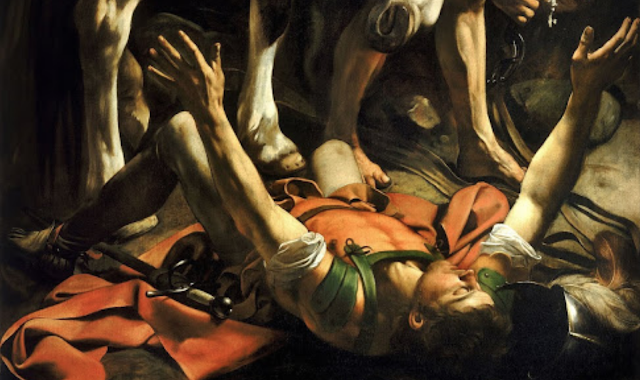
[Detail: Conversion on the Way to Damascus: Caravaggio (c.1600-1). Image from Wikipedia, in the public domain. Full image below.] I have been thinking about Pauline influences on, or echoes in, Hamlet.  Some of these in particular are in the first scene, some in a middle scene, and some in the last. In the first scene of Hamlet , Francisco might be the first sentinel on stage. The second sentinel, Bernardo, enters cautiously and asks a question. But instead of answering, sentinel Francisco demands that Bernardo answer his own question first: Bernardo: Who’s there? Francisco: Nay, answer me: stand, and unfold yourself! This construction of dialogue is notable for having one character ask a question, and the other, more authoritatively, turn it back on him. Most Shakespeare scholars assume Francisco is still on duty and the person in charge, coming to the end of his shift; Bernardo is coming on duty to relive him, but perhaps nervous and not quite following protocol. S...