Posts

Showing posts with the label Marriage

Marriage & Maternal Approval: Jacob - Hamlet Echoes - part 3

Image
Themes of marriage and maternal approval have some interesting connections when comparing the biblical Jacob tales with Shakespeare’s Hamlet: [1] Jacob’s mother plays a key role in favoring him for the birthright (Genesis 25:19-27), but also helping him deceive his father (Genesis 27:1-40). It is extremely important that Jacob receives encouragement and permission from his mother - who had coddled him, favored him - to go and seek a bride (Genesis 27:41-45) when his brother Esau is angry after learning that Jacob has deceived his father and received the birthright/blessing that Esau had expected. This permission and encouragement from Rebekah helps open a gap between mother and son that Freud and others would say is healthy. Queen Gertrude acts in similar motherly ways toward Ophelia as well as toward her son Hamlet. Ophelia’s mother is absent (like Hamlet's father; she is a feminine mirror image of Hamlet); like the ghost and Claudius, Polonius is a dysfunctional fathe...

"Incestuous" marriages of Henry VIII and Claudius: two relevant biblical passages

Image
What Bible verses relate to the allegedly incestuous marriages of Henry VIII and Claudius in Shakespeare’s Hamlet? Mainly two. These may seem contradictory, but examined carefully, make sense. [Image: Mishneh Torah (Maimonides), Perugia, c. 1400 (Elie Kedouri, The Jewish World, 1979, p. 193). Illuminated Hebrew manuscript. National Library of Israel, Jerusalem. Photo is from replica at the Diaspora Museum, Tel Aviv. Fair use. Via Wikimedia.org .] First, Arthur Tudor died without any children, so Deuteronomy 25:5-10 seems to apply: Verse 5 explains: If a brother dies without children (especially a male child in Hebrew biblical culture), his widow should not marry a “stranger” outside the family; a surviving brother should take the brother’s widow as a wife. (This is called "levirate marriage.") Verse 6: The first child she bears by this new marriage will be considered the child of the dead brother, to carry on his line and legacy. (Yes, very patriarchal.) Verses 7...

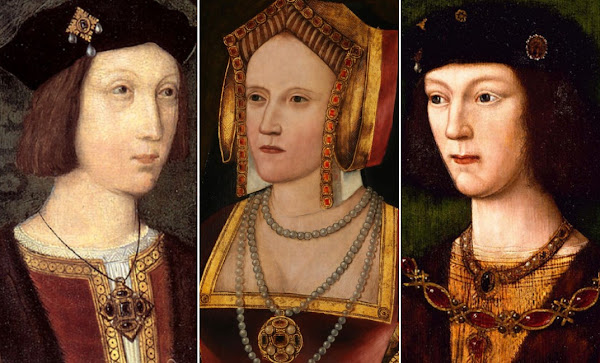
Hamlet and the Incestuous Marriages of Claudius and Henry VIII - via John Erskine Hankins

Image
Shakespeare certainly wrote of Claudius and Gertrude’s “incestuous” marriage with Henry VIII in mind. Early audiences recognized it. In teaching the play, is it a mistake to omit that context? [Left: Arthur Tudor, Prince of Wales (1486-1502), "regarded as the only surviving contemporary portrait"; circa 1500. Anglo-Flemish School. Private collection, Hever Castle, Kent. Public domain. Image via Wikimedia . Center: Catherine of Aragon (1485–1536), originally identified as Catherine Parr, but now recognized as Catherine of Aragon. Unidentified painter. 16th Century. Lambeth Palace. Public domain, via Wikimedia . Right: Henry VIII of England (1491-1547), circa 1509. Attributed to Meynnart Wewyck. Denver Art Museum. Public domain. Image via Wikimedia ]. From “The Character of Hamlet,” by John Erskine Hankins* (1941), p.101: ~~~ It will be remembered that Henry VII's eldest son Arthur was married to Katherine of Aragon to cement an alliance between England and Spa...

Emmaus Key Change in Hamlet & Merchant of Venice (Emmaus in Hamlet, part 6)

Image
When a song or orchestral piece changes keys, we not only hear it with our ears, but also feel it in our bodies, our bones, vibrating at a new frequency. Shakespeare accomplishes something similar, not only in Hamlet , but also in The Merchant of Venice when he sets up one character as a Christ-figure, then changes key, shifting to a new (improved) Christ figure. [Image: “Supper at Emmaus” (French: Le Repas d'Emmaüs), 17th century, by Matthias Stom (1615–1649). Collection: Museum of Grenoble. Public domain, via Wikimedia .] In Luke 24:13-35, after Jesus dies and rises, he later appears as a stranger on the road to Emmaus. I’ve noted previously how in Hamlet , biblical allusions suggest the ghost is a flawed Christ-figure/victim, with divine attributes.[1] But in the graveyard scene (5.1), instead of the ghost appearing as the stranger[2], our expectation is redirected: Yorick’s skull and the gravedigger-clown fill the role of the stranger in whom divine "infinite jest...

So Many Ophelia—Hamlet Parallels!

Image
I have been reading Julia Reinhard Lupton's good book, Thinking with Shakespeare , with special attention, of course, to the chapter on Hamlet , which is very rich in that it's challenging me to think in ways outside of my previous habits. This blog post is not to share any of Lupton's ideas in particular, though I hope to do so in a future post, especially regarding her mention of Moses as related to Hamlet seeing his father's ghost. Sometimes when I research, I mark or copy down quotes and ideas I think I can use. Other times, while the text I'm reading is about A, B, and C, my mind leaps, and I'm thinking of J,K,L. It's a mysterious process. I am not a fan of saying the Catholic Rosary, but I have heard some say that the prayers of the rosary are meant to occupy and distract your ego or consious mind (or "monkey mind"), which allows other insights to surface or breakthroughs to occur. This is what I mean by stumbling upon J-K-L while doing r...