Posts

Showing posts with the label political commentary

Hamlet the Demonic Iconoclast (Ten Commandments Series)

Image
IN THE PERSON OF HAMLET, DOES SHAKESPEARE ASSOCIATE ELIZABETHAN ICONOCLASM WITH DEMONIC POSSESSION?  In Reformation England, images that recreated scenes from familiar religious and biblical tales were destroyed, removed, or painted over as allegedly idolatrous (as described in the 2nd commandment, which prohibited making any “graven image”).  In their place? Commandment boards.  It is frequently noted that Shakespeare’s father, John, was charged with having to paint over images in their church in Stratford. People who loved religious statues and images in their local churches often had to be content with the Ten Commandments, and words, not images.  By placing on Hamlet’s lips a little speech that seems to make him an iconoclast by analogy – and at the very moment when Hamlet seems tempted to revenge by a possibly demonic ghost – this seems to associate English iconoclasm with the demonic [1].  Consider Hamlet’s little speech after his first encounter with the ...

Hamlet, John the Baptist, and Jesus as Symbolically Political

Image
My previous post noted that Hamlet alludes to John the Baptist [1]. Consider the religious, symbolic, and political significance of John baptizing at the Jordan [2], for Jews who knew their founding story by heart, that Moses led their ancestors through parted waters of the Red Sea to freedom and a promised land, escaping a foreign oppressor [3].  John at the Jordan plays into the same tropes, where Rome (not Egypt) is the foreign oppressor (which in part explains why Rome and Herod Antipas saw him as a threat). England’s Henry VIII claimed he needed to repent of incest, had seen action in battle, but was thought to have died a sinful man, guilty of foul crimes. Hamlet deals with an incestuous king and the ghost of a king, fearsome in battle, who died with sins on his soul, foul crimes. Same tropes. Hamlet alludes to both Julius Caesar and Jesus. Consider Jesus, preaching where Roman coins bore the image of a Roman emperor [4] with an inscription calling the emperor “son of a go...

Is Twelfth Night a Political Play?

Image
How might Londoners have reacted to seeing Shakespeare’s Twelfth Night at its first public performance on February 2, 1602 [1]? The play’s character Olivia, mourning a father’s and brother’s deaths, and reluctant to marry, might easily remind them of their queen, Elizabeth I. Olivia hides her face with a veil (1.1; 1.5); Elizabeth survived smallpox and hid her facial scars with thick makeup [2]. Olivia’s steward, Malvolio, might remind many of the late William Cecil, long-time advisor to Elizabeth and sometime spymaster [3]. Malvolio intercepts a letter - a forgery by Maria, designed to entrap him and bring about his downfall, which he believes contains a code - this would remind audiences of the downfall of Mary Queen of Scots (executed February 1587), accomplished in part by intercepted letters – some in code, some alleged forgeries - overseen by Cecil [4]. Mary claimed at her trial “That it was an easy matter to counterfeit the Ciphers and Characters of others” [5]. It was an old ...

"Hercules and his load," not Atlas at Shakespeare's Globe?

Image
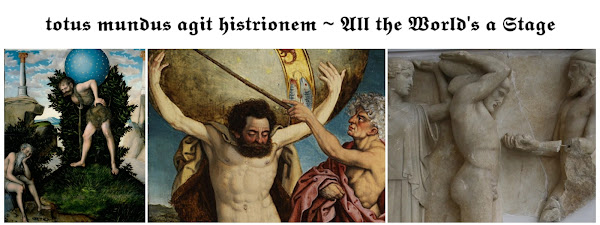
Rosencrantz in Shakespeare's Hamlet speaks of "Hercules and his load" (2.2.384-5) [1], which some take to be a reference to the sign or flag displayed at the Globe Theater in Shakespeare’s lifetime. [2] Was it Hercules on the sign, not Atlas? Or does Hamlet refer to Hercules for its thematic connections, while the sign actually displayed Atlas? In an Elizabethan context, the references are fraught with political implications: Atlas was a Titan who had led a rebellion against the new order of Gods on Olympus, but failed: His punishment was to hold up the world. In one story, Hercules temporarily held the world while Atlas did him a favor: [3] Hercules was a son of Zeus by one of many affairs with mortal women. Zeus’ wife Hera was jealous and tried to destroy Hercules. In one such effort, Hera made Hercules crazy, and he killed his wife and children. Grief-stricken Hercules was given labors to overcome his grief. One involved holding the world for At...

Elizabethan-Jacobean Politics in Hamlet, via Hankins (1941)

Image
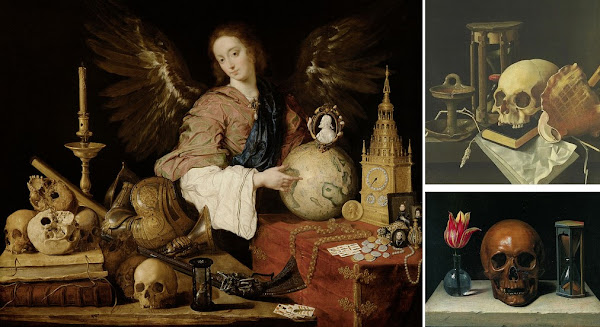
“. . . the purpose of playing . . . is . . . to hold . . . the mirror up to nature; to show . . . the very age and body of the time his form and pressure.” (Hamlet, 3.2)1 Many people assume that Shakespeare is unconcerned with the topical, political, ephemeral details of his time, because they don't spot all the parallels that original audiences did. But in fact plays like Hamlet are full of them. “Playing” doesn’t merely reveal so-called universal truths: John Erskine Hankins thinks Hamlet addresses historical-political events of Shakespeare's “very age” and “time”: “Though the scene of Hamlet is medieval Denmark, most critics will agree that its characters and problems are those of sixteenth-century England. As is his usual custom, Shakespeare writes of his own day, regardless of where and when the action of his drama takes place. This is truer of Hamlet than has been generally supposed.”2 [Left: Allegory of Vanity (1632-1636), by Antonio de Pereda (1611...

Politics in Hamlet - via John Erskine Hankins, 1941

Image
“. . . the purpose of playing . . . is . . . to hold . . . the mirror up to nature; to show . . . the very age and body of the time his form and pressure.” (Hamlet, 3.2)1 Many people assume that Shakespeare is unconcerned with the topical, political, ephemeral details of his time, because they don't spot all the parallels that original audiences did. But in fact plays like Hamlet are full of them. “Playing” doesn’t merely reveal so-called universal truths: John Erskine Hankins thinks Hamlet addresses historical-political events of Shakespeare's “very age” and “time”: “Though the scene of Hamlet is medieval Denmark, most critics will agree that its characters and problems are those of sixteenth-century England. As is his usual custom, Shakespeare writes of his own day, regardless of where and when the action of his drama takes place. This is truer of Hamlet than has been generally supposed.”2 [Left: Allegory of Vanity (1632-1636), by Antonio de Pereda (1611...

Why does Hamlet criticism often prefer the personal over the political?

Image
IF HAMLET SCHOLARS tried to interpret the play too exclusively in terms of the slim biographical facts we know about Shakespeare, expanding that understanding through perhaps baseless speculation on what we don't know about the playwright, we might be correct to criticize them as perhaps guilty of the biographical fallacy, a kind of reductionism that views work too exclusively as commentary about the author. If scholars did the same too exclusively with certain historical facts - about the "incestuous marriage" of Henry VIII that led to the English Reformation, or Elizabeth I's Lord Treasurer, William Cecil, or Cecil's daughter who, like Ophelia, died under suspicious circumstances - then we might do well to criticize the approach as a kind of historical reductionism - as if the meaning of the play is "nothing but" veiled commentary on certain historical events. (Some readers seem reductionist in this way, claiming the prince is nothing but a kind of...

What Kind of Fool was Shakespeare?

Image
What Kind of Fool was Shakespeare? Climate Change; Olivia & Malvolio; Ophelia & Polonius; Politics in Hamlet and Twelfth Night [1] How should we best think of Shakespeare’s relationship to his patrons and the powers-that-be? As an enthusiastic supporter of the English monarch and English church, regardless of its faults or occasional oppressions? Or might we better think of him like The Pianist , the film about a musician and piano player who escapes death in a concentration camp, and briefly entertains a Nazi military leader who would protect him? Or like the musicians in the 1980 film, Playing for Time , about musicians in a Nazi concentration camp allowed to escape death as long as they entertain their captors? [2] Or as a court fool, paid to entertain royalty, but required to speak awkward and inconvenient truths, as long as he could do so in a witty and entertaining manner? I’ve been thinking about this question for the past few weeks in light of a news item in ...