Posts

Showing posts with the label Welcome Strangers

Sixth Day of Christmas: Paul's shipwreck, Pericles (Series, Part 6)

Image
On the 6th day of Christmas (December 30) if Shakespeare attended church for morning or evening prayer, what Bible passages would he have heard? MORNING: Psalm 30 - The House of David [1]. Isaiah 63 - A vengeful God [2]. Acts 27 - Paul shipwrecked.* EVENING: Isaiah 64 - Divine intervention [3]? 3 John 1 - Welcome strangers [4]? “Demetrius” [5]? * Acts 27 is about St. Paul and a shipwreck, reminding us of Shakespeare’s Twelfth Night , but also of the Shakespeare collaboration, 𝘗𝘦𝘳𝘪𝘤𝘭𝘦𝘴, which echoes the geography of Paul’s travels. Hannibal Hamlin refers to the play as “The Acts of 𝘗𝘦𝘳𝘪𝘤𝘭𝘦𝘴” for all of its resemblances to Paul’s journeys [6]. After Paul’s shipwreck, Roman soldiers at first want to execute all prisoners so they don’t escape, but one wants Paul to be spared, an act of mercy. Paul argues that they can all swim to shore: Paul takes the gift of the soldier’s mercy and expands it to include all of the prisoners, not just himself (like a figurative multiplica...

Hamlet Act I: "'Tis Strange," a Poisoned King, and a Poisoned Lord Strange

Image
In the first act of Hamlet, the first five uses of the word "strange" all refer to the poisoned king. HORATIO: 'Tis *strange.* (1.1.75) HORATIO: ...This bodes some *strange* eruption to our state. (1.1.80) HAMLET: 'Tis very *strange.* (1.2.233) GHOST: Murther most foul, as in the best it is; But this most foul, *strange,* and unnatural. (1.5.34) HORATIO: O day and night, but this is wondrous *strange*! (1.5.185) HAMLET: And therefore as a *stranger* give it welcome. (1.5.186) Shortly after that, some of the next occurrences of the word "strange" refer to the way Hamlet may act while feigning madness. Having spoken to the ghost and learned of the poisoning, Hamlet warns Horatio and the sentinels that he may act *strange* (1.5.190), but that they are to keep his secret (1.5.201-202). IT SO HAPPENS that until the death in 1594 of Lord Strange, Ferdinando Stanley, more than half of the actors in Shakespeare's playing company were "Strangers," or ...

Fear, strangers as angels, (self-) transcendence, and the usefulness of failure

Image
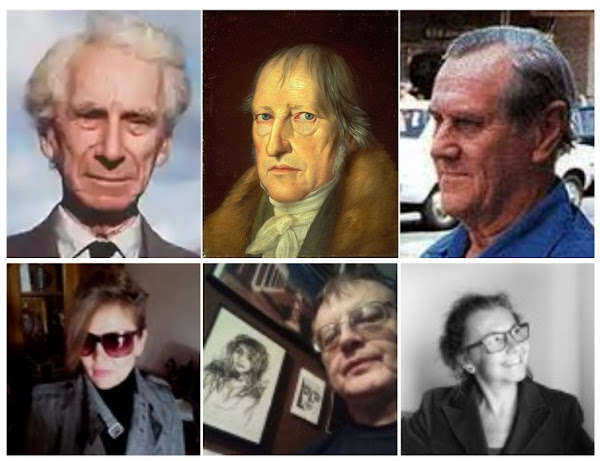
A number of weeks ago, three of my LinkedIn connections posted some passages from various sources that caught my attention and seemed somewhat related, as if belonging in a cluster - and to which I would add a fourth. 1) Gordana Lekovic shared the following quote from Bertrand Russell (British philosopher, 1872–1970), among other Russell quotes: “It is normal to hate what we fear, and it happens frequently that we fear what we hate. I think it may be taken as the rule among primitive men, that they both fear and hate whatever is unfamiliar.” This seems natural or normative, like a survival instinct: We hate and fear our enemies, as we often do strangers. 2) But this brought to mind Hamlet’s words to Horatio: Late in 1.5, upon seeing the ghost again, Horatio says, “this is wondrous strange!” Hamlet replies, “And therefore as a stranger give it welcome.” Hamlet seems to be thinking of the biblical injunctions to welcome the stranger: Hebrews 13:2 (in the Geneva translation wi...

Welcome Lazarus & Lord Strange's Men (Lazarus in Hamlet, Part 8)

Image
In Hamet , Horatio and the prince repeatedly describe as "strange" the apparition who claims to have been killed by poison. For those familiar with the history of Shakespeare's acting career and of various claimants to the English throne, Lord Strange (pronounced "Strang") might come to mind. He died at the age of 35, strongly suspected of having been poisoned, and was the patron of an acting company in which Shakespeare and a number of his fellow actors worked before the forming of The Lord Chamberlain's men. Lord Strange's grandmother was a younger sister of Henry VIII, and had been listed in his will as in the line of succession, so for that reason, Lord Strange, Ferdinando Stanley, 5th Earl of Derby, was also in the line of succession. [Dated 1594, oil portrait of Fernando Stanley, Lord Strange, 5th Earl of Derby (1559–16 April 1594), by unknown. Cropped. Public domain, via Wikimedia Commons .] Many others may have noticed this, but in spite ...

"Welcome the Stranger" in Sir Thomas More

Image
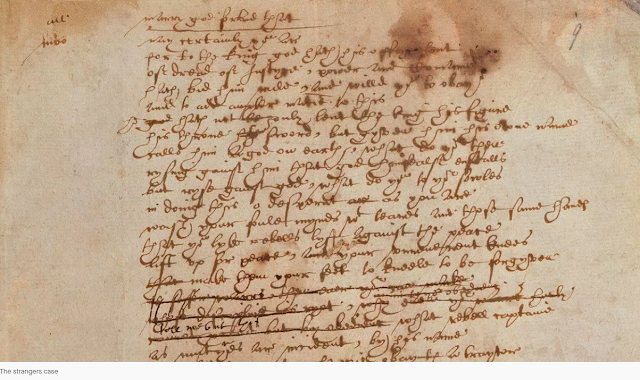
"Welcome the Stranger, for you were once strangers" is a theme repeated in the Bible, and is related to the theme of what Jesus calls the second most important commandment ("like the first), to love neighbors as we love ourselves (the first being to love God). Later Jesus says that what we do to "the least of these" we do unto him. People in Shakespeare's time would have been thoroughly familiar with these passages, especially adults who had heard them in church over and over throughout their lives. #Shakespeare embodied this theme in his contributions to a play about Sir Thomas More, never performed in his lifetime, which includes a speech More gave to a crowd to try to prevent mob violence against immigrants. At the link below , you can watch a video of Ian McKellen delivering the speech. https://qz.com/786163/the-banned-400-year-old-shakespearean-speech-being-used-for-refugee-rights-today/?fbclid=IwAR33VADBeO-eY0WVbRZVzGJswBpwpPWLgv1OBW3XalULLDfyl1e1...