Posts

Showing posts with the label William Cecil

Is Twelfth Night a Political Play?

Image
How might Londoners have reacted to seeing Shakespeare’s Twelfth Night at its first public performance on February 2, 1602 [1]? The play’s character Olivia, mourning a father’s and brother’s deaths, and reluctant to marry, might easily remind them of their queen, Elizabeth I. Olivia hides her face with a veil (1.1; 1.5); Elizabeth survived smallpox and hid her facial scars with thick makeup [2]. Olivia’s steward, Malvolio, might remind many of the late William Cecil, long-time advisor to Elizabeth and sometime spymaster [3]. Malvolio intercepts a letter - a forgery by Maria, designed to entrap him and bring about his downfall, which he believes contains a code - this would remind audiences of the downfall of Mary Queen of Scots (executed February 1587), accomplished in part by intercepted letters – some in code, some alleged forgeries - overseen by Cecil [4]. Mary claimed at her trial “That it was an easy matter to counterfeit the Ciphers and Characters of others” [5]. It was an old ...
Part 20: Ophelia and the Mousetrap of her Family’s Protectiveness

Image
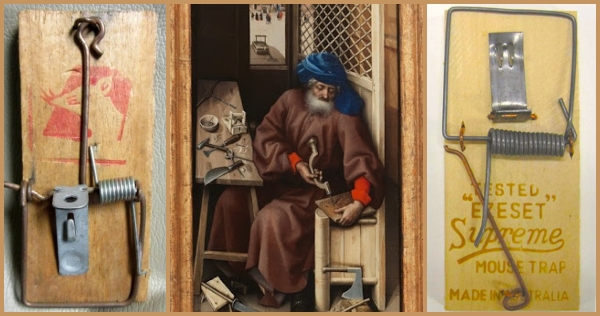
Shakespeare makes a mousetrap for the audience regarding Ophelia’s family and Hamlet. We could call this mousetrap, “Much Ado About Ophelia Marrying Hamlet.” Near the play’s end, Gertrude says in 5.1 that she’d rather have decorated Ophelia and Hamlet’s wedding bed with flowers than Ophelia’s grave. The Queen seems to have liked Ophelia and thought her a good match for her son.  Rewind to the start: After seeing the ghost, Horatio and the sentinels think so highly of Prince Hamlet that they report the sighting to him, and not to King Claudius or Polonius. [1] In 1.2, Horatio calls Prince Hamlet “my lord,” presenting himself to his friend as “your servant ever.” Hamlet replies that he would “change those names” [2]: He’d rather be Horatio’s servant, and Horatio his lord. When Horatio and the sentinels speak of their duty to him, Hamlet would rather have them think of their mutual love.[3]  Shakespeare presents Hamlet as a prince who desires to serve, to love and to be loved, ...

Part 14: Ophelia's figuratively incestuous family

Image
Ophelia’s brother and father are overly protective of her chastity [1], too suspicious that Hamlet might take advantage of her. Like a lover or spouse, Laertes leaving for France tells Ophelia, “do not sleep, But let me hear from you” [2]. Biblical sayings urge welcome for strangers, which involves risk; but they also discourage fear [3]. Laertes, in contrast, repeatedly urges Ophelia to fear Hamlet [4]. After warning her to be chaste, Laertes tells Ophelia to remember his advice. Ophelia replies, "'Tis in my memory lock'd, / And you yourself shall keep the key of it."[5] Chastity can be a virtue, keeping something of great value secret, disclosed only in an intimate, faithful relationship. Ophelia’s promise to Laertes is analogous: she has the feminine lock and he the masculine key, suggesting a figuratively incestuous relationship. Polonius mistrusts his children’s secret, so he figuratively rapes Ophelia's memory by demanding she disclose it. [6] Ten lines ea...

Pondering Polonius, again

Image
JSTOR Daily recently published a piece called “In Defense of Polonius,” which is a little misleading in its title and subtitle: “Shakespeare’s tedious old fool was also a dad just doing his best” (15 June, 2022). [1] The article admits that in Shakespeare’s Hamlet, Polonius is a poor father figure, but argues that the role is not only a good one, but an essential one to the play. I agree on that point. The article is by Jeffrey Wilson, also the author of an article I shared a few days ago which explored how today, Claudius would probably be considered an alcoholic. [2] In this 15 June piece, Wilson notes that Polonius apologizes twice, perhaps more convincingly the second time. And yet he softens the effect of the second apology by putting his own mistake in a larger context of mistakes often made by the young: “I am sorry that with better heed and judgment I had not quoted him. I fear'd he did but trifle And meant to wrack thee; but beshrew my jealousy! By heaven, it i...

The Missing Body Of Polonius And Alleged Atheism Of William Cecil

Image
Last week my post addressed the anxiety of characters in Hamlet about the missing body of Polonius, compared to that of the women at the tomb regarding the corpse of Jesus . [Images: Illuminations from Folio 117r of the Pericopes of Henry II, Reichenau, c. 1002–1012: The Three Marys, and the Angel at the Empty Tomb. Public domain, via Wikipedia , and fair use, via Flickr .] If Shakespeare is satirizing William Cecil as Polonius (and as *the antithesis of Jesus*), the point is not to affirm belief in a resurrection of Christ, but to perform political satire. But there is more to this missing body business (as there usually is with Shakespeare). Consider certain claims about William Cecil and the Privy Council before we return to Polonius: Robert Persons, a Jesuit priest, claimed in 1592 that there was a "school of atheism" in England centered on Sir Walter Raleigh . Atheism in Elizabethan England was a label for many things, including those (like later US Pres...

Jephthah/Polonius Series: "Pay Attention. Be Astonished. Tell About It." Index, Summaries, & Links

Image
For now , I have come to the end of my research and series of blog posts on Jephthah and Polonius. It has turned out to be very much like the poet Mary Oliver's "Instructions for living a life": Pay attention. Be astonished. Tell about it. This is far better than the vague and limited advice one hears more often: "Write what you know"; better to go on a quest to find out even more, and to be astonished in the process. Since at least last October I have been thinking and researching more methodically than I had in the past about Hamlet's Jephthah allusion in reference to Polonius. In paying attention, I’ve often  been astonished to find that the Jephthah allusion in Hamlet is much richer than many footnotes and other sources sometimes suggest (in my admittedly limited research).  So here is an index to my Jephthah/Polonius posts since last October, with links to those posts, and with some brief comments about the things I found that most astonished me in eac...

Jephthah, Cecil, & Three Instruments in Hamlet

Image
There are three occurrences of the word "instrument" in Shakespeare's Hamlet , one on the lips of Claudius, a second from Prince Hamlet, and a third from a dying Laertes. Each of these, considered in their contexts in the play as well as together, may strengthen the argument for Polonius being based at least in part on William Cecil, Lord Burghley, and the Jephthah allusion as pointing at least in part to what scholars usually call The Bond of Association (full text of which is provided below, near the end of this blog post, with some highlights for emphasis).  I have blogged recently about Polonius and Cecil, on November 24 of this year , and also on December 8 . This connection between Polonius and Cecil is not new or original with me, as many other scholars have noted the same thing for many years since at least 1869 when George Russell French suggested it (as noted by Connie Beane).[1] Scholars have also long associated the swearing of vows in the play (and in its all...