Posts

Showing posts with the label Nunnery Scene

Hamlet's "painted faces" as Shakespeare's critique of misogynistic religion?

Image
Does Shakespeare use Hamlet’s remarks about women’s “painted faces” to expose misogyny in official English Protestant sermons? Hamlet complains to Ophelia that he knows of the “paintings” she, and women in general, make when they take the one face God gave them and make themselves another. This may represent more than merely a cruel and misogynistic Hamlet, mistreating a former love. Hamlet is quoting almost word-for-word similar statements in a homily of the time. Not by a fringe preacher who made misogynistic remarks about women: An official Elizabethan homily [1]. Claudius uses the analogy of “The harlot's cheek, beautied with plast'ring art,” to describe his “deed” of having killed his brother, covered by lies (3.1.59-62). All acted out by actors who put on faces other than those God gave them, with make-up. This theme may be very related to England’s iconoclasm and the white-washing of old images in churches [2]. Shakespeare - who created many strong female characters in...
Religious and Political Meanings of the Annunciation and Susanna Allusions in Hamlet 3.1

Image
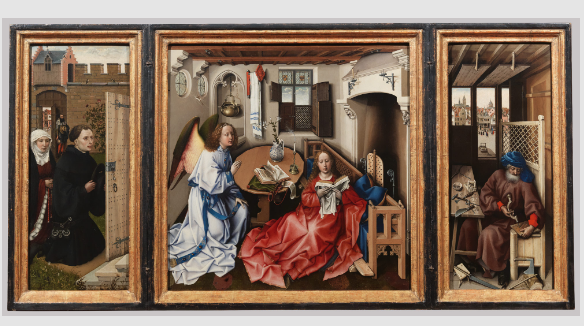
To prepare Ophelia as bait for eavesdropping, Polonius in 3.1 tells her, Read on this book, [...] [....] We are oft to blame in this, [...] that with devotion's visage And pious action we do sugar o'er The Devil himself. (49-55) So just look as if you’re devoted to reading, not bait for spying. But why “devotion's visage / And pious action”? “The Devil”? I’ve posted before about how Katharine Goodland (2006) [1] and Ruben Espinoza (2011) recognized that Polonius made Ophelia resemble a common image from old prayer books: the Virgin Mary is portrayed as reading a book of psalms when the angel Gabriel tells her that she is pregnant with Jesus (Lk 1: 26-38). [Robert Campin, Annunciation Triptych (Merode Altarpiece) in the MET museum (ca. 1427–32). Public domain. Image via Google Arts and Culture .] In Catholic prayer, the "Hail Mary" says, “Holy Mary, mother of God, pray for us sinners....” On seeing Ophelia, Hamlet says (aside), “in thy orisons...

Hamlet Nunnery Scene Haunted by Homily VI, Book 2, & Lazarus (part 14)

Image
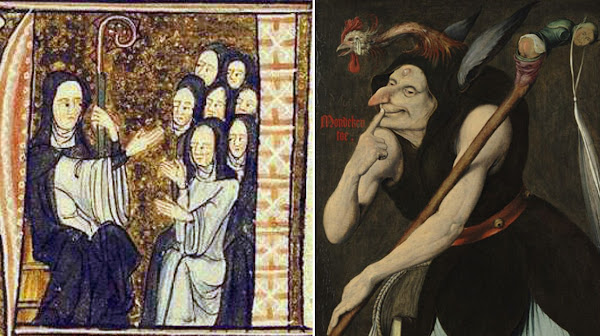
The nunnery scene (3.1) in Shakespeare's Hamlet is among the most famous of the play's scenes, with Hamlet telling Ophelia to get to a nunnery, criticizing women for painting themselves faces other than the one God gave them, and offering as a "plague for thy dowry" that, if she must marry, she should marry a fool. [NUNS AND A FOOL. Left: Hildegard von Bingen and her nuns, 13th Century, public domain here . Right: An Allegory of Folly, early 16th century, by Quentin Matsys (1456/1466–1530), New York, J. Held Collection. Image public domain, here .] All of these things - and Pyrrhus, and worm's suppers - also appear in Homily VI, "AN HOMILIE AGAINST excesse of Apparrell," from Book 2 of the official homilies used during Shakespeare's lifetime. The same homily also makes a connection between the sin of excess committed by the rich man in the Luke 16 Lazarus tale, and the excess of people wearing extravagant clothing, or we...

Ophelia's Prayer Book & the Annunciation of Mary

Image
In Hamlet act 3, scene 1, Ophelia's father Polonius asks her to read a book so that she might project "devotion's image" and "pious action" as well as her own loneliness when Prince Hamlet first sees her. In other words, he is using her for bait to trap Hamlet into conversation while Claudius and Polonius eavesdrop. I have written about this scene in a previous blog post regarding the echoes of the story of Suzannah and the Elders , from the book of Daniel. But today I want to note a visual echo of the Annunciation of Mary, when an angel visits to tell her that she is to bear a son, Jesus. [See Bridget Gellert Lyons, "The Iconography of Ophelia," page 61: "The woman with a book was reminiscent of countless representations of the Virgin, who was most commonly shown reading when the Angel of the Annunciation came to visit her." ELH , Spring, 1977, Vol. 44, No. 1, pp. 60-74 https://www.jstor.org/stable/2872526 ] In her remarka...

Suzannah & the Elders: Ophelia, Eliz I, & the Nunnery Scene

Image
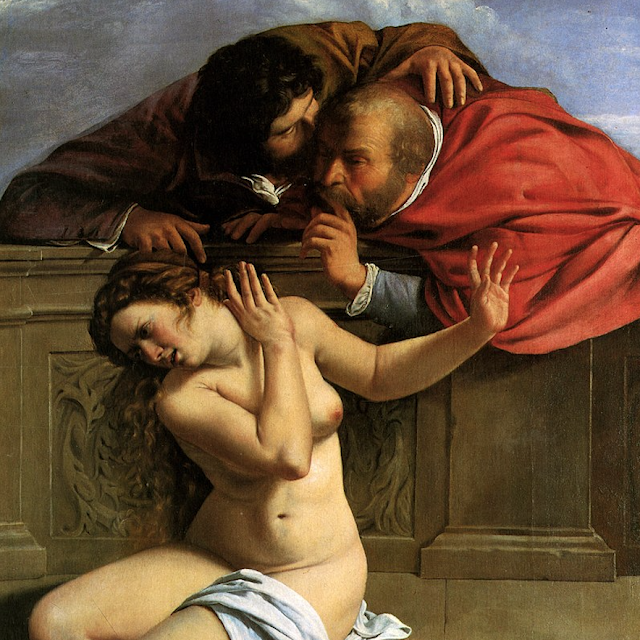
Painting, 1610 Artemisia Gentileschi What if we're missing something important in our understanding of the nunnery/eavesdropping scene (3.1), with Ophelia and Hamlet spied on by Polonius and Claudius? —What if it has more to do with Elizabethan politics and propaganda than with Freud? —What if Elizabethans may have understood the scene very differently because of current events of the Elizabethan age, but which has been lost over time? —What if the missing clue is that the scene offers a radical variation on the tale in Daniel 13, about the virtuous Suzannah, whom two judges tried to coerce into having sex with them? Frank Ardolino (author of Apocalypse & Armada ) says the eavesdropping scene in Kyd's Spanish Tragedy echoes the biblical tale of Suzannah & corrupt judges (Daniel 13), a tale often used to defend Elizabeth I from her critics: Her defenders compared the Virgin Queen Elizabeth to the virtuous Suzannah, and compared her critics to the corrupt jud...