Posts

Showing posts with the label Shakespeare

Hamlet, John the Baptist, and Jesus as Symbolically Political

Image
My previous post noted that Hamlet alludes to John the Baptist [1]. Consider the religious, symbolic, and political significance of John baptizing at the Jordan [2], for Jews who knew their founding story by heart, that Moses led their ancestors through parted waters of the Red Sea to freedom and a promised land, escaping a foreign oppressor [3].  John at the Jordan plays into the same tropes, where Rome (not Egypt) is the foreign oppressor (which in part explains why Rome and Herod Antipas saw him as a threat). England’s Henry VIII claimed he needed to repent of incest, had seen action in battle, but was thought to have died a sinful man, guilty of foul crimes. Hamlet deals with an incestuous king and the ghost of a king, fearsome in battle, who died with sins on his soul, foul crimes. Same tropes. Hamlet alludes to both Julius Caesar and Jesus. Consider Jesus, preaching where Roman coins bore the image of a Roman emperor [4] with an inscription calling the emperor “son of a go...

Hamlet, Uriah, and Shakespeare's Transformation of the Death Letter

Image
How old is the death letter motif in Hamlet, where did it come from, and is there anything special about the way Shakespeare uses it? In Hamlet, Shakespeare retains the motif of the death letter from the Danish source. Claudius sends a letter with Rosencrantz, Guildenstern, and Hamlet on their journey to England [4.3.67-77], but they don’t know that it orders Hamlet’s death. People in Shakespeare’s time knew this death letter motif by way of the biblical story of David’s affair with Bathsheba (circa 10c. BCE). King David sends Bathsheba’s husband Uriah to the battlefront with a letter that he is to be placed at the front of battle, and others should pull back. He is killed [1]. A later Greek version of the motif comes from the 8th century BCE myth of Bellerophon [2]. The reluctance of kings to violate rules of hospitality plays a key role in delaying fatal plans and helping Bellerophon prevail in the end. For anyone who is sad to hear of Uriah’s fate, a faithful soldier deceived b...

Hamlet's Denmark as prison, John 14:2, and Dante

Image
When Hamlet says, “Denmark’s a prison…in which there are many confines, wards, and dungeons,” there is a bitter, sarcastic echo of John 14:2, “In my father’s house there are many dwelling places” – but all four major reference works on Shakespeare and the Bible since 1905 ignore it [1] HAMLET What have you, my good friends, deserved at the hands of Fortune that she sends you to prison hither? GUILDENSTERN Prison, my lord? HAMLET Denmark’s a prison. ROSENCRANTZ Then is the world one. HAMLET A goodly one, in which there are many confines, wards, and dungeons, Denmark being one o’ th’ worst. (2.2.58-66) Compare: In my Father’s house are many dwelling places: [...] - John 14:2 [2] Instead of God sending people to their dwelling as in John 14, Fortune sends Rosencrantz and Guildenstern hence to Denmark as prison, in Hamlet's statement.  Why do these reference works miss or ignore this allusion? Probably for its bitter twist to sarcasm. Especially by Act 5, scene 2, Hamlet’s biblical ...

Beloved Boudica, Contemptible Claudius, Elizabethan Analogies (Part 8, Claudius series)

Image
“CLAUDIUS” WAS NOT A NEUTRAL NAME in Shakespeare’s England, nor was the fact that Claudius I of Rome had invaded England with elephants in 43 AD [1]. By the time Shakespeare’s first and second quartos of Hamlet were published (1603-4), two Roman Catholic popes had excommunicated Elizabeth (Pius V, 1570; Sixtus V, 1588) and openly encouraged her assassination. Rome also supported three Spanish Armada’s attempts to invade England during her reign (1588-1597). All of this colored England’s views of Roman history and of native resistance, such as that of Boudica [2], sometimes called “Queen of the Iceni” tribe, who led a rebellion against Roman occupiers slightly less than two decades after the invasion of Claudius. When her husband, King Prasutagus died, Boudica was flogged and her daughters were raped. Killing as many as 80,000, Boudica’s revolt destroyed a settlement of Roman military veterans at Camulodunum (now Colchester), where a large and expensive temple to Claudius I was locate...

The 11TH DAY OF CHRISTMAS in Churches of Shakespeare's Time - Series, Part 11

Image
On the 11TH DAY OF CHRISTMAS IN SHAKESPEARE’S TIME, JANUARY 4, church congregations would have heard the following scriptures, part of the religious-literary fabric from which Shakespeare borrowed: Psalm 4 involves David’s prayer when he was persecuted by King Saul. David must be clever to avoid being killed by Saul, as Hamlet must be clever to avoid being killed by Caudius. Genesis 5 tells of Lamech, descendant of Seth and Methuselah, not to be confused with Lamech descendant of Cain, mentioned on the 3rd, “Lameth” being an anagram of “Hamlet” [1]. Matthew 3 speaks of John the Baptist (mentioned on Christmas Day, "First Day of Christmas," and on the last two Sundays of Advent), and of his baptizing of Jesus in the Jordan, an echo of Moses leading the Israelites out of Pharaoh’s Egypt. John the Baptist, as previously mentioned [2], is alluded to in Hamlet and his player queen, “Baptista” (3.2.263). Romans 3 speaks again of circumcision, as did the Feast of the Circumcision ...

Shakespeare's Pericles - Royal Shakespeare Company on Tour in Chicago

Image
We went on pilgrimage to Chicago over the weekend to see Shakespeare's 𝙋𝙚𝙧𝙞𝙘𝙡𝙚𝙨 performed by the Royal Shakespeare Company at the Chicago Shakespeare Theater on Navy Pier. The production was absolutely stunning: - Its set features dramatic use of ropes (as seen in the CST post below) which evokes a sailing ship for the sea-journeys of Prince Pericles. - A surprising number of key scenes incorporate masterfully choreographed dance to convey the competition for, and wooing of, a princess to be the wife of the prince. - The acting was excellent, making the words and lines clear, but also conveying their emotion, and also adding humor and fun. - The performance also included music in very effective ways! This was not merely pre-recorded, but performed live by the actors themselves. - Some members of the playing company had to play more than one (strongly contrasting!) role: they switched with seeming effortlessness and brought each new role to life. Even the smallest grunt o...

Patrick Grey on Shakespeare, Christianity, and Aristotle's Poetics

Image
"So critics want to see Shakespeare as early modern and secular, but Shakespeare is also Late Medieval and Christian. And tragedy for Shakespeare is, I would say, essentially the same thing it is for 15th century, 16th century vernacular drama: tragedy is the failure of a sinner to repent. Whereas for Aristotle, tragedy is something very alien to a Christian sensibility. Aristotle doesn't really care about moral character. [PF note: in the context of his poetic, though he does care about moral character in his ethics]. What Aristotle means by 'hamartia' is not sin, but something more like a mistake. And what he means by 'anagnorisis' is not repentance, but something more like a discovery, like a correction of an error as regards to matters of fact. So for Aristotle, tragedy is amoral: it's like the process of legal discovery that occurs in a court of law. Nonetheless, I think many critics continue to use Aristotle's terms to describe Shakespeare's...

Part 15: Ophelia's Suffering: Chastened, Chosen, Beloved of God?

Image
Critics, readers, and viewers today may think of Ophelia’s suffering very differently than did devout Christians in Shakespeare’s time. Modern critics sometimes assume that, when characters suffer, when prayers to heaven seem unanswered, this must prove there is no God, or that Shakespeare didn’t believe in one. But many churchgoers viewed undeserved suffering differently. Three times every year (10 April, 9 August, and 6 December), Hebrews 12: 6-11 was read at Evening Prayer: 6 For whom the Lord loveth, he chasteneth: and he scourgeth every son that he receiveth. 7 If ye endure chastening, God offered himself unto you as unto sons: for what son is it whom the father chasteneth not? 8 If therefore ye be without correction, whereof all are partakers, then are ye bastards, and not sons. 9 Moreover we have had the fathers of our bodies which corrected us, and we gave them reverence: should we not much rather be in subjection unto the father of spirits, that we might live? 10 For they ve...

Mother's Day After-Party: Mothers in Shakespeare, Part 2

Image
IS IT FAIR, for educators to hijack Mother’s Day as an occasion to examine the rich diversity of mother figures in Shakespeare, and also at times, their absence? I would say yes. Educators often treat such occasions as “teachable moments” when they invite students to study some text or artifact so as to better come to understand history and their culture. In Act 4, scene 4, Hamlet says, How all occasions do inform against me [...]. Sure He that made us with such large discourse, Looking before and after, gave us not That capability and godlike reason To fust in us unused. (4.4.34-41) [1] Such teachable moments should not be wasted, unused. Educators have at their disposal many resources which can work a kind of alchemy to turn occasions like Mother’s Day into gold. - Biology teachers can glimpse in wonder at the workings of the human body that allow conception and breast-feeding; - teachers in the human sciences can explore Freud’s ideas about the centrality of relationships to mothers...

Shakespeare's First Folio Anniversary

Image
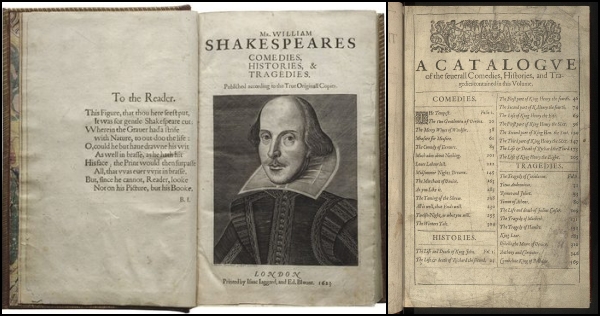
This year is the 400th anniversary of the printing of Shakespeare's First Folio, which contains 36 plays that it labels as 15 comedies, 10 histories, and 12 tragedies. Some of these have later been called problem plays or romances. Of the 36 plays, 18 may have been lost forever if not for the printing of the First Folio. - There are a few others that we know Shakespeare had a hand in that are not included in the First Folio: Two Noble Kinsmen, Pericles, and Edward III. - There are also lost Shakespeare plays: Love's Labour's Won, and Cardenio. - And some Folio plays are known to have been collaborations. The exact date of Shakespeare's birth is not known, although his baptism was recorded as taking place on April 26, 1564, and his death on April 23, 1616. To keep things neat and tidy, his birth and death are observed on the same date, April 23, and this year, the anniversary of the First Folio has attracted special celebrations and publications. Seven years after Sh...

Hilary Gatti on Bruno and Shakespeare: Hamlet / The Historical Context

Image
From Chapter 7 BRUNO AND SHAKESPEARE: HAMLET The Historical Context By HILARY GATTI [...] Those who wish to underline Shakespeare’s position in the course of British history between the end of the sixteenth century and the beginning of the seventeenth, when Hamlet was written and acted for the first time (1600–1601), often explain this dramatic change of mood by pointing to the final years of the long and fertile reign of Queen Elizabeth I, which would soon, in 1603, give way to the beginning of the more unpopular and conflictual story of the Stuart dynasty. For it seems difficult to deny that Shakespeare was possessed of an almost prophetic vision when, in the first decade of the seventeenth century, he elaborated his remarkable sequence of tragic stories of failed princes, who drag with them in their personal disaster the whole kingdom over which they should have reigned (King Lear, Macbeth, Antony and Cleopatra). Such tragedies surely have something to do with the coronation ...