Posts

Showing posts with the label Incarnation

First Day of Christmas in English churches of Shakespeare's Time (series, Part 1)

Image
On the first day of Christmas in Shakespeare’s time, what Bible tales did they hear? People in England were required by law to attend church on Sundays and Holy Days, so hearing at least some of the Bible readings in church [1] would have been mandatory. On Christmas Day, if one rose early and made it to church for Matins (early morning prayer), one would hear the tale from the Gospel of Luke of the shepherds hearing the angels announcing the birth of Jesus, and going to adore him [2]. But if one attended only the later liturgy with communion service, one would hear from the Gospel of John about the Word of God being made flesh (the incarnation, the God of heaven made “incarnate” as a human being on earth), and about John the Baptist preparing the way for Jesus [3]. John the Baptist was already familiar from the gospels for the last two Sundays of Advent, a theme repeated on the first few days of Christmas at morning prayer. How do these come up in Shakespeare? - The infant princess,...

Christmas and the sweep of the incarnation narratives in Hamlet

Image
It is often noted that in its first scene, Shakespeare's Hamlet contains one of the only explicit references to Christmas: Some say that ever ’gainst that season comes Wherein our Savior’s birth is celebrated, This bird of dawning singeth all night long; And then, they say, no spirit dare stir abroad, The nights are wholesome; then no planets strike, No fairy takes, nor witch hath power to charm, So hallowed and so gracious is that time. (1.1.173-179) [1] But the Christmas narrative is actually much longer than merely the story of Jesus' birth. It includes numerous other stories or episodes, each celebrated in gospel readings assigned to particular days in the church calendar. If we don't include all of Judaeo-Christian salvation history but merely the conception, birth, and childhood of Jesus, it begins with Mary being told by the Angel Gabriel that she has conceived by the Holy Spirit. This is called the Annunciation. Shakespeare's Hamlet alludes t...

The Black Rubric and Hamlet’s Feminizing of a Distant, Indifferent Divine

Image
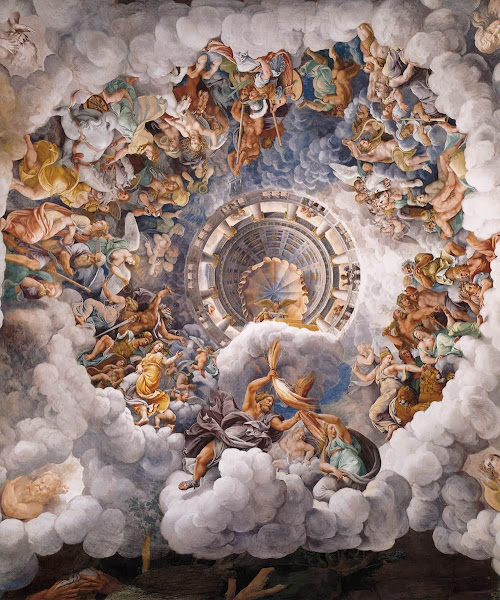
Consider two moments in Hamlet when it is made explicit: Maybe God is not paying attention to human suffering? THE FIRST is when the First Player tells the revenge tale of Priam’s death at the hands of Pyrrhus (2.2). Hecuba, Priam’s wife, watches. [See note #1 below: "Who in Shakespeare's England was like Hecuba, witness to a brutal killing of a loved one?"] The First Player says that the “synod” of the gods (like bishops and cardinals?) should take away the powers of the goddess Fortune (like an excommunicated Elizabeth I?), breaking her wheel, and “bowling” her “down the hill of heaven, / As low as to the fiends!” First Player: But if the gods themselves did see her [Hecuba] then, [/...] The instant burst of clamour that she made (Unless things mortal move them not at all) Would have made milch [milk] the burning eyes of heaven.... [In a fresco (circa 1532-1534) by Giulio Romano (1499–1546), the image above depicts the gods overcoming the titans. Public ...

IN HAMLET, MUST AN ALLUSION TO THE INCARNATION IMPLY A DIVINE INFANCY NARRATIVE?

FOR SHAKESPEARE, MUST AN ALLUSION TO THE INCARNATION IMPLY A DIVINE INFANCY NARRATIVE? Two weeks ago, I posted regarding how Hamlet 1.1 refers to many Christian mysteries: Incarnation, teachings, passion, resurrection, and end times. The allusion to the incarnation takes the form of an allusion to “that season... / Wherein our Saviour's birth is celebrated.” But the gospels show that the Christian idea of God can be incarnate in more ways than a Bethlehem-born infant: —The Emmaus tale shows how one can find the risen Jesus in the stranger who does for us things like those things that Jesus did. —Ophelia’s mention of the story about how “the owl was a baker’s daughter” is an example of how we sometimes reject the presence of Jesus in the stranger or beggar, with negative consequences. So we should not assume that mention of “our savior’s birth” is a foreshadowing of another infancy narrative in the play. That never comes. Hamlet finds God’s hand at work in the pirates; p...