Posts

Showing posts with the label Beggar

Worms and beggars will triumph over Kings - Herod Antipas and Hamlet 4.3

Image
In Hamlet 4.3, instead of “Long live King Claudius!” Hamlet names worms as emperors [1]: Eventually, worms will overcome every king, after which even a beggar might eat, digest, and defecate a monarch. In the end, the meek (including beggars and worms) inherit the earth and its kingdoms [2].  But how can a beggar defecate a king?  (Some people in the USA, terrorized by ICE, may be asking the same thing.)  Hamlet explains the food chain to Claudius, who has lied consistently in the play about a key murder for which he is responsible:  KING  Now, Hamlet, where’s Polonius? HAMLET  At supper. KING  At supper where? HAMLET  Not where he eats, but where he is eaten. A certain convocation of politic worms are e’en at him. Your worm is your only emperor for diet. We fat all creatures else to fat us, and we fat ourselves for maggots. Your fat king and your lean beggar is but variable service—two dishes but to one table. That’s the end. KING  Alas, ala...

Part 47: Ophelia's “O” and the Virtues of Nothingness

Image
Ophelia in Hamlet represents a paradox about both the injustice and virtue of nothing, emptiness, poverty: Ophelia is an intelligent young woman [1], lectured, silenced [2], taken for granted [3], told what to do, where to go [4], and whose death is linked to crown-envy [5], a cautious way for Gertrude to blame the envious actions of Claudius for Ophelia’s death. When Hamlet makes bawdy remarks at the playlet, “The Mousetrap,” Ophelia says, “I think nothing” [6]. In Elizabethan slang, women have “nothing” between their legs, while men have a “thing.”[7] “Nothing” is a theme in other Shakespeare plays: - A self-centered Richard II, losing his throne, says, “I must nothing be” [8]. - King Lear wants his favorite daughter Cordelia to be best at expressing her love for her father, but she refuses to play the game. Lear tells her “Nothing can come of nothing” [9]. By the end, Lear will be emptied and learn poverty. Many world religions emphasize the virtue of humility and spiritual povert...

Laertes in Hamlet & the Odyssey - Part 1

Image
Federico La Sala recently reminded me that the name Laertes in Hamlet comes from Homer's Odyssey. [1] I am grateful to him for pointing me in this direction. Allusions for Shakespeare are usually not all-encompassing, and don’t align on every point, but seem chosen for what limited light they shed. I usually focus on biblical allusions, but here’s a detour (some possible Odyssey allusions or influences): 1. DEFENDER OF WOMEN AND PRINCES: ODYSSEY: Laertes defends Penelope, wife of his son Odysseus (gone 20 years), from suitors who believe he is dead. HAMLET: Laertes defends his sister from a possible affair with Prince Hamlet, and defends the prince, in case Hamlet must marry to secure a foreign alliance (1.3). (Polonius is widely believed to be a satire of William Cecil, and therefore Laertes may be a satire of his son Robert Cecil, who became a key advisor to Elizabeth even before his father's death; to call a satire of Robert Cecil "Laertes," may be the ...

Begging & Poor (& Chastity & Pregnancy) in Love's Labour's Lost (1594-1597)

Image
Love's Labour's Lost has an earliest recorded performance before Queen Elizabeth as part of the court's Christmas festivities in December, 1597. [Title page from the 1598 first quarto, cropped, via Wikipedia . Public domain.] Elizabeth had been promoted as "Virgin Queen," but was rumored to have had affairs, and many in England were anxious about the fact that she had not married and produced an heir; so it is interesting and significant that the play has a theme of how difficult and impractical chastity can be. It's as if Shakespeare said: Court Christmas play? Virgin queen? Rumored affairs? No heir? How about a comedie about failing at chastity, pregnancy before marriage, falling in love, and reforming bad habits? (Let’s face it: Life is not all about work, even for a monarch! It’s about love. Right?) The play preempts heckling from the court by including a masque, which members of the court heckle; it preempts criticism of its playwright for having ...

Begging and Poor in The Comedy of Errors (1594)

Image
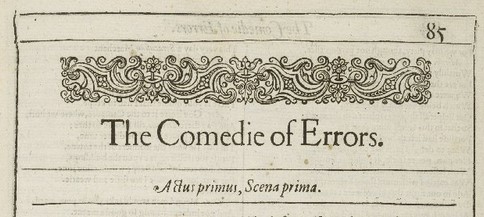
In The Comedy of Errors, "beg" occurs only four times; "poor," 10. The story contains two sets of twins, and each set bears the same name: Two of Antipholus, two of Dromio, the former raised to be masters, the latter bought and raised to be servants (slaves). - Because "their parents were exceeding *poor*," the Dromio twins were "bought and brought up to attend" Egeon's sons (1.1, an act of charity, or exploitation, or both). - But Egeon of Syracuse has traveled to Ephesus as a refugee to find his later-separated sons, risking death by execution because Syracuse and Ephesus are at war. - Solinus, Duke of Ephesus, tells Egeon to *beg* or borrow the money for his ransom to spare his life (1.1). - Luciana, sister-in-law to Antipholus of Ephesus, tells her sister that the love she *begged* for her sister from the Antipholus she believed was her sister's husband, he begged of her (4.2, because unknown to her, the Antipholus who begged lov...

Begging and Poor in Richard III (1592–1593)

Image
The word "beg" occurs 13 times, and "poor," 25 times in Richard III . On the lips of Richard, Duke of Gloucester, when it is not disparaging, it is often dishonest and manipulative. The Princes in the Tower (among others) are very concerned with avoiding the appearance of begging as a mark of weakness. A failed assassin claims conscience leaves him a beggar (a theme that comes up again in Hamlet). In comparison, when Prince Hamlet and others refer to him as “poor” and “beggar” (more often than any other character in that play) the contrast between Hamlet and these other royals is stark and significant. [From title page, Richard III (cropped), from the second folio of 1632. Image via Folger Shakespeare Library . Creative Commons.] Nizar Zouidi of the University of Hail has noted the performative aspect of Richard III : He performs the roles of script writer, actor, and director in his own show ( See Nizar's abstract for his essay/chapter here .) R...

Begging and Poor in 3 Henry VI (1591)

Image
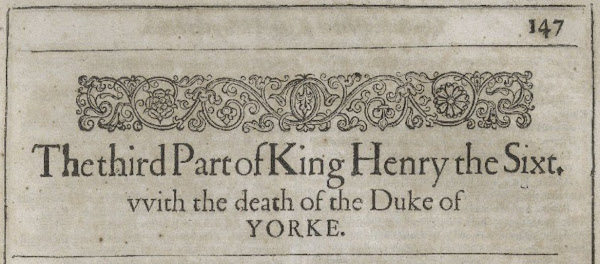
Shakespeare's Henry VI, Part 3 has five instances of "beg" and 18 of "poor." Characters often act more like the self-concerned rich man in the gospel tale than like beggar Lazarus, with the exception of Henry, who, while a weak king, is more humble than most of his nobles. [Image cropped from The third Part of Henry the Sixt, with the death of the Duke of Yorke , in the Second Folio edition of 1632, via Folger Shakespeare Library Digital Image Collection . Creative Commons.] "Poor" in this play is often used to mean "pitiable," and often sarcastically by characters who lack pity ( *emphasis* mine): 1.1 York and Lancaster factions argue about their claims to the throne. Lord Clifford is impoverished by the death of his father but also by his thirst for revenge. Warwick calls him "poor Clifford" as one might taunt an enemy: Earl of Warwick: " *Poor* Clifford! how I scorn his worthless threats!" Under duress, He...