Posts

Showing posts with the label Salvation by faith or works

Hamlet and the Numbering of the First and Second Commandments - Series

Image
The ways that different Christian groups numbered the Ten Commandments may mean little to us today, but these meant a great deal in Shakespeare’s lifetime and may have left its marks on Hamlet. Catholics and Lutherans followed the numbering of St. Augustine (5th century):  1. THOU SHALT HAVE NO OTHER GODS BUT ME - and - THOU SHALT NOT MAKE TO THYSELF ANY GRAVEN IMAGE.  The second half emphasizes the first: Worship God alone, not other gods or graven images.  But reformed churches (including Calvinist Scottish and English churches) used an older numbering of Origen (3rd Century):  1. "THOU SHALT HAVE NO OTHER GODS BUT ME."  2. "THOU SHALT NOT MAKE TO THYSELF ANY GRAVEN IMAGE."  Graven images included icons, statues, paintings: targets of Elizabethan iconoclasm.  To reformed churches, Catholics were idolators, worshiping statues, rosaries, and paintings of saints instead of God alone. Following the older numbering from Origen made it easier to justify...

Faith vs. Works in Hamlet: Horatio and Marcellus in 1.4

Image
My last post was on "Works vs. Faith" [1], relating to Hamlet changing the death letter on his ship to England. Salvation by faith and/or works was a hot topic in Shakespeare’s England, much less so today. But an analogy can be found in economics: - Some advocate Laissez-faire (or “free-market”) economics with minimal guidelines or interventions, a materialistic parallel of salvation by faith. - Others advocate managed economics (like democratic socialism). This is like faith plus works: basic faith in the system, but more “works” regulating it, and more social safety net to level the playing field. Some critics and scholars note a reference to a faith vs. works in Act 1, scene 4, when Hamlet wants to follow the ghost and commands his friends not to stop him: MARCELLUS: Let’s follow. ’Tis not fit thus to obey him. HORATIO: Have after. To what issue will this come? MARCELLUS: Something is rotten in the state of Denmark. HORATIO: Heaven will direct it. MARCELLUS: Nay, let’s f...

Works vs. Faith in Hamlet: Changeling Letter vs. the Mercy of Pirates

Image
When Shakespeare's Hamlet was first produced, a hot topic in reformation England was faith vs. works: Are we justified in the eyes of heaven by our faith, or our works? All English Christians (Catholic, Protestant, and others) used bible translations featuring St. Paul who wrote of salvation by faith (e.g. Romans 3:28, 5:1; Galatians 2:16). But a letter of James said that "faith without works is dead" (2:14-26) and that "a person is justified by works and not by faith alone" (v.24). This apparent contradiction is similar to what Shakespeare's Richard II notes while imprisoned, comparing what seem to be incompatible scripture phrases: "...thoughts of things divine, are intermixed With scruples, and do set the word itself Against the word..." (5.5.12-14). On faith v. works, Protestants preferred Paul's formulations, while Catholics preferred James. Events on Hamlet's sea voyage relate to this debate without ever using the words “faith” or “...

Hamlet's Indecision and Shakespeare's Mousetrap for Impatience

Image
Shakespeare catches the conscience of audiences impatient for action: 1. Speaking to the ghost, Hamlet says he’ll act with wings swift as... lightning? Nope. As “meditation or thoughts of love” [1.5.36]. In other words, NOT SWIFT. He's not planning swiftness but caution. 2. After the players arrive, Hamlet scolds himself for cowardice: "O, what a rogue and peasant slave am I! [...] A dull and muddy-mettled rascal, [...] I am pigeon-livered" [2]. Whether or not we condone revenge, we may admire Hamlet scolding himself for apparent cowardice.  3. Hamlet ends this speech saying he needs to be more certain of the ghost’s honesty and Claudius’ guilt, so he’ll put on a play to catch the conscience of the king [3]. This may inspire a public confession from Claudius. If not, then what should Hamlet do?  4. Next act: To be or not? Should Hamlet patiently tolerate the scandal of his father's murder and his mother's hasty remarriage - "suffer / The slings and arrows o...

Blasphemous Claudius revisited (Part 19, Claudius series)

Image
An idea central to the Protestant Reformation was salvation by “faith alone,” not works [1]. This may help to understand why Marjorie Garber says the drinking game of Claudius approaches blasphemy [2]. Claudius’s drinking game is a celebration of works: Can the king drink the whole flagon without stopping? Fire the cannon! Best king? Claudius! To his health! Long live Claudius! Fire the cannon! The works of Claudius result in “earthly thunder” that the heavens “re-speak” [3] (echo). This is deeply ironic: the work of Claudius by which he obtained the throne was a work of poisoning, fratricide, regicide, usurpation, and lying to cover it up. Celebrate, fire the cannon: He got away with it? When Hamlet tries to conspire – to force his “works” to achieve revenge for his father’s death – he makes mistakes, and innocent people (like Polonius) are killed (3.4). Only late in the play does he articulate his new faith: “There's a divinity that shapes our ends, Rough-hew them how we will” ...

Part 39: Ophelia, Gertrude, Hamlet: three damned souls as saved Christ-figures

Image
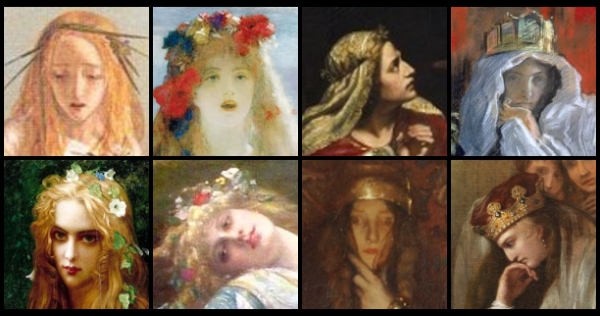
Shakespeare’s Hamlet is radical in a religious sense. Shakespeare hints that Ophelia, Gertrude, and Hamlet—apparently damned for different reasons—are not only saved, but in fact are Christ-figures [1]. The texts support such a reading. Yet even if Shakespeare uses religion mostly for dramatic (not religious)  purposes [2], it is safe to say that a majority of scholars today might reject this idea, or at least be quite disinterested in it. Ophelia is apparently damned as a suicide [3], but Gertrude blames her death in part on an “envious sliver” of willow [4], envious — like Claudius — that it didn’t get a crown. Ophelia was generous in bestowing crowns (coronets) [5], like Christian scriptures which claim that all people can be adopted sons and daughters of God, and can inherit a heavenly crown [6]. Gertrude is apparently damned for her “incestuous marriage” to her dead husband’s brother [7], scandalous and forbidden, especially after the divorce of Henry VIII from his first wife ...

Part 28: Ophelia saved by faith alone, or by Gertrude's work of mercy?

Image
Shakespeare’s Hamlet begins with Horatio acting like a doubting Thomas [1], not believing in ghosts, converted to belief after witnessing a ghost first-hand. But unmentioned is the lesson Jesus gives in John’s gospel after Thomas comes to belief: “...blessed are they that have not seen, and have believed.” [Jn 20:29] Are we invited to wait for this other shoe to drop? Shakespeare constructed his play so that Ophelia’s death, and Gertrude’s account of it, requires of all a leap of faith: Not seeing, but believing. Gertrude describes it not as a death in despair, but in charity (generously bestowing crowns) [2] and in faith (chanting sacred hymns) [3] after falling in the brook by accident, not intent.[4] In Gertrude’s account, Ophelia floats toward her death without struggle, as if to accept the risk of her own death in faith, like Hamlet: “Let be.”[5] We have not seen her death, yet we are invited to believe. The play invites cognitive dissonance between the expected damnation of sui...

Sleuthing Biblical Contexts of Lazarus Echoes in Hamlet (Part 5)

Image
IF SHERLOCK HOLMES had been assigned to investigate a murder (perhaps of a king?), and if the evidence included multiple references to the tale of "Lazarus and the Rich Man," both explicit and subtle, implicit, or veiled, he would be remiss if he neglected to review one of the main sources of the tale, the 16th chapter of the Gospel of Luke (reprinted here from the Geneva translation at the end of this blog post). [Sherlock Holmes image via Public Domain Images-dot-net . Geneva Bible front page via Wikimedia Commons .] If the murder involved Shakespeare references to the Lazarus tale, he might check both the Bishop's Bible translation (which was read in church in Shakespeare's lifetime), and the Geneva translation, most common in home copies of at the time. Representations of the tale of Lazarus and the Rich Man were manifest in many ways in Shakespeare's England, in church art and architecture, in song and official sermons, and transformed in folk ...