Posts

Showing posts with the label Baptista

Hamlet's Baptista and the Multiverse of Allusions

Image
In Shakespeare's England, the 3rd and 4th Sundays of Advent (before Christmas) featured John the Baptist [1], a prophet referred to in Hamlet. The name is feminized to "Baptista" and given to the player queen in 3.2. Hamlet claims "The Mousetrap" or "Murder of Gonzago" was an existing ("extant") historical tale [2]. In fact a Duke of Urbino (not Vienna) was poisoned; Eleanor Gonzaga was his wife. The wife of a predecessor was Battista Sforza [3]. Shakespeare made historical errors on purpose: Hamlet picks the duke’s predecessor’s wife’s name to borrow the name Baptista, so he can allude to John the Baptist, who condemned the marriage of Herod Antipas to his brother's divorced wife [4]. Hamlet wants to catch the king's conscience [5], but must avoid being too confrontational, so he borrows "Baptista" to subtly evoke (but also cleverly distract from) a biblical allusion to Jesus’ kinsman [6] who was beheaded for opposing a k...

Painting of John the Baptist in Shakespeare's schoolroom

Image
On Instagram, ShakespearesSchoolroom notes, "during the restoration of Shakespeare’s Schoolroom & Guildhall in 2016 a rare medieval wall painting was uncovered. Identified by experts as John the Baptiste..." [1]. Interesting to think of a young Shakespeare perhaps seeing that and other paintings of the prophet, and later naming the player queen in Hamlet as "Baptista," after the prophet who condemned the marriage of Herod Antipas to his brother's divorced wife. Also, when Jesus goes to be baptized by John at the Jordan River, John says to Jesus, *you* should be baptizing *me* - but Jesus replies, "Let be." Famous line also in Hamlet, and in Paul McCartney's song catalog. In some of the old variorum Shakespeare editions, some editors resisted the idea that "Baptista" was an allusion to John the Baptist, claiming it was merely a common female name, but Joseph Ritson (1752-1803) held his ground and said it was. Good for him. Even centuri...

First Day of Christmas in English churches of Shakespeare's Time (series, Part 1)

Image
On the first day of Christmas in Shakespeare’s time, what Bible tales did they hear? People in England were required by law to attend church on Sundays and Holy Days, so hearing at least some of the Bible readings in church [1] would have been mandatory. On Christmas Day, if one rose early and made it to church for Matins (early morning prayer), one would hear the tale from the Gospel of Luke of the shepherds hearing the angels announcing the birth of Jesus, and going to adore him [2]. But if one attended only the later liturgy with communion service, one would hear from the Gospel of John about the Word of God being made flesh (the incarnation, the God of heaven made “incarnate” as a human being on earth), and about John the Baptist preparing the way for Jesus [3]. John the Baptist was already familiar from the gospels for the last two Sundays of Advent, a theme repeated on the first few days of Christmas at morning prayer. How do these come up in Shakespeare? - The infant princess,...

Religious and Biblical allusions and plot echoes in Hamlet 1.2

Image
Here are a few key religious and biblical allusions in Hamlet 1.2 (not an exhaustive list): ~~~~~ CLAUDIUS: ...our sometime sister, now our queen,/ [...] Taken to wife. (1.2.8-14) For Shakespeare’s English audience, this would have struck a nerve: Henry VIII had married his dead brother’s widow, Katherine of Aragon, but later (after no living sons and an affair with Anne Boleyn) claimed it was a biblically forbidden marriage.  [For more on the biblical passages related to "incestuous marriage" see this link: https://pauladrianfried.blogspot.com/2022/06/the-bible-henry-viii-claudius-and.html ] Therefore he claimed he needed an annulment, which triggered the English Reformation and many executions of Protestants as heretics (by Mary I) and of Catholics as treasonous (by Henry, Edward, Elizabeth). So audiences would have viewed Claudius as being like a Henry VIII who had not repented of his incestuous marriage. ~~~~~ CLAUDIUS: Young Fortinbras, Holding a weak supposal of our...

13 Handles on Hamlet's Mousetrap

Image
How might we best grasp (“get a handle on”) Hamlet’s “Mousetrap,” the play-within-the-play? Thirteen handles (see also more lengthy endnotes corresponding to numbered list): 1. Hamlet asks the first player if he can play “The Murder of Gonzago.” This points to Francesco Maria I della Rovere, Duke of Urbino; whose wife was Eleonora Gonzaga, and who was marginalized (like Essex and Lord Strange, and poisoned like Strange).[1] 2. “The play’s the thing / Wherein I’ll catch the conscience of the King.” — Hamlet says he will do this by reproducing events like his father’s murder with the help of the players.[2] 3. This conscience-trap echoes the prophet Nathan catching King David’s conscience in a story, after David’s affair with Bathsheba and arranging for the death of her husband.[3] 4. The play-within-the-play begins as a trap for the conscience of his mother, Queen Gertrude. — Later in Gertrude’s closet scene, it’s clear that Hamlet wants his mother to repent, a...

Does Shakespeare’s Hamlet depict religiously shaped or motivated regicide?

Image
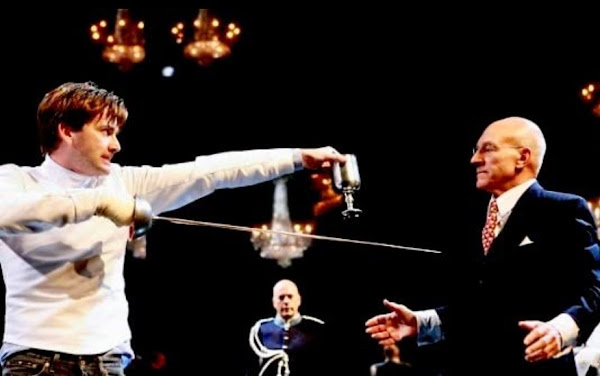
Does Shakespeare’s Hamlet depict religiously shaped or motivated regicide? [1] Given its many religious and biblical allusions and plot echoes, I would argue that it does. [David Tennant (L) as Hamlet and Patrick Stewart (R) as Claudius in the 2009 film, Hamlet , dir. Gregory Doran. Source: IMDB . Fair use.] Dr. Arthur F. Marotti gave a talk at Fordham in late October of 2013 in which he noted, “In the last years of Elizabeth’s rule people believed something was rotten in England—though perhaps not rotten enough to justify regicide. ” [2] Marotti has written numerous books [3] about Early Modern literature and religion, including a 2004 essay with Ken Jackson on “The Turn to Religion” in Shakespeare studies. In an abstract for a more recent (2017) essay [4], Marotti notes that “Shakespeare's plays may not stage religiously motivated regicides…,” with “may” being the operative word here: Scholars may disagree on this point. But what about Hamlet? Recognizing that H...

Hamlet & the Gerasene Demoniac: Using Subversive, "Changeling" Words

Image
Sometimes a single word can be politically subversive. BAPTISTA: Prince Hamlet claims the wife of the player queen (actually of a poisoned Italian duke) was named "Baptista," an Italian name in an otherwise mostly English play. An actual, historical figure, he claims. But this is not true. "Battista" was the wife of a predecessor of the poisoned duke, not the wife of the poisoned duke himself. [See the long note, p. 507, bottom, in the 1982 Arden Hamlet edited by Jenkins.] Did Hamlet and Shakespeare mess up the history, or is something else going on here? Something else, I think. Hamlet makes a point of it to mention her name because she is named after John the Baptist, the prophet mentioned in the gospels who opposed the marriage of Herod Antipas to his brother's divorced wife. Hamlet wants to use this name because, like John the Baptist who opposed an incestuous marriage, Hamlet opposes the incestuous marriage of Claudius and Gertrude. Shakespeare's ...