Posts

Showing posts with the label Ernest Jones

Prodigal is Oedipal spelled badly - Biblical Allusions as Lenses for Hamlet

Image
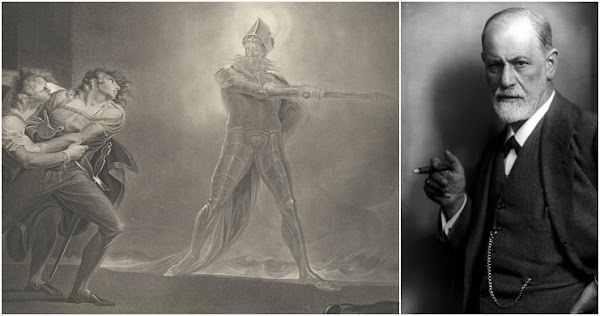
HAMLET AS PRODIGAL (OEDIPAL SPELLED BADLY) OEDIPAL [1]: Freud claimed that men want to kill their fathers and possess their mothers, like Oedipus, whose father (Laius) was in fact a jerk. Laius made bad karma, abandoning his son to die.[2] - Oedipus doesn't know he was saved and adopted, so he thinks the prophecy means he will kill his adoptive father and marry his adoptive mother. He doesn't want that, so he flees. - While fleeing, his biological father is cruel to him on the road, and Oedipus kills him, not knowing it is his father. - Having suffered trauma as a child, Oedipus may be lashing out in revenge at a stranger who happens to be his father. All fathers die, most before their sons. But the tale is also a metaphor for how children need to establish their own identities as distinct from their parents (though some sons may "want a girl / just like the girl / that married dear old Dad," as the song says.[3]) We can follow Freud and read Hamlet as Oedipal. PRODIG...

Part 21: Ophelia's Bonny Sweet Robin: Tricksters who Redistribute Agency

Image
In her alleged madness, one of Ophelia’s lines that has attracted critical attention is when she sings, “For bonny sweet Robin is all my joy” (4.5.210). For years I ignored this song of Ophelia's, but given how many feminists speak of the lack of agency of Ophelia and Gertrude, it occurred to me:  Robin Hood is a trickster who stole from the rich and gave to the poor. In doing so, he redistributes not only wealth, but also agency. As often happens, the lines we once ignored may be more important than we thought at first.  In 1958, during the cold war and still relatively soon after the impact of Freud and his student, Ernest Jones (Hamlet and Oedipus, 1949), Harry Morris wrote an essay about this part of Ophelia’s songs, highlighting mostly the bawdy slang implied with Robin (Bob, Knob) and such details as one tale of Maid Marian given over to Friar Tuck as a concubine. [1] This should not be ignored, as the Robin Hood tales and plays were associated with spring festiva...

Part 1: Hamlet Before Freud ("Tough Love" for Gertrude and Ophelia)

Image
If we take seriously that Hamlet, Horatio and the sentinels saw a ghost from purgatory, [1] then we have to consider this possibility: Hamlet is harsh with his mother and Ophelia because he thinks he has seen his father’s ghost from purgatory who claims to be there because he had sinned, committed foul crimes. Hamlet doesn’t want the two women he loves most to end up in purgatory like his father, or worse, in hell. He scolds Ophelia and tells her to get to a nunnery; he scolds his mother, tells her to repent of her incestuous marriage, a relationship that began, according to the ghost, with adultery when his father was still alive. Hamlet feels a duty to be harsh with them because he fears for their eternal fate. If one encountered a ghost from purgatory as Hamlet did, and loved his mother and Ophelia, it makes sense that one might want to warn them, to spare them such a fate. [2] To be clear, while many in Shakespeare’s time believed in ghosts [3], there were also those who did not,...