Posts

Showing posts with the label Richard Strier

MORE PARTICIPANTS AT SAA DENVER 2026

Image
MORE PARTICIPANTS AT SAA DENVER 2026 My previous post named members in my seminar (Shakespeare and the Forms of Religion), but I met many other wonderful scholars in Denver for The Shakespeare Association of America 2026 conference. Here are six more:  TOP (L-R):  EVELYN GAJOWSKI is an author and one of the most prolific Shakespeare essay collection editors today. [1]  ARNIE PERLSTEIN has long been a strong supporter of my work, and was presenting in a workshop on the afterlives of The Taming the Shrew. His focus was on Shakespeare’s influence on Jane Austen in works like Pride and Prejudice and he has a blog about Jane Austen’s works. [2] RICHARD STRIER (emeritus, U. of Chicago) has written a number of books that have had a profound effect on my thinking [3]. Strier nicely distinguishes between common scholarly assumptions and facts related to texts:  “Interpretive conclusions, even widely held ones, do not become facts. That Hamlet delays in killing Claudius is a...

The Seduction of Fiction: A Plea for Putting Emotions Back Into Literary Interpretation by Jean-François Vernay

Image
The Seduction of Fiction: A Plea for Putting Emotions Back Into Literary Interpretation by Jean-François Vernay English translation by Carolyne Lee Arabic translation by Fuad Abdul Muttaleb Because of my connection with Fuad Abdul Muttaleb, I learned of Vernay’s book and am very happy to have obtained a copy. Vernay is concerned not only with declining interest in literature studies, but also with how the teaching of literature can be too alienating for students because it takes much of the emotion and joy out of reading: Scholars and teachers can seem more interested in forcing literature to fit into the too-restrictive boxes of various literary-critical schools of thought, so instead of being immersed in the experience of reading, literature is used as a screen upon which scholars and instructors project their predetermined literary-critical ideologies. Chapter 3 begins with an abstract: “Acknowledging the influence of New Criticism on literary studies, Vernay notes that conceptualiz...

Part 1: Hamlet Before Freud ("Tough Love" for Gertrude and Ophelia)

Image
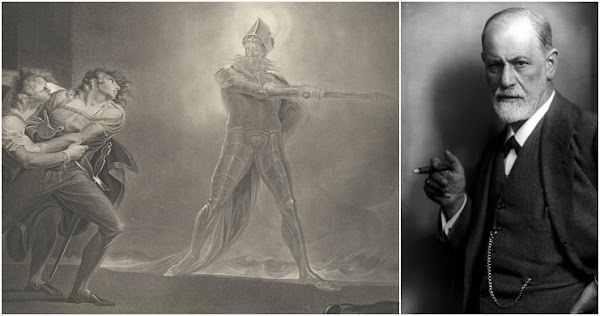
If we take seriously that Hamlet, Horatio and the sentinels saw a ghost from purgatory, [1] then we have to consider this possibility: Hamlet is harsh with his mother and Ophelia because he thinks he has seen his father’s ghost from purgatory who claims to be there because he had sinned, committed foul crimes. Hamlet doesn’t want the two women he loves most to end up in purgatory like his father, or worse, in hell. He scolds Ophelia and tells her to get to a nunnery; he scolds his mother, tells her to repent of her incestuous marriage, a relationship that began, according to the ghost, with adultery when his father was still alive. Hamlet feels a duty to be harsh with them because he fears for their eternal fate. If one encountered a ghost from purgatory as Hamlet did, and loved his mother and Ophelia, it makes sense that one might want to warn them, to spare them such a fate. [2] To be clear, while many in Shakespeare’s time believed in ghosts [3], there were also those who did not,...

Meeting Debra Shuger, Richard Strier, and Nicholas Terpstra at SCSC

Image
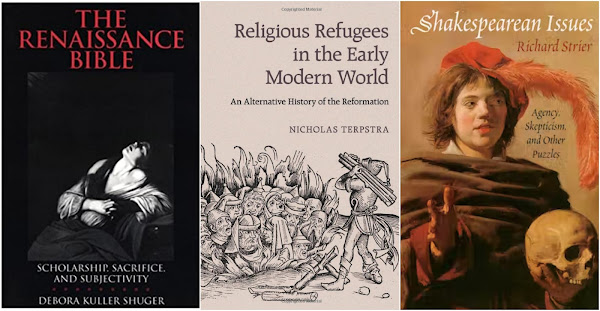
At the Sixteenth Century Society Conference convention in Minneapolis last week, I had many serendipitous meetings with scholar/authors. In a Friday session, “Literature and Religion in Early Elizabethan England,” one presenter cited a source claiming God the Father as defending the masculinity of Jesus. I was reminded of parts of Debora K. Shuger’s book, The Renaissance Bible: Scholarship, Sacrifice, and Subjectivity .[1] During Q&A time, I mentioned how Shuger’s book seemed to offer an alternative view. The presenter replied, “Do you know you are sitting right behind Debora Shuger?” So that is how I met Debora Shuger ,[2] who was kind and generous to talk with me then and later in the conference. I attended a roundtable on Thursday night called “Crisis And Refuge: Historical Reflections On War, Persecution, And Exile.” I had started reading Nicholas Terpstra’s book, Religious Refugees in the Early Modern World: An Alternative History of the Reformation .[3] Terpstra[4] wa...