Posts

Showing posts with the label owl

Part 43: Ophelia's Owl and Hamlet's Mousetrap (cont.)

Image
Last week [1] I shared my belated realization that, after seeing Hamlet’s playlet that he calls “The Mousetrap” [2], Ophelia refers to a folktale in which a baker’s daughter is turned into an owl [3], and that an owl is a “living mousetrap.” For now, I’d like to call mousetraps masculine and externalizing, and owls, female and internalizing. In Shakespeare’s Elizabethan slang, a man had a “thing” between his legs, an external organ; a woman had a “nothing,” an “O,” which could potentially receive a man’s “thing” and which led to her womb, another “O” of potential.[4] Hamlet’s mousetrap analogy for a play to catch the king’s conscience [5] is an external thing, as the script and players (like moving parts of a mousetrap) are external to his body. One sets a mousetrap and waits.[6] In contrast, the owl, a living mousetrap, consumes mice, takes them inside itself, later regurgitating bones and hair. Mousetraps are externalizing and male, like rapiers that Hamlet and Laertes use ...

Part 42: A Living Mousetrap: Ophelia's Owl

Image
OPHELIA: “They say the owl was a baker’s daughter.” What are owls famous for eating — even a dozen in a single night? Mice. What does Hamlet call the play by which he hopes to catch the conscience of the king? “The Mousetrap” [1]. Ophelia sat with Hamlet at his playlet, heard him call it “The Mousetrap.” She soon references a folktale in which a baker’s daughter is ungenerous with a beggar at the door (Jesus or a fairy in disguise), and as punishment, is changed into an owl [2]. Into a living mousetrap. (And the owl asks, “Who? Who?” First words of the play: “Who’s there?”) The name “Gertrude” may point to a Christian saint famous for getting rid of mice [3]. I have argued that, by drinking the poison cup, Gertrude builds a better mousetrap, catching the conscience of Claudius [4]. So there is a trilogy of mouse-trapping characters in the play: Hamlet, Ophelia, and Gertrude. But Ophelia’s owl reference is usually not viewed by scholars, critics, teachers and students as a reference t...

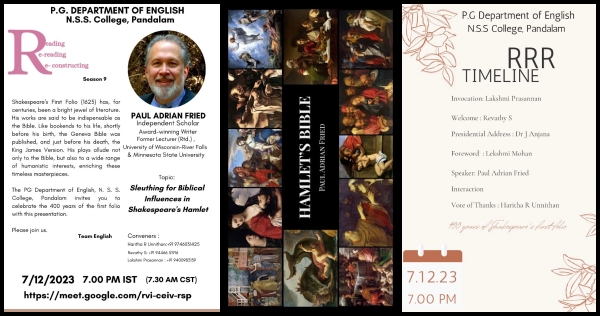
TRANSCRIPT: Presentation for Post Graduates, N.S.S. College, Kerala, India, 7 December, 2023

Image
TRANSCRIPT: Presentation for Post Graduates, N.S.S. College, Kerala, India, 7 December, 2023 Edited planned transcript of remarks delivered on 7 December, 2023, in an online presentation for the Post Graduate program, N.S.S. College, Kerala, India, 7 P.M. IST, 7:30 A.M. CST. (A few words and points below were cut from the live presentation for time considerations, and I made a few additional extemporaneous remarks, but for the most part, this is the transcript.) (I did not have time to talk about allusions that fit into the theme of orphaned children who find transcendent parents in others or in a heavenly parent, but perhaps some other time....) ~~~~~~~~~~~~~~~~~~~~~~~~~~~~~ Informal outline (followed by transcript): INTRODUCTION: [Disclaimers] - Contested times, contested scripture LIST OF BOOKS cataloging Bible allusions in Shakespeare, some open-access: Sleuthing scripture allusions in Hamlet CHANGE THOSE NAMES WITH YOU: Servant-Prince, & Renunciation of Fruits DOUBTING ...

Part 17: Ophelia's "Owl" and "False Steward" Allusions: Why in that order?

Image
In her alleged madness, Ophelia says things that seem merely mad ramblings. But to original audiences, these may have been allusions to well-known tales, and there may be a reason for their ordering. First: OPHELIA: They say the owl was a baker’s daughter. Lord, we know what we are but know not what we may be. God be at your table. (4.5.47-49) [1] Second: OPHELIA:  You must sing “A-down a-down”—and you “Call him a-down-a.”—O, how the wheel becomes it! It is the false steward that stole his master’s Daughter. (4.5.194-197) Consider: “THE OWL WAS A BAKER’S DAUGHTER” is a reference to a tale in which a baker’s daughter is turned into an owl after being repeatedly ungenerous with a beggar at the door - who was Jesus in disguise. This is a folktale retelling of the gospel tale of the Rich Man (Dives) and the beggar Lazarus.[2] Ophelia summarizes: “Lord, we know what we are but / know not what we may be.” Ophelia may feel punished, like the baker’s daughter, and as people in Denmark’s ...

Owl & Beggar Lazarus at Baker's Door in Hamlet 4.5 (part 11)

Image
How Can an Owl Be a Baker’s Daughter? Shakespeare offers a Lazarus allusion in Hamlet 1.5 (couched in a compound word, "lazar-like"). We find things analogous to rich men and beggars in earlier and later scenes (as shown in 1.3 with Ophelia , and in 2.2 with the players , among other such analogous moments). An indirect allusion to the Lazarus tale also comes in 4.5, when Ophelia says, "They say the owl was a baker's daughter." (4.5.2784) The connection of this statement to the Lazarus tale is easy to miss for audiences unfamiliar with the folktale of a beggar treated ungenerously by a baker's daughter. In that tale, a baker is not literally a rich man, but at least rich in bread. When a beggar comes to the door, he readies dough to bake in order to feed the beggar, but after it rises, the daughter repeatedly tells him to make it smaller. He does, but each of three times, it rises even more. The beggar in disguise was Jesus in some versions of the...