Posts

Showing posts with the label conscience

What does it feel like to be Laertes in Hamlet 5.2.324?

Image
What does it feel like to be wrong? In Shakespeare's Hamlet, Claudius had conspired with Laertes to poison Hamlet with a rapier and a chalice of wine. Hamlet apologizes for the death of Polonius: “I shot mine arrow over the house and hurt my brother” - an accident, blaming madness [1]. Laertes sees the queen drink deeply from the poison chalice. Laertes knows she will die. Witnessing her, Laertes hesitates. Kill Hamlet, now? He says in an aside:  “yet it is almost against my conscience.” (5.2.324) But he is too committed to the plan, so he goes ahead. What does it feel like to be Laertes in that moment?  In her book, “Being Wrong” (2010), award-winning author Kathryn Schulz notes that being wrong often feels exactly like being right. When Laertes goes ahead with the murderous poisoning plan, when the crucifier follows orders and nails Jesus to the cross, when the Nazi starts up the gas chamber, some people are so committed to a false ideology that they don’t realize (as Lae...
Part 25: Ophelia's Self-Catching Conscience in the Mirror of her Arts

Image
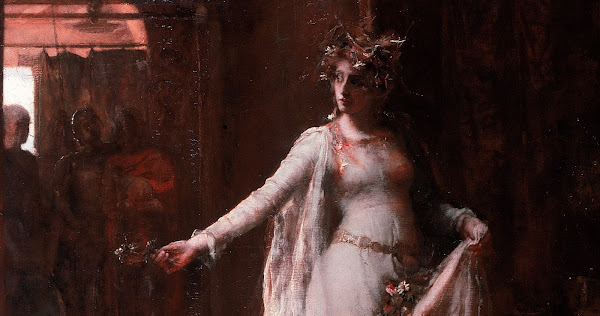
Unlike Claudius, who ignored qualms of conscience to murder his brother and usurp the throne, Ophelia’s relationship to her conscience is more healthy, rich, and self-directed.   Claudius just doesn’t get it, so he needs Hamlet to catch his conscience in The Mousetrap, [1] which reenacts Claudius poisoning his brother and wooing his victim’s wife. Hamlet says playing holds a mirror up to the age [2], and he uses the playlet to hold a mirror up to Gertrude and Claudius, showing what they’ve done. But Ophelia gets it, and doesn’t need someone to hold up a mirror for her conscience. She chooses her own songs, stories, and allusions to reflect upon her sadness and conscience. [3] She knows her father died, but doesn’t know that Hamlet killed him thinking it was Claudius. She sings songs of mourning for perhaps her father and/or the dead king [4], songs of her own choosing. Ophelia knows Hamlet made to her “almost all the holy vows of heaven” [5] perhaps the equivalent of a handfast w...

Hamlet and Cicero on Conscience

Image
“Conscience” in Hamlet is often in dialectic, or even process of formation; in Cicero, more idealized. Compare: HAMLET : O...that the Everlasting had not fix'd His canon 'gainst self-slaughter! (1.2.133-6) HAMLET : The play’s the thing Wherein I’ll catch the conscience of the King. (2.2.633-4) POLONIUS : We are oft to blame in this (’Tis too much proved), that with devotion’s visage And pious action we do sugar o’er The devil himself. CLAUDIUS (aside): ’tis too true! How smart a lash that speech doth give my conscience. (3.1.52-8) HAMLET : Thus conscience does make cowards of us all, And thus the native hue of resolution Is sicklied o’er with the pale cast of thought, And enterprises of great pitch and moment With this regard their currents turn awry And lose the name of action. (3.1.91-6) LAERTES : ...I’ll not be juggled with. To hell, allegiance! Vows, to the blackest devil! Conscience and grace, to the profoundest pit! I dare damnati...

Hamlet's Nietzschean madness, via M. Grenke - Hamlet & the Odyssey - Part 5

Image
Perhaps one way to view the corruption in Denmark in Shakespeare's Hamlet, and to view Hamlet's madness as well, is that it has to do with slavery to time and to impatience. As I mentioned in my previous post, Hamlet makes some of his worst mistakes (killing Polonius), not because he delays, but because he is impatient. Claudius kills his brother, not only because he wants the throne, and wants Gertrude for his wife, but because he is impatient. Michael Grenke's Fall 2016 essay, “Penelope: The Odyssey’s Creative Thinker,” includes rich reflections on the character of Penelope from Homer's Odyssey, and about Nietzsche and the madness of impatience, or slavery to time. I would suggest that Hamlet feels a similar pressure and impatience about revenge due to images of masculinity that he has learned from his father and his culture, and which he has internalized. Grenke writes: ~~~ Human beings become slaves to the clock mostly because other human beings put them on...

Hamlet's Delay, Penelope's Weaving, via M. Grenke - Hamlet & the Odyssey - Part 4

Image
Many people ask regarding Shakespeare's Hamlet , "Why does the prince delay for so long to kill Claudius?" In a number of places in the play, Hamlet scolds himself for delaying his killing of Claudius. These include his "To be or not to be" speech (3.1.64-96), and also in his speech, "How all occasions do inform against me" (4.4.34-69). In 2.2 (577-634), he is especially harsh with himself. By the end of the speech, he weaves his way to a solution. He is held back by conscience: He wants wants to be more sure that Claudius is guilty of murder, and that the ghost is being honest. In the fall of 2016, Michael Grenke published an article about the character of Penelope from Homer's Odyssey, and about the significance of her patient weaving and unweaving. [1] Some scholars [2] have suggested that Hamlet is right to delay, and at his worst when he impatiently scolds Ophelia, worried perhaps for her eternal fate, telling her to get to a nunner...