Posts

Showing posts with the label Robert Alter

Ophelia's Prayer Book & the Annunciation of Mary
Image
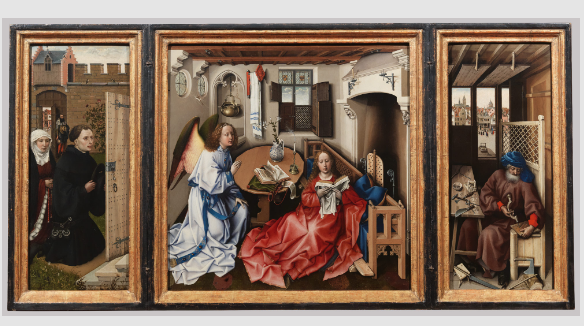
In Hamlet act 3, scene 1, Ophelia's father Polonius asks her to read a book so that she might project "devotion's image" and "pious action" as well as her own loneliness when Prince Hamlet first sees her. In other words, he is using her for bait to trap Hamlet into conversation while Claudius and Polonius eavesdrop. I have written about this scene in a previous blog post regarding the echoes of the story of Suzannah and the Elders , from the book of Daniel. But today I want to note a visual echo of the Annunciation of Mary, when an angel visits to tell her that she is to bear a son, Jesus. [See Bridget Gellert Lyons, "The Iconography of Ophelia," page 61: "The woman with a book was reminiscent of countless representations of the Virgin, who was most commonly shown reading when the Angel of the Annunciation came to visit her." ELH , Spring, 1977, Vol. 44, No. 1, pp. 60-74 https://www.jstor.org/stable/2872526 ] In her remarka...

Still Glowing from RMMRA-Denver

Image
The Rocky Mountain Medieval & Renaissance Association (RMMRA) conference in Denver, April 11-13, was amazing, very thought-provoking and affirming, so while still glowing, I wanted to share a few things about how it went and what impressed me. First, I volunteered to chair a session about male shame and honor in medieval texts, including the poem, "Sir Gawain and the Green Knight." Three graduate students in the Institute for Medieval Studies at The University of New Mexico presented papers. To prepare, I read some literature on the psychology of shame, and also reviewed some literature on gift economies (Lewis Hyde's The Gift: Imagination and the Erotic Life of Property , a cult favorite). The presenters seemed to assume at first that it was a binary: Either honor or shame, and that this was mostly related to warrior culture. In fact, I found that gift dynamics are inextricably tied in with these other dynamics of violence, honor, and shame, and I would go so far a...

RMMRA Denver topic: PROTESTANT, EMPIRICAL, & CONFIRMATION BIASES IN SHAKESPEARE & THE BIBLE, AND HOW WE MIGHT TRANSCEND THEM

Image
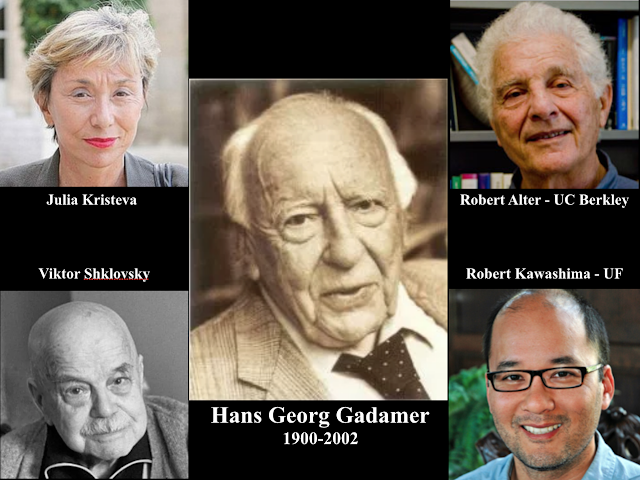
This week I am headed to Denver, Colorado, for a meeting of the Rocky Mountain Medieval and Renaissance Association (instead of attending the Shakespeare Association of America conference in Washington D.C., which was tempting for its proximity to the Folger Shakespeare Library). I am presenting a paper called “How Gadamer Might Rethink Shakespeare & the Bible,” in which I consider how a Protestant bias of “Scripture Alone” (Sola Scriptura), and an empirical bias of the emerging sciences in the mid-1800s, established an early tradition that favored very literal references in biblical allusions that utilized biblical names and phrases, over paraphrase and plot echo, which are often relatively neglected by many of the main reference books in the field. (Darwin's book, On the Origin of Species , was published just five years before Charles Wordsworth's 1864 book on Shakespeare and the Bible, and it, too, is obsessed with empirical evidence and close observation). These b...

TO ASSUME, OR NOT TO ASSUME: Defamiliarization & Allusion in Shakespeare & the Bible

Image
[Illustration: Bottom the Weaver from Shakespeare's Midsummer Night's Dream , by Arthur Rackham, 1939] In the last few years, I have been reading as many books and essays about Shakespeare and religion as I can get my hands on, and among the many things that strike me is this: Protestant, Catholic, Jewish, and other critics can read the same text and come away with very different interpretations, even paying attention to the same details. Of course, this makes perfect sense, and Shakespeare implies that this will happen through certain lines in Hamlet. Readers or viewers bring different assumptions to their experience of the plays, and they often exercise a kind of confirmation bias, noticing details that confirm their assumptions or biases. We all do this, of course, and in part, it's what makes academic research interesting: to discover what people with different experiences, assumptions, and biases make of the same text. But when you've been wrestling with th...