Posts

Showing posts with the label 1 Henry IV

Shakespeare's Staged Resurrections and What to Make of Them

Image
It is said that in Shakespeare’s plays, all resurrections are staged, faked: Much Ado About Nothing (Hero) [1]; Henry IV, Part 1 (Falstaff) [2]. Staging can fail badly: Romeo and Juliet [3] (as if to admit the limitations of such staging?). Poor Tom/Edgar stages a miracle for Gloucester in King Lear [4].   Sonnet 18 ends, “So long as men can breathe, or eyes can see, / So long lives this, and this gives life to thee,” as if the poem bestows (stages) everlasting life. What to make of this? As is said in Hamlet of Ophelia’s “mad” speech, many will “botch” these facts up “fit to their own thoughts” [5]: Atheists may claim this proves Shakespeare’s atheism. Christians may note: Miracle and Mystery Plays were banned by Henry VIII, still restricted in Elizabethan times. Even if Shakespeare wanted to portray resurrections, his hands were tied. Many of Hamlet’s verbal tricks with Claudius [6] and Polonius [7] (and Claudius again [8]) – and the gravedigger’s with Hamlet [8] – depend on ta...

Pieta in Lear, and Sons Sacrificed for Fathers in 1 Henry VI & Hamlet

Image
Last week I posted about instances of "beg" and "poor" in 1 Henry VI, in light of references in Hamlet to the prince as begging or poor, and of the Lazarus allusion in that play. I mentioned how, in 4.5, John Talbot begs his father to flee, while he himself will stay behind and fight to his death. This is a touching moment, as is the moment when the father later finds the dead body of the son. And as my blog often focuses upon biblical allusions, I should mention that this scene echoes two essential plot ideas from the Christian story of the gospels: First, it echoes the idea that Jesus is the son who was sent and sacrificed for the salvation of humanity. The son has to die, and is obedient to the father to the end. (In fact, some Biblical scholars and theologians have noted that Pauline theology assumes that the human Jesus only becomes divine through his love/service and obedience to the father, to his death, rather than being divine from birth; Paul's let...

Other instances of "lazar" in Shakespeare besides Hamlet

Image
Shakespeare uses “lazar” only six times, all before Elizabeth I’s death: once in 1 Henry IV , written in 1596-7 ("Lazarus," 4.2, discussed last week) ; twice in Henry V , written in 1599; once in Hamlet , written in 1599-1601 (1.5, "lazar-like"); and twice in Troilus and Cressida, 1600-2. Three evoke Biblical contexts: the ghost in Hamlet , Falstaff in 1 Henry IV , the Archbishop of Canterbury in Henry V . The other three come are comic insults from Pistol (an ensign serving under Falstaff) and Thersites, (a slave serving Ajax, then Achilles, in Troilus and Cressida). [L: Pistol, with Henry V in disguise, illustration by H. C. Selous, c.1864-68, from The Plays of William Shakespeare , edited/annotated by Charles and Mary Cowden Clarke; image public domain via ShakespeareIllustration.org . R: Thersites and Achilles, illustration by H. C. Selous, c.1886, from Cassell's illustrated Shakespeare, v 3, p 20. Edited and annotated by Charles and Mary Cowden Clarke. ...

Lazarus & prodigals in Henry IV, Part I, & Hamlet

Image
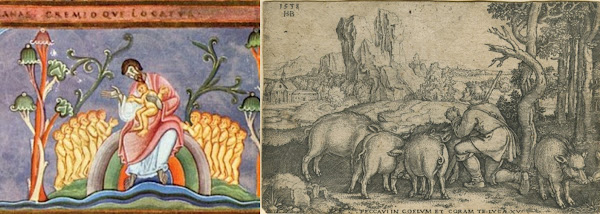
Before I conclude my series on the Lazarus allusion in Hamlet , let’s step back and consider his use of “Lazarus” and related terms in other plays. For today, consider: Shakespeare only uses the full word "Lazarus" once,* on the lips of Falstaff in Henry IV, Part I (1613). [* According to the Advanced Search Engine at OpenSourceShakespeare .] This single instance of "Lazarus" comes in a soliloquy in which Falstaff also happens to mention "prodigal," a reference to another tale from Luke's gospel. [Left: Detail from Lazarus and the Rich Man, Meister des Codex Aureus Epternacensis (1035-1040), via Wikipedia . Public domain. Right: Der verlorene Sohn beim Schweinehüten (The Prodigal Son tending the Swine), 1538, by (Hans) Sebald Beham (1500-1550), via Wikipedia . Public domain.] It so happens that there are allusions in Hamlet to both Lazarus ("lazar-like," 1.5.79, Folger) and the prodigal (Laertes 1.3.40, Polonius 1.3.1...

Preview: Other instances of Lazarus/lazar/beg/beggar/poor in Shakespeare (Part 19)

Image
We are still in the middle of a good raspberry-picking season, but here's a preview of what's coming: LAZARUS: The works of Shakespeare contain the word "Lazarus" only once, in 1 Henry IV, from Falstaff, who also mentions "prodigal" ("lazar" appears once in Hamlet, "prodigal" twice). This is interesting because both Hamlet and 1 Henry IV are about princes (Hamlet, Hal) with strained relationships with distant biological fathers; each finds an affectionate surrogate father in a fool/clown figure (Yorick, Falstaff). ("Prodigal" appears 25 times in Shakespeare's works.) LAZAR: Shakespeare's works use the word "lazar" (derived from the beggar Lazarus in Luke 16) five other times besides in the word "Lazarus": once in Hamlet; twice in Henry V; and twice in Troilus and Cressida. Often "lazar" may simply refer to leprosy or unattractive skin conditions associated with the poor and outcasts. ...