Posts

Showing posts with the label Andrew Scott

Part 30: A Tale of Four Gertrudes (Interlude/Prelude)

Image
There are as many interpretations of Gertrude as there are readers, spectators, and actors. My next four posts will explore just four readings of Gertrude, especially regarding motivations for drinking from what she may or may not know is the poison cup intended for her son. Whether Ophelia and Hamlet influence Gertrude or not can only be determined by scrutinizing what really happens with Gertrude. A brief summary of just four of many possibilities (I prefer # 4): 1. Gertrude as Protestant allegory for a corrupt Catholic Church. Gertrude drinks because she is a slave to her animal passions as mother, as incestuous adulterer, and as slave to drink. For an example of this reading, see Linda Kay Hoff, Hamlet's Choice: A Reformation Allegory. 2. A surprised Gertrude as queen of wishful thinking [1]: Gertrude sees “The Mousetrap” (with its mention of poison) and hears Hamlet accuse Claudius of murder, but thinks Hamlet is mad; she doesn’t tell Claudius of Hamlet’s accusations to protec...
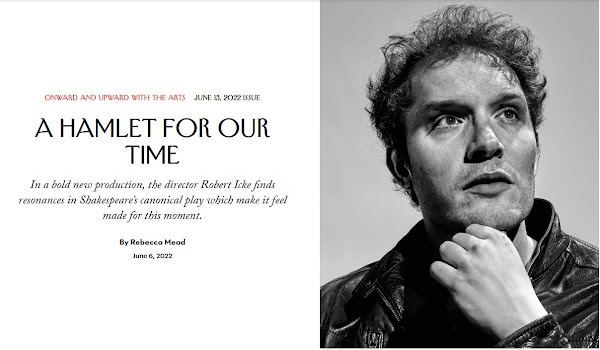
Hamlet's Real or Feigned Grief - via Rebecca Mead on Andrew Scott in Robert Icke's Hamlet

Image
When Hamlet is seen for the first time in the first act, second scene of Shakespeare's play that bears his name, is he wearing black because he is just a spoiled boy having a tantrum because he didn't get to be king, or can we take him at his word that he is in deep grief? Excerpts from Rebecca Mead’s 6/6 New Yorker article on Robert Icke’s Hamlet stood out to me in part because of the emphasis on real rather than feigned grief, or “Hamlet as neurotically indecisive or Oedipally compromised”: [Photo by Jeff Brown for the Ney Yorker. Fair use.] ~~~~~ [...] Icke first staged “Hamlet” in 2017 [...] with Andrew Scott in the lead role [...]. Scott was then best known for his performance as Moriarty, on “Sherlock” [...] The production, in which Denmark was imagined as a chilling surveillance state, incorporated the use of video to powerful effect—the Ghost is initially observed on grainy security footage—and was heralded for its emotional veracity. Especially praised was the i...