Posts

Showing posts with the label Polonius

INDEX: Good Friday echoes in Hamlet

Image
Since at least 2022, I've done a post around the time of Good Friday, sharing what seem to be either direct allusions, or at least echoes of the Good Friday gospel stories (the Passion of Christ) in Shakespeare's Hamlet .  The index link below is to blog posts about allusions in Hamlet to the Good Friday stories (which Shakespeare and others in England would have been required to hear via mandatory church attendance. The index covers related posts on this subject from 2022-2026. The 2022 post [1] collected a few general allusions or plot echoes. For people interested in a list of detailed, short references in the text of the play, this is a good place to start.  - A post in December of 2023 related to these by way of Ophelia's "willow" [2];  - Good Friday posts in 2024 [3] and in 2025 [4] continued this, each with new insights.  INDEX: Good Friday echoes in Hamlet - April 03, 2026. https://pauladrianfried.blogspot.com/2026/04/index-good-friday-echoes-in-hamlet...

Why "Hugger Mugger" & "Impostume" are in Hamlet

Image
HUGGER-MUGGER: Shakespeare has Claudius use these words to describe the burial of Polonius in Hamlet 4.5. "Hugger-mugger" means "secret," "chaotic," "clandestine, sly," or "disorderly, chaotic" [1].  Shakespeare consulted the 1579 Thomas North translation of Plutarch, which used “hugger-mugger” to describe the burial of Julius Caesar [2]. Polonius once played Julius Caesar in a play production, as he reveals to Hamlet in 3.2.  HUGGER-MUGGER as HOARDING a SECRET:  To do something secretly is to hoard the knowledge of the thing: Claudius hoards not only knowledge of the secret burial of Polonius, but also of his murder of his own brother.  IMPOSTUME:  Observing Norway’s troops ready to invade Poland, Hamlet notes:  This is th’ impostume of much wealth and peace, That inward breaks and shows no cause without Why the man dies. (4.4.28-30) An impostume is an abscess, as if the body is secretly hoarding puss from an infection. Hamlet impli...

Hamlet, Prodigals, Fatted Calves, and Caesar as Capital Calf

Image
References to Julius Caesar in Shakespeare’s “Hamlet” from Horatio (1.1) and from Polonius (3.2) may remind us that Shakespeare’s play, Julius Caesar (published 1599), only shortly preceded his Hamlet (published 1603-4); the earlier play may still have been in the company’s repertoire. But besides good advertising, why mention Julius in this play? HORATIO: “In the most high and palmy state of Rome, A little ere the mightiest Julius fell, The graves stood tenantless, and the sheeted dead Did squeak and gibber in the Roman streets” (1.1.125-8) Horatio is at first a doubting Thomas, yet he mentions not graves opening after Jesus’ death (Matt 27:51-53), but another J.C.: Julius Caesar, tyrant who crossed the Rubicon with his army, violating the social order. Polonius mentions playing Caesar at university, killed in the capital: “Brutus killed me.” HAMLET: It was a brute part of him to kill so capital a calf there.” (3.2.111-2) This foreshadows that Hamlet will stab Polonius in a later sce...

Plato vs. Polonius on being true to truth, or to self-interest

Image
"...'Every man by nature is and ought to be his own friend'. Whereas the excessive love of self is in reality the source to each man of all offenses; for the lover is blinded about the beloved, so that he judges wrongly of the just, the good, and the honorable, and thinks that he ought always to prefer himself to the truth." - Plato Laws, c. 360 B.C.E Consider using this as context and historical background for the advice of Polonius to his son Laertes in Shakespeare's Hamlet: "This above all: to thine own self be true, And it must follow, as the night the day. Thou canst not then be false to any man." (1.3.84-86) Polonius also seems narcissistic and miserly, advising his son, "Neither a borrower nor a lender be..." (1.3.81), and having learned that Ophelia has been "most free and bounteous" of her time spent with Hamlet (1.3.101-2), urges that she should "tender" herself "more dearly" (1.3.116), or in other words,...

Part 20: Ophelia and the Mousetrap of her Family’s Protectiveness

Image
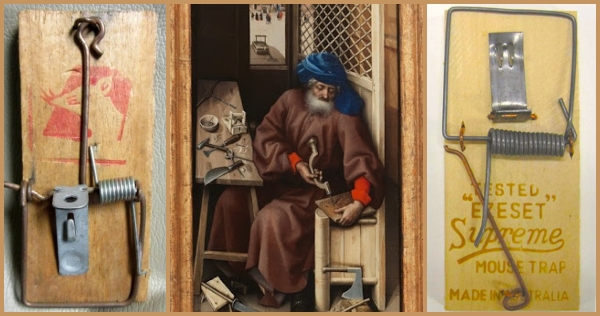
Shakespeare makes a mousetrap for the audience regarding Ophelia’s family and Hamlet. We could call this mousetrap, “Much Ado About Ophelia Marrying Hamlet.” Near the play’s end, Gertrude says in 5.1 that she’d rather have decorated Ophelia and Hamlet’s wedding bed with flowers than Ophelia’s grave. The Queen seems to have liked Ophelia and thought her a good match for her son.  Rewind to the start: After seeing the ghost, Horatio and the sentinels think so highly of Prince Hamlet that they report the sighting to him, and not to King Claudius or Polonius. [1] In 1.2, Horatio calls Prince Hamlet “my lord,” presenting himself to his friend as “your servant ever.” Hamlet replies that he would “change those names” [2]: He’d rather be Horatio’s servant, and Horatio his lord. When Horatio and the sentinels speak of their duty to him, Hamlet would rather have them think of their mutual love.[3]  Shakespeare presents Hamlet as a prince who desires to serve, to love and to be loved, ...

Part 19: Ophelia's Parley in Polonius' War

Image
Cassidy Cash of That Shakespeare Life podcast fame recently posted regarding occurrences of the word “parley” in Shakespeare.[1] She explains that we may have heard the word from Pirates of the Caribbean films. In a parley, opposing sides cease hostilities, sometimes to clear the battlefield of wounded and dead, or to discuss terms of a truce.  In Hamlet , Polonius uses the word “parley” in an interesting way in his statements to Ophelia, discouraging her from believing Hamlet’s expressions and vows of love. It is clear in their discussion that Ophelia wishes to believe Hamlet’s vows and “tenders” of his affection, while Polonius repeatedly assumes that Hamlet is waging an adversarial war to win Ophelia as a prize and to violate her chastity as an enemy might violate an opponent’s borders.   Polonius tells Ophelia, From this time Be something scanter of your maiden presence. Set your entreatments at a higher rate Than a command to *parley.* (1.3.129-132) [2]   The contra...

Part 17: Ophelia's "Owl" and "False Steward" Allusions: Why in that order?

Image
In her alleged madness, Ophelia says things that seem merely mad ramblings. But to original audiences, these may have been allusions to well-known tales, and there may be a reason for their ordering. First: OPHELIA: They say the owl was a baker’s daughter. Lord, we know what we are but know not what we may be. God be at your table. (4.5.47-49) [1] Second: OPHELIA:  You must sing “A-down a-down”—and you “Call him a-down-a.”—O, how the wheel becomes it! It is the false steward that stole his master’s Daughter. (4.5.194-197) Consider: “THE OWL WAS A BAKER’S DAUGHTER” is a reference to a tale in which a baker’s daughter is turned into an owl after being repeatedly ungenerous with a beggar at the door - who was Jesus in disguise. This is a folktale retelling of the gospel tale of the Rich Man (Dives) and the beggar Lazarus.[2] Ophelia summarizes: “Lord, we know what we are but / know not what we may be.” Ophelia may feel punished, like the baker’s daughter, and as people in Denmark’s ...

Part 14: Ophelia's figuratively incestuous family

Image
Ophelia’s brother and father are overly protective of her chastity [1], too suspicious that Hamlet might take advantage of her. Like a lover or spouse, Laertes leaving for France tells Ophelia, “do not sleep, But let me hear from you” [2]. Biblical sayings urge welcome for strangers, which involves risk; but they also discourage fear [3]. Laertes, in contrast, repeatedly urges Ophelia to fear Hamlet [4]. After warning her to be chaste, Laertes tells Ophelia to remember his advice. Ophelia replies, "'Tis in my memory lock'd, / And you yourself shall keep the key of it."[5] Chastity can be a virtue, keeping something of great value secret, disclosed only in an intimate, faithful relationship. Ophelia’s promise to Laertes is analogous: she has the feminine lock and he the masculine key, suggesting a figuratively incestuous relationship. Polonius mistrusts his children’s secret, so he figuratively rapes Ophelia's memory by demanding she disclose it. [6] Ten lines ea...

Part 12: Ophelia and Hamlet as Orpheus and Eurydice

Image
To her father in 2.1, Ophelia describes Hamlet’s frightening visit to her closet. In Ophelia’s description of Hamlet’s exit, Jonathan Bate finds an allusion to Orpheus' glance back at Eurydice as he leaves the underworld (left image), a Greek myth recently adapted for the Broadway musical, Hadestown. Ophelia describes Hamlet: [...] with a look so piteous in purport As if he had been loosèd out of hell To speak of horrors—he comes before me. [...] He took me by the wrist and held me hard. Then goes he to the length of all his arm, And, with his other hand thus o’er his brow, He falls to such perusal of my face As he would draw it. Long stayed he so. At last, a little shaking of mine arm, And thrice his head thus waving up and down, He raised a sigh so piteous and profound As it did seem to shatter all his bulk And end his being. That done, he lets me go, And, with his head over his shoulder turned, He seemed to find his way without his eyes, For out o’ doors he went without their he...

Part 11: "Mad" Ophelia grasps "tricks i' th' world" and Denmark's corruption

Image
Too many critics, readers and viewers of Shakespeare’s Hamlet assume that Ophelia’s madness is merely an inability to deal with emotions, mostly about her father and Hamlet. Showlater cites Theodore Lidz (a typical example of this) who claims “Ophelia goes mad because she fails in the female developmental task of shifting her sexual attachment from her father ‘to a man who can bring her fulfillment as a woman.’” (294) [1] Too few consider that her madness may have been as much, or more, caused by a startling epiphany about Denmark’s corruption, understanding it perhaps even better than her father. Why would (mostly male) critics have neglected this possibility for so long? A tendency among critics to keep Ophelia out of politics, like keeping women out of voting booths? A “GENTLEMAN” and Horatio speak about Ophelia the first we hear of her having gone mad: GENTLEMAN: She speaks much of her father, says she hears There’s tricks i’ th’ world, and hems, and beats her heart, Spurns envious...

Part 5: Ophelia Drowning in Conflicting Authorities

Image
When Ophelia says, “ “I do not know, my lord, what I should think” (1.3.113), people in Early Modern England would have assumed that, at least in part, she may have felt torn between apparently contradictory biblical injunctions. In Act 1, scene 3, Ophelia has her first brief lines, spoken to her long-winded brother Laertes and her even more long-winded father, Polonius. She says that Hamlet has made her “almost all the holy vows of heaven” [1]: She could be the next queen of Denmark. Laertes suspects Hamlet may be tempted to use and abandon her, needing to marry someone else to secure a treaty [2]. But the play gives no evidence of treaty-marriages, or that Hamlet would take love lightly: He wants to return to university in Wittenberg, while Laertes wants to return to France where his father suspects he will be “drabbing” (whoring), and where Ophelia suspects he will be a hypocrite for not heeding his own strict advice. Ophelia’s father similarly suspects bad intentions on Hamlet’s pa...