Posts

Showing posts with the label Paraphrase-Plot Echo

Jonah swallowed by Fish, Hamlet by Pirate Ship, Christ by Tomb

Image
Years ago, prompted by a student question, I noticed that Hamlet’s westward sea-voyage toward England - and change of mode of transportation mid-sea - was like Jonah’s. I thought others had probably noticed and considered this at length, but never found any. Hannibal Hamlin notes that a popular play, “A Looking Glass for London and England,” featured the prophet Jonah [1] (performed when Shakespeare was with The Lord Strange's Men), and that Elizabeth I named one of her ships Elizabeth Jonas, with a speech that (strangely?) read the Jonah story as a triumph over enemies [2]. Two gospels quote Jesus speaking of the “sign of Jonah” [3]. English citizens were required to attend church, and would have heard these every year of their lives [4]. Many people only know that Jonah was swallowed by a fish. Fewer know that, even after being saved from the fish’s belly, Jonah would rather witness the destruction of Nineveh than see them repent and be saved by God’s mercy. Dennis Taylor notes t...

Top 20 Greatest Hits: Hamlet & the Bible

Image
Below are some of my most essential posts about biblical echoes in Shakespeare, most of them beyond those listed by Naseeb Shaheen & predecessors ( Biblical References in Shakespeare's Plays , which focuses mostly on explicit biblical name- and verse-allusion). A description of my book project is included at the very end. This is not intended to replace Naseeb Shaheen's reference book, but to compliment it, especially with plot echoes that are less explicit and may have been more thoroughly internalized by the writer, or used in more subtle ways for artistic or political reasons. Most of these are short reads, especially early in the list, with a few longer posts toward the end, and a few of them including links for more details. I've tried to illustrate all of these with paintings and drawings from Shakespeare's time or earlier in most instances. Where credits for the images are missing here, see the link for each section. On the one hand, a part of me...

Paraphrased biblical allusions in Shakespeare may be among the most important (though harder to spot)

Some of the harder biblical allusions to spot in Shakespeare's plays are the ones that are more thoroughly paraphrased, or subtle plot echoes. - Some of these might have been made subtle for aesthetic reasons (e.g. to avoid cliches) or to avoid the censors (avoid criticizing the crown and its advisers with political commentary laced with righteous biblical quotes). - But some of the paraphrased and subtle references may be among the most important, in part because, to paraphrase or create a subtle plot echo, you must have internalized the scripture reference very deeply and insightfully; then you can make it your own in fresh writing that resonates with the influence of the buried allusion. This idea contradicts most of the major works (and many minor ones as well) that attempted to catalog all the (obvious) biblical allusions in Shakespeare's plays. These include books by authors Bishop Charles Wordsworth (1864), Thomas Carter (1905), Richmond Noble (1935), Naseeb Shahee...

HAMLET AS SERVANT-PRINCE: A PARAPHRASED & OFTEN-MISSED BIBLE ALLUSION

Image
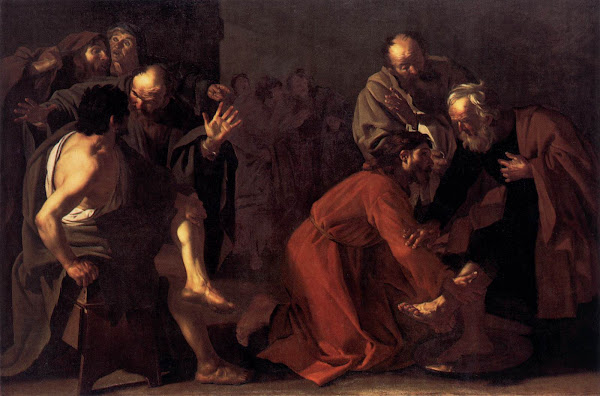
HAMLET AS SERVANT-PRINCE: A PARAPHRASED & OFTEN-MISSED BIBLE ALLUSION: Hamlet: I am glad to see you well. Horatio! - or I do forget myself. Horatio: The same, my lord, and your poor servant ever. Hamlet: Sir, my good friend - I'll change that name with you. Four key Shakespeare & the Bible scholars missed this, while Peter Milward (on the tragedies) caught it: Hamlet says he would be his friend Horatio’s “poor servant,” not the other way around. This alludes to multiple gospel passages in which Jesus says that if you would be greatest, you must be servant of all (Matt 20:26; Mark 9:35; Luke 22:26) and that Jesus won’t call his disciples servants any longer, but friends (John 15:15), and he washes their feet to demonstrate such service (John 13:1-9). [IMAGE: Dirck van Baburen (circa 1594/1595–1624) / Christ Washing the Apostles Feet / circa 1616 / Public domain via Wikipedia.] Why does it matter? Along with Hamlet’s scolding of Polonius for his judgmental and...

PARAPHRASED BIBLICAL ALLUSIONS OR PLOT ECHOES MAY BE AMONG THE MOST DEEPLY INTERNALIZED

Some of the harder biblical allusions to spot in Shakespeare's plays are the ones that are more thoroughly paraphrased or subtle plot echoes. ~ Some of these might have been made subtle for aesthetic reasons (e.g. to avoid cliches) or to avoid the censors (avoid criticizing the crown and its advisers with political commentary laced with righteous biblical quotes). ~ But some of the paraphrased and subtle references may be among the most important, in part because, to paraphrase or create a subtle plot echo, you must have internalized the scripture reference very deeply and insightfully; then you can make it your own in fresh writing that resonates with the influence of the buried allusion. This idea contradicts most of the major works (and many minor ones as well) that attempted to catalog all the (obvious) biblical allusions in Shakespeare's plays. These include Bishop Charles Wordsworth (1864), Thomas Carter (1905), Richmond Noble (1935), Naseeb Shaheem (tragedies, 1987),...