Posts

Showing posts with the label Odyssey

Hamlet and Homer - part 8 (Louden, Aguirre, Hornback)

Image
Names, common themes, and similar incidents in Homer* and Hamlet are too explicit and numerous to avoid (Laertes, Hyperion, Pyrrhus, Priam, Hecuba... See my previous posts in this series).[1] The text of Hamlet expects readers and audiences to view Hamlet through the lens of Homer, both for its similarities and for the ways it diverges from the old heroic texts. (*When I say Homer in this instance, it's shorthand for all the sources Shakespeare used, including Virgil, Ovid; Chaucer, and Chapman's partial translation of the Iliad, as well as other secondary sources.) Bruce Louden observes [2] that among the many new characters and plot elements in Hamlet that are not found in the Saxo Grammaticus and Belleforest sources, four of them are found in Homer: 1. the Ghost; 2. the coming of the actors to Elsinore; 3. the play-within-the-play; 4. the pirates who intercept the ship…. (33-34) Louden notes that Hamlet identifies with Pyrrhus, who wears black in mourning for the d...

Sixteen Ways of Looking at Hamlet & Odysseus - part 7

Image
The list of similar incidents and themes in Hamlet and literature mentioning the Trojan War* is long. We might one day discern what similarities are coincidental [1], as compared to evidence that Shakespeare knew and was influenced by his first- or second-hand knowledge of Trojan War-related texts [1].   For now, here is a new list: 1. Odysseus swears an oath to Tyndareus to defend whoever wins Helen; Hamlet swears an oath to avenge Claudius having taken Gertrude from his father. 2. Paris takes Helen from Menelaus. Claudius takes Gertrude from King Hamlet. 3. Odysseus feigns madness , delays keeping his oath to Tyndareus; Hamlet feigns madness, delays keeping his oath to the ghost. 4. Hyperion/Helios is unsympathetic to Odysseus’ hungry men who steal his cattle. The ghost’s skin was made “ Lazar -like,” (ref. to a rich man who was unsympathetic to the beggar Lazarus in Luke 16). 5. Ithika's court & society are corrupted in Odysseus’ absence. Denmark is corrupted...

Hyperion & Lazarus: Kings, Rich Men, & Pitiless Gods - Hamlet & The Odyssey part 6

Image
In Hamlet , the prince says that, compared to his Uncle Claudius, his dead father was “So excellent a king, that was to this Hyperion to a satyr” (1.2.143-4). [1] He compares his father to Hyperion and three other pagan gods (Jove, Mars, Mercury) with his mother in the closet scene. (3.4.66-8) What are the implications of comparing his father, the dead king, to Hyperion? Are some of the implications affirmed by another allusion, to the skin-sores of the beggar Lazarus? In The Odyssey, against his advice, Odysseus' men kill and eat the cattle of Hyperion/Helios. [2] The fact that they’re hungry sailors on a long journey home doesn’t matter so much to Hyperion as their disrespect. Are they not like bread-stealing Jean Valjean in Victor Hugo's Les Misérables, starving, to be pitied? [3] Hyperion seems ungenerous, greedy, unmerciful toward the hungry sailors. As punishment, they never make it home. Consider: Hyperion and the sailors resemble the Rich Man and L...

Seeking Penelope in Ophelia & Hamlet: Hamlet & The Odyssey - Part 3

Image
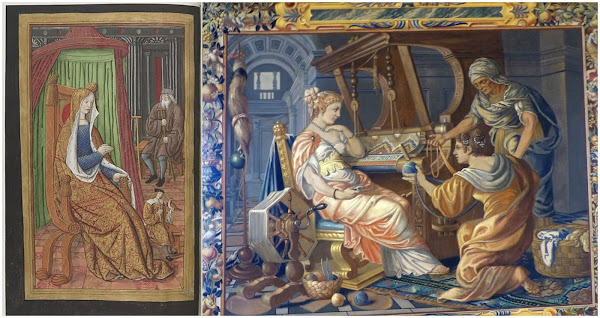
In The Odyssey, the weaving of Penelope, as a ruse to avoid her 108 suitors* later seems to find parallels not only in Ophelia and her sewing and reading, but also in Prince Hamlet. (Penelope and others fending off 108 suitors makes me think of the Buddhist idea of the importance of quieting the "monkey mind" of distractions!) Katherine Goodland has noted: Polonius wants Ophelia reading, to look like common images of Mary at the Annunciation. ( See this post .) [1] So now we have to think loosely, of Ophelia as associated in her sewing with Penelope, and in her reading, with Mary at the Annunciation; In a way, we might consider Penelope's weaving as a kind of compromised involvement with the world (to fend off suitors) and then a kind of prayer or repenting (unweaving, undoing the work), but also a kind of scheming for survival. Hamlet and Ophelia both have rhythms of compromised involvement in their world, followed by types of repenting or undoing: They weave...

Laertes in Hamlet & the Odyssey - Part 2

Image
Can anyone recommend good books or articles that explore connections between Laertes in Hamlet and Laertes in The Odyssey ? Yesterday (8/4/2022) I posted about Shakespeare’s choice of the name Laertes for the son of Polonius . [1] (If that link doesn't work, try here: https://pauladrianfried.blogspot.com/2022/08/laertes-in-hamlet-odyssey-part-1.html ) I observed: - in The Odyssey , Laertes and his funeral shroud are the alleged excuse Penelope uses for fending off suitors; Laertes helps Odysseus deal with the families of Penelope’s suitors; - in Hamlet, Laertes and Polonius fend off Hamlet as suitor for Ophelia, and fend off Ophelia as love interest for Hamlet, perhaps similar to the way William Cecil and other advisors micromanaged suitors for Elizabeth, preferring foreign princes over domestic suitors; - like Penelope at her weaving, Ophelia is at her sewing when Hamlet visits her in her closet, perhaps disguised in feigned madness; - like Odysseus disguised as beggar...

Laertes in Hamlet & the Odyssey - Part 1

Image
Federico La Sala recently reminded me that the name Laertes in Hamlet comes from Homer's Odyssey. [1] I am grateful to him for pointing me in this direction. Allusions for Shakespeare are usually not all-encompassing, and don’t align on every point, but seem chosen for what limited light they shed. I usually focus on biblical allusions, but here’s a detour (some possible Odyssey allusions or influences): 1. DEFENDER OF WOMEN AND PRINCES: ODYSSEY: Laertes defends Penelope, wife of his son Odysseus (gone 20 years), from suitors who believe he is dead. HAMLET: Laertes defends his sister from a possible affair with Prince Hamlet, and defends the prince, in case Hamlet must marry to secure a foreign alliance (1.3). (Polonius is widely believed to be a satire of William Cecil, and therefore Laertes may be a satire of his son Robert Cecil, who became a key advisor to Elizabeth even before his father's death; to call a satire of Robert Cecil "Laertes," may be the ...