Posts

Showing posts with the label scourge and minister

"They know not what they do": Hamlet as Crucifier in Gertrude's Closet
Image
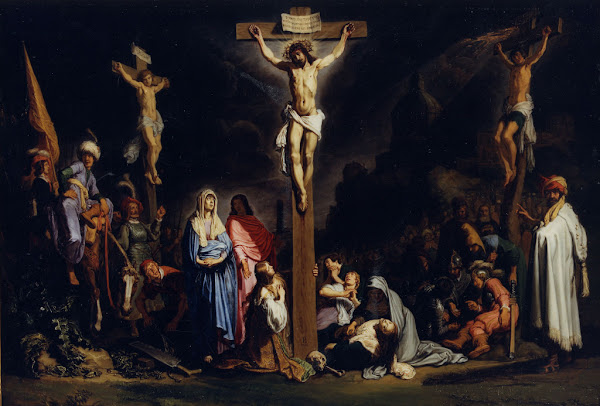
In Act 3, scene 4, Hamlet kills Polonius behind the arras, thinking he is stabbing Claudius. This exchange follows (emphasis mine): Polonius : [Behind the arras] Oh, I am slain! Queen : Oh, me, what hast thou done? Hamlet : Nay I know not . Is it the King? 3.4.2405-2407 For English audiences in Shakespeare's lifetime, required to attend church each Sunday and on Holy Days, the combination of Gertrude's question about what Hamlet has done , followed by Hamlet's reply, "I know not," may have sounded quite familiar. If there is any Biblical passage those audiences would have found echoed in the exchange, it would have been from the Gospel of Luke (23:34), with this passage included in a larger section from Luke chapter 23, read every year on Holy Thursday (emphasis mine): "Then said Jesus, Father, forgive them: for they know not what they do ." [ "The Crucifixion" - 1616 (the year of Shakespeare's death), by Pieter Lastman, oil on ...
A TALE OF HAMLET & TWO BIBLES: BISHOPS & GENEVA

Image
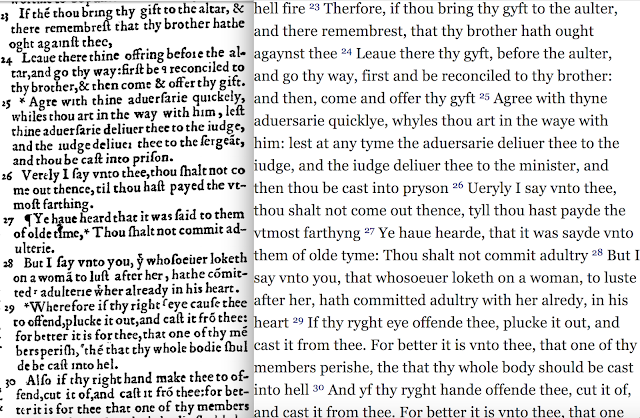
A TALE OF HAMLET & TWO BIBLES: BISHOPS & GENEVA In Shakespeare’s time, the approved Bishops’ bible was used in church; the inexpensive Geneva translation was used at home. Specific words (unlike paraphrase) can point to specific translations: Regarding his accidental killing of Polonius (3.4), Hamlet says, “...heaven hath pleased it so,/ To punish me with this and this with me,/ That I must be their scourge and *minister*.” Hamlet's phrase, “scourge and minister,” uses "minister" in the same sense as the Bishops’ bible Mt 5:25 (in the picture below, right): a minister of justice carries out a judge’s sentence. Because church attendance was required (and absence punishable by fines), Shakespeare would have heard this word, used in this biblical context, every year, all his life. In the Bishops' bible, the word "minister" is used instead of the word "sergeant, which appears in the same place in the Geneva bible. But when Hamlet says...

INDEX OF POSTS on Francisco & Bernardo

Image
Starting in 2017, I did a number of posts about Francisco and Bernardo, two sentinels in the opening scene who may have been named not only after the Catholic saints (Francis of Assisi, and Bernard of Clairvaux), each of whom have rich stories and possible reasons for allusions, but also after the two assassins in the Pazzi Conspiracy. The possible implications for holding up a mirror to the times and to Shakespeare's original audiences are wide-reaching and profound. MIGHT ART LOST IN DISSOLVED MONASTERIES HAVE HELPED CONNECT HAMLET'S FRANCISCO & BERNARDO TO THE SAINTS? https://pauladrianfried.blogspot.com/2017/04/might-lost-art-in-dissolved-monasteries.html - April 03, 2017 FATHER ISSUES FOR HAMLET & FRANCISCO https://pauladrianfried.blogspot.com/2019/01/shakespeares-hamlet-has-father-issues.html - April 10, 2017 TOP SIX REASONS Shakespeare probably named sentinel Francisco after Francis of Assisi https://pauladrianfried.blogspot.com/2017/04/top-six-reas...